ICSD National Bond Integrated Account Establishment
KSD IT System Overhaul Promotion
50th Anniversary Commemoration 'International Conference' Held
The Korea Securities Depository (KSD) is the only central securities depository and electronic registration institution in Korea, and it is no exaggeration to say that it has grown alongside the Korean capital market. It has taken the lead in reading the flow of changing times, reflecting market demand, introducing capital market systems, and building infrastructure. Since taking its first step into the capital market as the Korea Securities Settlement Corporation on December 6, 1974, KSD, now celebrating its 50th anniversary, has played a core infrastructure role in the capital market by handling centralized custody of securities, account-to-account transfers, settlement operations, and distribution.
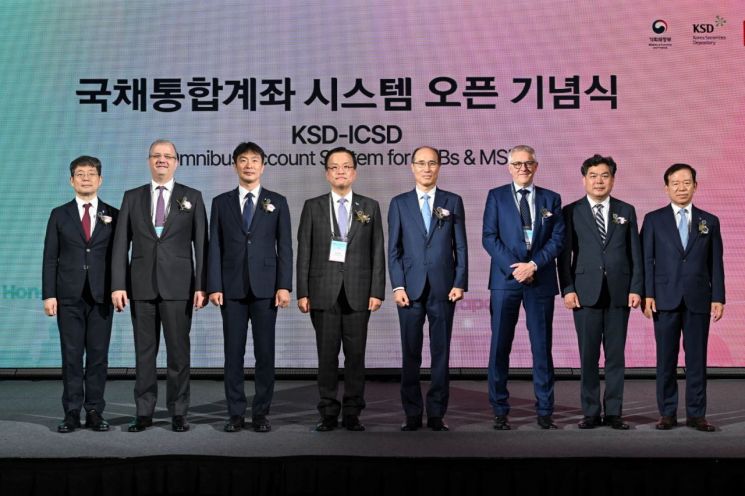 Yoo Sang-dae, Deputy Governor of the Bank of Korea (from left), Robert Tabet, Head of Clearstream Asia-Pacific, Lee Bok-hyun, Governor of the Financial Supervisory Service, Choi Sang-mok, Deputy Prime Minister and Minister of Economy and Finance, Lee Soon-ho, President of the Korea Securities Depository, Peter Sneyers, CEO of Euroclear, Kim Tae-ho, Deputy Commissioner of the National Tax Service, and Seo Yoo-seok, Chairman of the Korea Financial Investment Association, are posing for a commemorative photo at the opening ceremony of the National Bond Integrated Account System held in June. Korea Securities Depository
As a result of efforts to develop various services in line with market demand, KSD currently holds the broadest range of business areas among central securities depositories (CSDs) worldwide. It has established and operates ‘Fundnet,’ which manages all processes from the creation to growth and dissolution of funds, and also operates ‘K-VOTE,’ which provides electronic voting and electronic proxy services. Additionally, it supports securities financing for financial companies through securities lending and collateral management and supports the short-term financial market by issuing electronic short-term bonds. Furthermore, it handles custody, settlement, and exercise of rights for securities and funds when domestic investors trade foreign securities in 40 markets worldwide.
KSD has also led the way in ushering in the era of electronic securities, replacing paper securities. KSD introduced the electronic securities system in 2019, and as of the end of June this year, 3,478 issuing companies (2,701 listed companies and 777 unlisted companies) are using the electronic securities system. As digitalization rapidly progresses across society, securities issuance and distribution have shifted from paper-based to electronic methods. The fundraising period has also been shortened. Whereas it used to take at least a week to establish a corporation, now it only takes one day. The Ministry of Economy and Finance estimates that the introduction of the electronic securities system will save approximately 904.5 billion KRW over five years.
The establishment of the International Central Securities Depository (ICSD) government bond integrated account is recognized as a contribution to the advancement of the capital market. Recently, KSD built the ICSD government bond integrated account to enable foreign investors to trade Korean government bonds safely and conveniently. It oversees related administrative tasks such as electronic registration of government bonds for individual investors, collection and payment of issuance funds, principal and interest repayment, and public announcements.
As a central securities depository and electronic registration institution playing a pivotal role in the capital market, KSD strives to protect the property rights of the public. The scale of national assets held by KSD is 697.5 trillion KRW. Considering that the national budget allocated this year was about 65.7 trillion KRW, this is a scale ten times larger. Through the ‘Unclaimed Stocks Recovery’ campaign, which returns unclaimed stocks and dividends to their rightful owners, KSD has surpassed a cumulative achievement of 1 trillion KRW over 15 years.
KSD is also pushing forward with the overhaul of its IT system. By developing various systems that reflect new IT, it aims to support market users in processing their tasks conveniently and efficiently. Furthermore, once the amendment to the Commercial Act passes the National Assembly, KSD plans to develop and officially launch an electronic shareholders’ meeting system. Additionally, it will promote the restructuring of clearing and settlement infrastructure following the launch of the Alternative Trading System (ATS) to help ATS settle firmly in the market. KSD also plans to support the institutionalization of token securities.
In preparation for the institutionalization of token securities, KSD will collect transaction information recorded on distributed ledgers and perform total volume management tasks, such as verifying that the issuance volume and circulation volume of token securities match.
Marking its 50th anniversary, KSD is preparing to leap forward as a 100-year company. It is compiling a company history that looks back on the past half-century and preparing to announce a new vision looking ahead to the next 100 years, as well as preparing to publish a guidebook on the electronic securities system. On December 5, it plans to hold an international conference titled ‘Digital Innovation and the Future of CSD’ at the Fairmont Ambassador Hotel in Yeouido, Seoul, to discuss digital innovation in the financial market and current issues related to the financial industry and CSD.
© The Asia Business Daily(www.asiae.co.kr). All rights reserved.
![Clutching a Stolen Dior Bag, Saying "I Hate Being Poor but Real"... The Grotesque Con of a "Human Knockoff" [Slate]](https://cwcontent.asiae.co.kr/asiaresize/183/2026021902243444107_1771435474.jpg)
















