Lee Byung-in, Director of the Korea-China System IC Cooperation Research Institute
China has raised the localization rate to 70% across the entire system semiconductor process, including central processing units (CPUs) and graphics processing units (GPUs), leading to evaluations that it has already achieved the 'Made in 2025' goal.
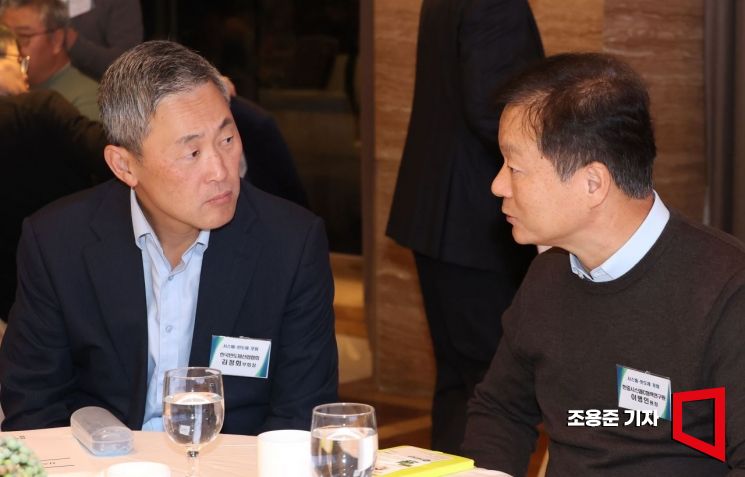 Kim Jeonghoe, Vice Chairman of the Korea Semiconductor Industry Association (left), and Lee Byeongin, Director of the Korea-China System IC Cooperation Research Institute, are attending and conversing at the System-Semiconductor Forum held on the 26th at EL Tower in Yangjae, Seocho-gu, Seoul.
On the 26th, Lee Byung-in, President of the Korea-China System IC Cooperation Research Institute, said at the 'System Semiconductor Forum Breakfast Seminar' held at EL Tower in Yangjae, Seoul, hosted by the Ministry of Trade, Industry and Energy and organized by the Korea Semiconductor Industry Association and the Korea Institute for Advancement of Technology, "China's global market share is only 15%, but it has secured domestically produced substitutes in all product categories." The Korea-China System IC Cooperation Research Institute is the first public research and development (R&D) institution established in Shenzhen, Guangdong Province, China, in May 2012 as an international cooperation between the two governments.
'Made in 2025' is a manufacturing upgrade policy announced by China in 2015, which set a goal to achieve a 70% localization rate for system semiconductors by 2025.
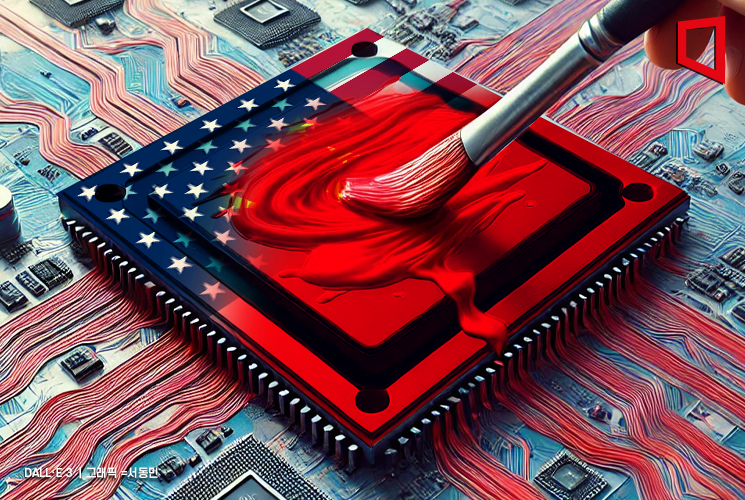
President Lee said, "China is realizing decoupling from the U.S. across the entire system semiconductor value chain, including semiconductor intellectual property (IP), electronic design automation (EDA), design, foundry, and back-end processes," adding, "It is moving toward completely eliminating dependence on U.S. technology."
He added, "In a situation where importing advanced process equipment is impossible, China is establishing its own technology and production facilities to replace them and is making these core assets," and "In the case of compound semiconductors, China is actively investing in the entire value chain, including materials, components, and modules, and it is expected that equipment dependence for future processes can also be replaced through localization."
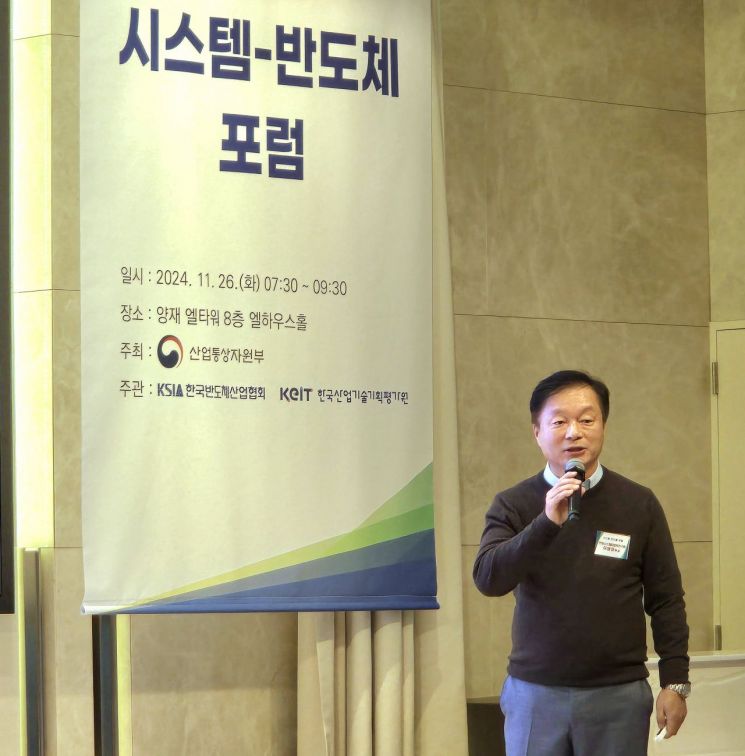 Lee Byung-in, Director of the Korea-China System IC Cooperation Research Institute, is giving a keynote presentation at the System-Semiconductor Forum held on the 26th at EL Tower in Yangjae, Seocho-gu, Seoul. Photo by Choi Seo-yoon
He also gave high marks to Chinese fabless companies. He explained, "(In the capital market, Chinese fabless companies) are valued up to five times higher compared to similar companies in other countries, including Korea," and "With the support of the Chinese government, they are provided with a favorable environment for technology expansion and market share acquisition through domestic and international M&A."
President Lee assessed that U.S. sanctions have rather accelerated the integration and technological innovation of China's semiconductor industry. He said, "Private companies in China are actively participating in the strategic value chain led by the Party," adding, "This will further strengthen China's independence and competitiveness in the global semiconductor market."
© The Asia Business Daily(www.asiae.co.kr). All rights reserved.
![Clutching a Stolen Dior Bag, Saying "I Hate Being Poor but Real"... The Grotesque Con of a "Human Knockoff" [Slate]](https://cwcontent.asiae.co.kr/asiaresize/183/2026021902243444107_1771435474.jpg)













