Major Plastic Raw Material 'Polymer'
International Community Discusses Polymer Regulation
Low Feasibility Due to Oil-Producing Countries' Opposition
Environmental Groups "Must Secure Strong Agreement"
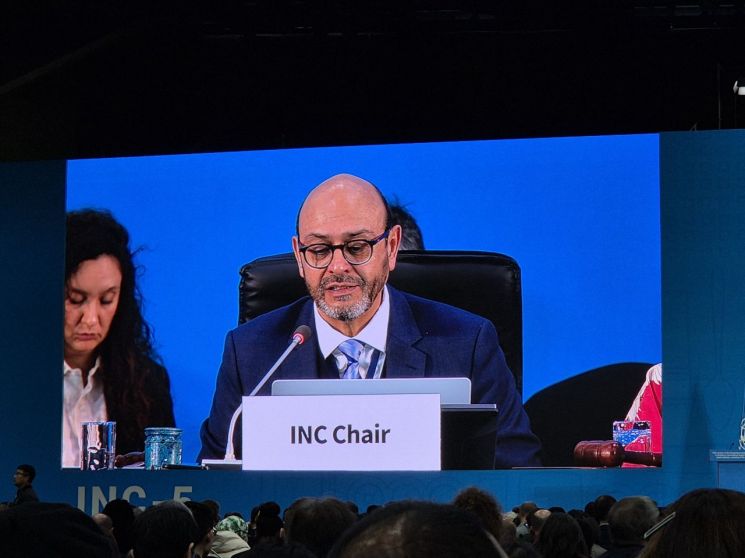 Luis Bayas Balvidieso, Chair of the 5th Intergovernmental Negotiating Committee (INC-5) for the Development of an International Treaty to End Plastic Pollution, is speaking at the general assembly held on the 25th at BEXCO in Haeundae-gu, Busan. Photo by Seungseop Song tmdtjq8506@
The international community has officially begun discussions on an agreement to reduce plastic. This comes after prolonged debates among countries on whether to discuss reducing the production of 'polymer,' the raw material for plastic. Despite strong opposition from oil-producing countries, the issue was placed on the agenda, but the likelihood of concrete reduction targets being proposed remains low. If polymer production regulations become a reality, global plastic factories, including domestic companies, will be affected, drawing significant attention from the international community.
The '5th Intergovernmental Negotiating Committee (INC-5) for the Development of an International Legally Binding Instrument on Plastic Pollution' is currently holding discussions, including on polymer production regulations, at BEXCO in Suyeong-gu, Busan, on the 26th. INC-5 is a forum for discussing an international agreement related to plastic pollution. Four meetings have been held so far, and the current meeting in Busan, running until the 1st of next month, is the final one. Discussions are divided into four subcommittees: product and design regulations and production, waste management, financing, and implementation.
The biggest issue at this meeting is polymer regulation. Polymers are substances made using petroleum and are the raw materials for plastic. At the meeting, there was sharp conflict over whether polymer production should be controlled to reduce plastic. Even though the opening ceremony started at 10 a.m. on the first day, the 25th, the meeting was delayed because there was no agreement on whether to discuss polymer production regulations. Over 3,000 disagreements were raised on reports produced by INC over four sessions, leading Chair Luis Bayas Balvidieso to propose an unofficial document (non-paper) for discussion. However, oil-producing countries rejected it, claiming it included discussions on production reduction.
Supporters of polymer regulation include the European Union (EU) and South American countries. The International Plastic Treaty Friendly Nations Coalition (HAC), which includes 67 countries such as South Korea and Japan, also acknowledges polymer reduction. On the other hand, some countries argue that the focus should be on recycling after use rather than production regulation. This group, the 'International Alliance for Plastic Sustainability,' was launched last year under the leadership of Saudi Arabia and includes six countries: China, Russia, Cuba, Bahrain, Iran, and Saudi Arabia. These are oil-producing countries or nations where the petrochemical industry plays a significant role in the national economy.
After much difficulty, the non-paper proposed by Chair Balvidieso was adopted as an agenda item, bringing polymer regulation to the negotiation table. However, opposition from oil-producing countries remains strong. A South Korean government negotiation official hinted, "We agreed to discuss it, but the opposition stance of oil-producing countries has not changed at all."
The Possibility of Production Regulation is Slim... The Petrochemical Industry is Highly Tense
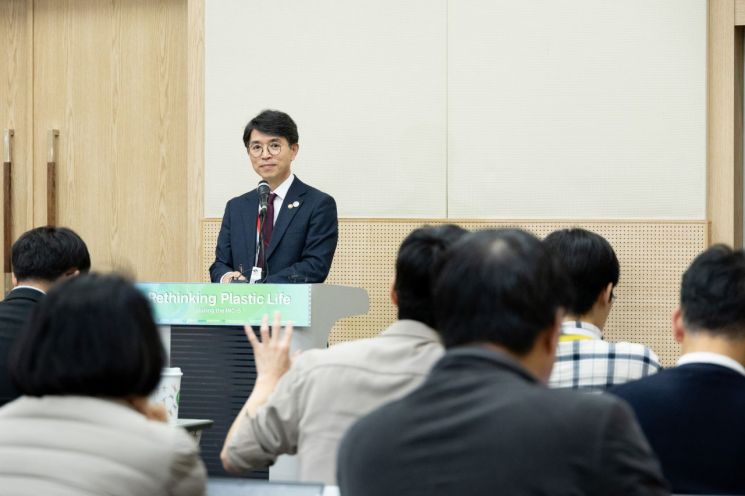 Minister of Environment Kim Wan-seop is holding a press conference at the 5th Intergovernmental Negotiating Committee (INC-5) for the establishment of an international agreement to end plastic pollution, currently underway at BEXCO in Suyeong-gu, Busan on the 25th. Photo by Ministry of Environment
The prevailing view is that it will be difficult to include specific targets. Minister of Environment Kim Wan-seop told reporters the day before, "If there are countries that want to discuss (reduction) numbers in the negotiations, it will realistically be difficult to reach an agreement," adding, "It's not a matter of right or wrong, but because the positions are firmly opposed, it won't be easy to proceed that way." Inger Andersen, Executive Director of the United Nations Environment Programme (UNEP), also stated, "To make the agreement meaningful, we should not lower standards on details but address them later and focus on urgent issues."
The South Korean government is proposing various mediation plans aiming to establish an effective agreement. This is a so-called phased approach that starts by reducing harmful or unnecessary plastics. To this end, the Ministry of Environment proposed an 'annex' listing unnecessary plastics to UNEP. This document would first define unnecessary plastics and later regulate or eliminate those products and substances, serving as a kind of alternative.
The petrochemical industry is inevitably tense about the agreement. If production regulations are proposed, the impact on the entire industry would be significant. South Korea is the world's fourth-largest petrochemical producer. According to Statistics Korea, as of the first half of this year, there are 13,638 rubber and plastic manufacturing factories domestically, steadily increasing over the past five years. Expanding to factories handling plastic-related materials, the scale is even larger. According to Greenpeace calculations, polymer production, the raw material, amounts to 19.92 million metric tons annually, exceeding that of Japan and Taiwan. Since plastics are widely used in automobiles, mobile phones, and other products, there will be direct and indirect effects on other industries as well.
The situation overseas is similar. The global petrochemical industry is known to have dispatched numerous lobbyists to the Busan international plastic negotiations. At the 4th meeting held in Canada, about 200 petrochemical industry figures conducted lobbying. Environmental groups believe the purpose of the petrochemical industry lobbyists' participation is to block plastic production regulations.
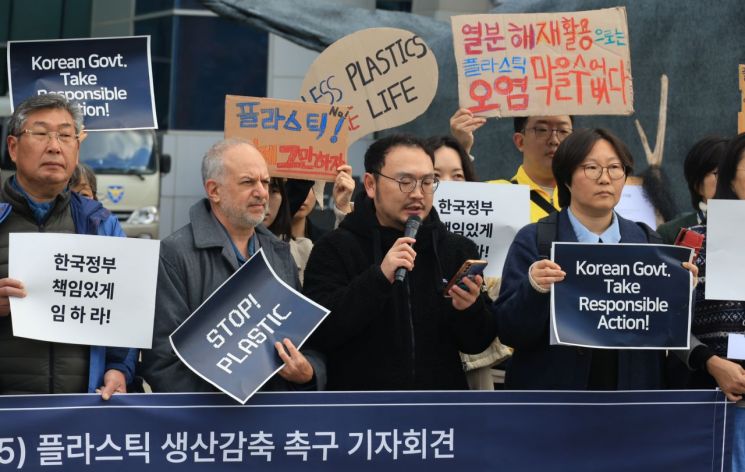 On the 25th, a press conference urging the reduction of plastic production was held in front of BEXCO in Haeundae-gu, Busan, where the 5th meeting of the International Plastic Treaty took place. The event was hosted by Climate Crisis Emergency Action and the Plppuri Solidarity (Solidarity to Eradicate Plastic Problems). Photo by Yonhap News.
Meanwhile, environmental groups are urging for a strong agreement. Eric Lindebjerg, Head of Plastic Policy at the World Wide Fund for Nature (WWF), stated, "Only a strong and legally binding international plastic agreement can solve the problem," and insisted, "In this negotiation, governments worldwide must achieve a successful outcome that protects people and nature."
© The Asia Business Daily(www.asiae.co.kr). All rights reserved.
![Clutching a Stolen Dior Bag, Saying "I Hate Being Poor but Real"... The Grotesque Con of a "Human Knockoff" [Slate]](https://cwcontent.asiae.co.kr/asiaresize/183/2026021902243444107_1771435474.jpg)


















