Human Rights Promotion Training for 310 Employers Participating in the 2025 Foreign Seasonal Worker Program
The Gyeonggi Province and the Gyeonggi-do Agricultural and Fisheries Promotion Institute-operated Gyeonggi-do Rural Workforce Support Center will conduct a "Human Rights Education for Employers Participating in the 2025 Foreign Seasonal Worker Program" until December 4.
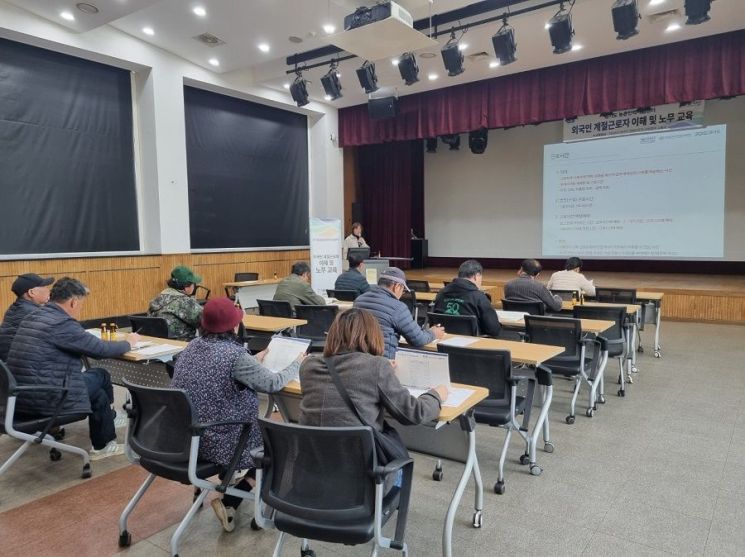 Gyeonggi-do Rural Workforce Support Center will conduct "Human Rights Education for Employers Participating in the 2025 Foreign Seasonal Worker Program" until December 4. Provided by Gyeonggi-do
The "Foreign Seasonal Worker Program" is designed to support the stable recruitment of foreign seasonal workers by assisting with entry and exit procedures and worker management, in response to the rapidly increasing demand for foreign seasonal workers due to the decline in farming population, aging, and rising labor costs causing shortages in agricultural labor supply. The Ministry of Justice reviews the necessity based on the number of workers requested by each local government and allocates foreign seasonal workers accordingly.
As of the end of September this year, the number of foreign seasonal workers employed in Gyeonggi Province increased by 145% (1,533 people) from 1,054 last year to 2,587. The number of foreign seasonal workers requested as needed for 2025 by 1,137 farms in 20 cities and counties is 4,411.
The center has prepared employer human rights education, including understanding foreign seasonal workers and labor management training, to promote the stable settlement and human rights of foreign seasonal workers and improve farm management efficiency.
The education targets are 310 employers from nine cities and counties in the 9th term, including Hwaseong, Namyangju, Pyeongtaek, Paju, Gimpo, Gwangmyeong, Anseong, Pocheon, and Yangpyeong. On the 19th, 16 people completed the training in two regions, Namyangju and Gimpo, and until December 4, the center plans to visit the remaining seven cities and counties to explain ▲ employer compliance requirements ▲ foreign seasonal workers’ Labor Standards Act guidance ▲ prevention of human rights violations ▲ and results of on-site worker consultations.
Additionally, 11 cities and counties that will introduce the 2025 foreign seasonal worker program will conduct their own training.
Earlier, the Gyeonggi-do Rural Workforce Support Center visited farms in August and September to provide consultations on the human rights of foreign seasonal workers, including wages, working conditions, education, and life in Korea. Accordingly, the center included issues related to accommodation, working conditions, and education revealed through consultations in this education program.
Choi Chang-su, director of the Gyeonggi-do Agricultural and Fisheries Promotion Institute, said, “Due to local extinction and shortage of agricultural labor, the foreign seasonal worker program is continuously expanding,” adding, “We will strive to improve the human rights of foreign seasonal workers to stabilize farm management.”
© The Asia Business Daily(www.asiae.co.kr). All rights reserved.

















