127 Cases of Illegal Lodging Business Reported This Year
Significant Increase Since the COVID-19 Pandemic
In front of an officetel in Donggyo-dong, Mapo-gu, Seoul on the 25th, five to six people speaking Chinese came out of the elevator. When asked where they were staying, they replied that they had booked a room in the officetel. Mei Tin (30), a traveler from Taiwan, said, “We were looking for accommodation where our group could stay together, and this was the cheapest, so we booked it on Airbnb.”
After observing the officetel for about an hour, people who appeared to be foreign travelers frequently entered and exited the building. In fact, many posts on the accommodation sharing service platform Airbnb offer rooms in this building for rent. Lee (32), a hostel operator nearby, said, “They are competitors to us, so if they are making money illegally, I think it is right to crack down on them,” but lamented, “However, in the eight years I have operated the hostel, I have never heard of crackdowns on illegal lodging businesses.”
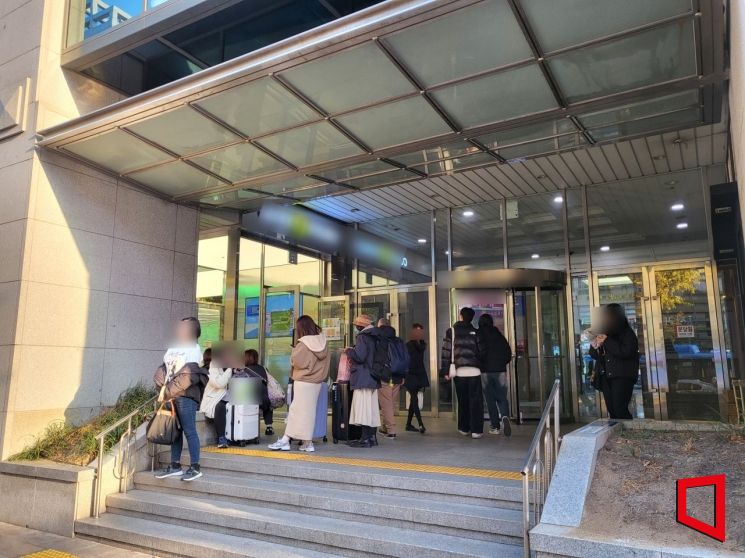 A group of foreign tourists stands in front of the entrance of an officetel in Donggyo-dong, Mapo-gu, Seoul on the 25th. Photo by Shim Sung-ah
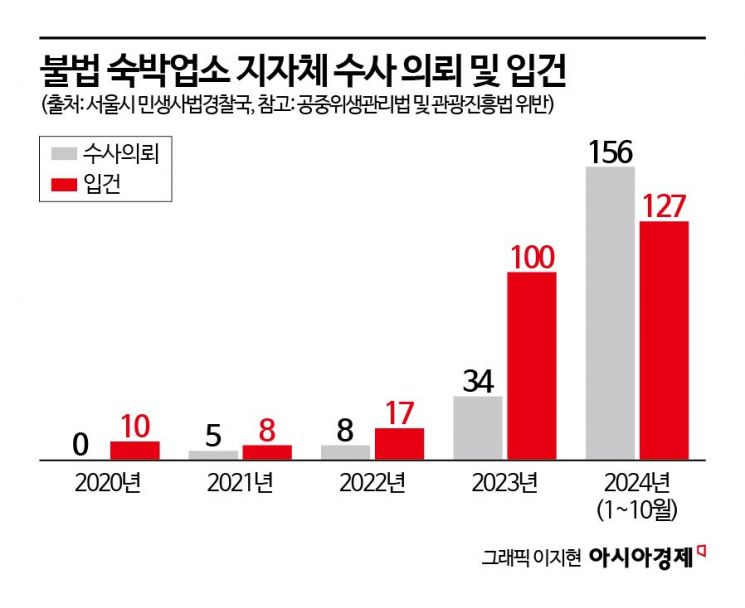
According to the Seoul Metropolitan Government’s Civil Affairs Judicial Police Bureau, there have been 156 investigations requested and 127 cases booked for illegal lodging businesses this year. In 2020, there were zero investigation requests and 10 cases booked, but the numbers have increased sharply since the COVID-19 pandemic. However, compared to over 400 complaints related to illegal lodging businesses received by three district offices?Mapo-gu Office, Jung-gu Office, and Dongdaemun-gu Office?the figures are far from sufficient.
A hotel manager near Dongdaemun History & Culture Park Station in Seoul pointed out, “There are many places openly operating lodging businesses in officetels,” and added, “If they really wanted to, they could find illegal places, but it doesn’t seem like proper crackdowns are taking place.”
An employee at a residential lodging facility in Chungmuro, Jung-gu, Seoul expressed concern, saying, “Leaving illegal lodging businesses as they are leads to tax evasion, which is a serious problem,” and added, “If an accident occurs at such accommodations, compensation issues arise, damaging the local image among foreigners. Ultimately, everyone could suffer.”
To operate shared lodging, one must comply with the Public Health Control Act as a lodging business or meet the standards for foreigner-targeted tourist city homestays. Officetels or one-room apartments do not meet any of these standards. Violating the law can result in imprisonment of up to two years or a fine of up to 20 million won. Although local governments in Seoul are conducting inspections mainly based on complaints, it is insufficient. Officials from various district offices in Seoul complain, “There is a lack of personnel and no investigative authority, so there are many limitations.”
Jeong Ransu, an adjunct professor in the Department of Tourism at Hanyang University, also said, “The biggest cause is the lack of personnel,” explaining, “Usually, there is only one or two public officials in charge at each local government, and without investigative authority, even if they go to the site, it is difficult to conduct crackdowns because the door is not opened or the landlord claims, ‘I didn’t take money; I just invited acquaintances.’” He advised, “Not only local governments but also related government ministries need to conduct large-scale surveys or actively review the situation using external contractors.”
© The Asia Business Daily(www.asiae.co.kr). All rights reserved.
![Clutching a Stolen Dior Bag, Saying "I Hate Being Poor but Real"... The Grotesque Con of a "Human Knockoff" [Slate]](https://cwcontent.asiae.co.kr/asiaresize/183/2026021902243444107_1771435474.jpg)

















