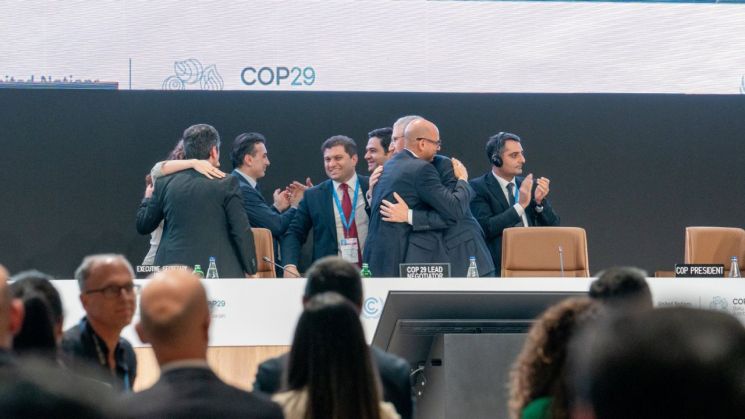
 The closing ceremony of the United Nations Framework Convention on Climate Change Conference of the Parties (COP29) held on the 24th (local time) in Baku, Azerbaijan. Photo by COP29 Azerbaijan X
The international community has agreed to raise $300 billion annually by 2035 to support developing countries in responding to climate change.
The United Nations Framework Convention on Climate Change Conference of the Parties (COP29) decided on the 24th (local time) in Baku, Azerbaijan, to set the "New Climate Finance Goal (NCQG)" at a minimum of $300 billion per year (approximately 421.65 trillion KRW). This amount is three times larger than the previous target. The funds will be provided by developed countries and used for climate change adaptation and damage recovery in developing countries.
The NCQG concerns discussions on who, how, and how much climate finance will be provided after next year. Initially, the international community agreed at COP15 in 2009 to mobilize $100 billion in climate finance by 2020. Although the deadline was extended due to negotiation difficulties, the promised funds were successfully mobilized this year. The key agenda at this climate conference was to establish new climate finance mechanisms for the period after next year.
However, developed and developing countries sharply clashed over the amount. Developed countries, led by the United States, proposed starting with the existing $100 billion climate finance. In contrast, developing countries suggested amounts ranging from $400 billion to nearly $2 trillion. After adjustments, a final proposal of $1.3 trillion?13 times the previous amount?was made but was not accepted by developed countries.
There were also disagreements over the method and donor countries. Developed countries proposed including private funds in climate finance going forward, but developing countries insisted that only public funds should be counted. Additionally, developed countries argued for collecting climate finance from "high-income developing countries" such as China and India. Developing countries strongly opposed this, stating it violated the "polluter pays principle," which holds developed countries responsible for global warming to pay.
As a result, discussions were not concluded even on the closing day, the 22nd, and were extended until that day. Azerbaijan, the chair country, proposed a developed country contribution of $250 billion annually, but developing countries rejected it as too low. Developed countries again proposed $300 billion, but developing countries still did not accept it. Eventually, an agreement was reached dramatically when the term "minimum" was included.
However, proposals to impose obligations on wealthy developing countries failed. Instead, contributions from countries classified as developing, including China, were "encouraged."
The agreement reached at last year's COP29 on "phasing down fossil fuel use" and "tripling renewable energy capacity" did not include specific implementation plans.
Evaluations of this agreement were mixed. According to major foreign media such as Reuters, Simon Stiell, Executive Secretary of the United Nations Framework Convention on Climate Change, welcomed the deal, saying, "It was a difficult journey, but we made the deal," and "This deal will continue to grow the clean energy boom and protect billions of lives."
On the other hand, voices of dissatisfaction emerged from developing countries. Chandni Raina, India's representative, criticized it as a "meager amount," saying, "Unfortunately, we cannot accept it. It is merely a visual illusion." Juan Carlos Monterrey, Panama's climate envoy, pointed out, "The process was chaotic, poorly managed, and completely failed in terms of achieving the necessary ambition."
© The Asia Business Daily(www.asiae.co.kr). All rights reserved.
![Clutching a Stolen Dior Bag, Saying "I Hate Being Poor but Real"... The Grotesque Con of a "Human Knockoff" [Slate]](https://cwcontent.asiae.co.kr/asiaresize/183/2026021902243444107_1771435474.jpg)
















