Results of Proactive Inspection by the Ministry of Food and Drug Safety
Temu Barbecue Skewers · Ali Camping Folding Turner
Nickel, a heavy metal, was detected in camping cookware purchased from AliExpress, Temu, and other platforms.
On the 21st, the Ministry of Food and Drug Safety announced that, in response to the increasing number of camping enthusiasts, it conducted a proactive inspection of 31 camping cookware items sold on overseas online shopping malls such as AliExpress and Temu. As a result, nickel exceeding domestic standards was detected in two products.
The products in which nickel was detected are Temu's barbecue (BBQ) skewers and AliExpress's camping foldable spatula. The barbecue skewers are manufactured in China and sold in bundles of 10 for 2,045 KRW. The foldable spatula is priced at 1,392 KRW each, and it is reported that the manufacturer could not even be identified for this product.
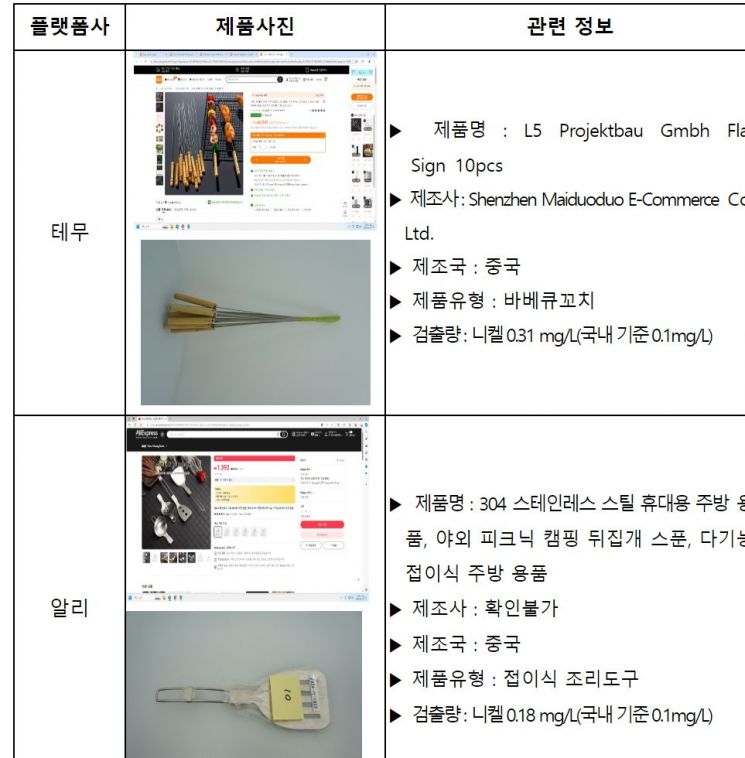 Two types of camping cookware detected with nickel. Provided by the Ministry of Food and Drug Safety
Nickel (Ni) can cause lung or nasopharyngeal cancer, kidney abnormalities, and bronchial stenosis when exposed to high concentrations. It can also cause allergic rashes or dermatitis upon contact. The domestic detection standard for nickel is below 0.1 mg/L, but these products contained 0.18 mg/L and 0.31 mg/L of nickel, respectively. The Ministry of Food and Drug Safety urgently requested the platforms to suspend sales of the two nickel-detected products.
Meanwhile, Seoul City conducted safety inspections on children's and infants' winter textile products sold on Chinese online platforms such as AliExpress, Temu, and SHEIN. Among 26 products, 7 were found to be non-compliant. On the 22nd, Seoul City announced the safety inspection results for children's and infants' winter textile products sold on these online platforms. Among the inspected products, one children's jacket sold on Temu contained phthalate plasticizers exceeding domestic standards by 622 times. Phthalate plasticizers are endocrine-disrupting substances that affect reproductive functions and can cause irritation to eyes and skin upon contact.
Additionally, one children's jumpsuit contained phthalate plasticizers exceeding domestic standards by approximately 294 times. The pH of this product was 7.8, which is outside the domestic standard range (pH 4.0?7.5). If the pH of textile products exceeds the standard, it can cause skin irritation and allergic contact dermatitis. Furthermore, one pair of children's shoes sold on AliExpress contained lead, a heavy metal, exceeding domestic standards by about 5 times. One infant spacesuit contained phthalate plasticizers exceeding standards by 3.5 times, and one pair of overalls contained lead exceeding domestic standards by up to 19.12 times. Lead is classified by the International Agency for Research on Cancer (IARC) as a Group 2B possible human carcinogen, and long-term low-level exposure can cause neurodevelopmental toxicity and hypertension.
Earlier, on the 8th, Seoul City announced that among 176 products sold on the same online platforms, 15 products, including 8 accessories and 7 cosmetics, contained harmful substances greatly exceeding domestic standards. In particular, bracelets contained lead levels exceeding domestic standards by up to 900 times. The inspected products included 8 hygiene products, 87 cosmetics, 51 food containers, and 30 accessories.
In earrings, cadmium (Cd) was detected at 47.4%, exceeding the domestic standard (below 0.1%) by up to 474 times, and in necklaces, nickel (Ni) exceeded the domestic standard (below 0.5 μg/cm²/week) by up to 3.8 times. Regarding cosmetics, two highlighters purchased from Ali contained phthalates (DEHP) exceeding domestic standards (100 μg/g) by up to 14.9 times, and three lip balms contained cadmium exceeding domestic standards (5 μg/g) by 11.4 times. Cadmium is classified by the International Agency for Research on Cancer (IARC), under the World Health Organization (WHO), as a Group 1 human carcinogen and typically accumulates in the human body through respiratory and digestive tracts.
© The Asia Business Daily(www.asiae.co.kr). All rights reserved.

















