162 Missiles Detected Monthly Over Middle East Airspace
Civilian Passenger Planes Exposed to Danger
Since the outbreak of the Gaza Strip war last October, tensions in the Middle East have escalated, raising concerns that civilian passenger planes passing through the area are also being exposed to danger.
On the 21st (local time), the American daily The Wall Street Journal (WSJ) reported that numerous aircraft are inadvertently entering Middle Eastern war zones. WSJ cited the announcement from aviation safety assessment company Ostry Aviation Solutions (hereafter 'Ostry'), stating that the number of missiles detected in Middle Eastern airspace this year averages 162 per month. This is 16 times higher than the average of 10 per month last year. Moreover, this figure is based on ballistic and cruise missiles, so when including rockets, mortars, artillery shells, and drones, the total number of projectiles is estimated to be much higher.
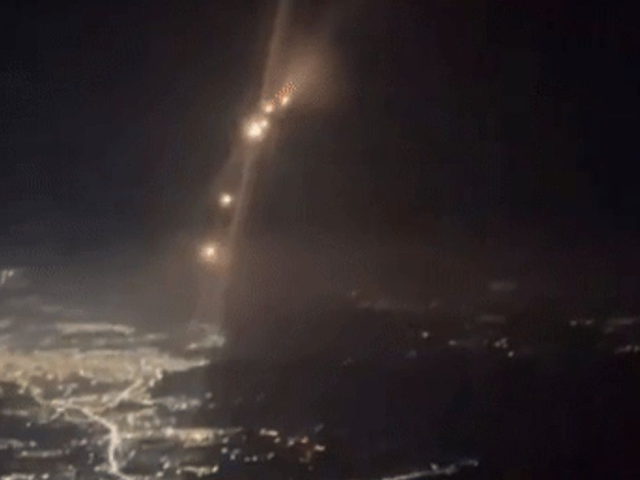 The scene of the Iranian missile swarm spotted on a passenger plane on the 1st of last month.
 [Photo by X (formerly Twitter)]
On the 1st of last month, when Iran launched a large-scale missile attack on mainland Israel, there was a case where a civilian passenger plane occupant witnessed a missile swarm. A video posted on social media at the time shows a passenger on an Emirates flight from Amsterdam, Netherlands to Dubai, United Arab Emirates (UAE), asking, "Are those fireworks? What is that?" However, what he saw was a 'missile swarm' launched by Iran heading toward Israel. WSJ explained this as "an example of civilian passenger planes being endangered in some of the world's busiest skies due to escalating Middle East conflicts," adding that "airlines were not even warned about the missile launches."
Flying close to missiles and civilian aircraft is extremely dangerous. Ballistic missiles travel at altitudes much higher than civilian aircraft, but during launch and descent toward their targets, they can pose significant risks. Additionally, cruise missiles fly at low altitudes, which can be hazardous during aircraft takeoff and landing. If air defense systems mistake civilian aircraft for missiles, a catastrophic disaster could occur.
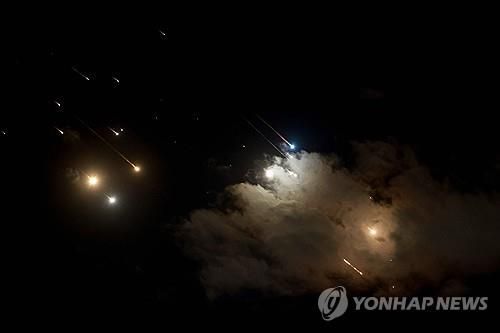
Such accidents have indeed happened. In late 2014, Malaysia Airlines flight MH17 was shot down by a Russian-made missile over eastern Ukraine, killing all 298 passengers and crew. In 2020, Ukraine International Airlines flight PS752 crashed near Tehran, Iran, after being shot down by the Iranian military, resulting in the deaths of all 176 onboard.
The problem is that airspace control measures by Middle Eastern governments are not being properly enforced. During Iran's airstrike on Israel on the 1st of last month, many flights passed through the airspace over Iraq, Jordan, Syria, and northern Saudi Arabia, located between Iran and Israel, following their original routes. Similarly, during Israel's retaliatory airstrikes against Iran on the 26th of the same month, aircraft continued to operate in the area.
Ostry's Chief Information Officer (CIO), Matt Bory, pointed out, "National security and foreign policy are prioritized over aviation safety," adding, "Such incidents repeatedly occur in conflict zones." Pilot Kuroshi Dushehnas warned, "Disasters that can take innocent lives can happen again at any time." He lost a colleague in the 2020 PS752 crash.
© The Asia Business Daily(www.asiae.co.kr). All rights reserved.


















