"Carbon Reduction Performance Should Be Predicted to Provide Incentives"
Choi Tae-won, Chairman of SK Group, proposed the introduction of an incentive system related to carbon reduction called the Environmental Protection Credit (EPC).
On the 22nd, Chairman Choi participated as a panelist in the business leader session of the 'Tokyo Forum 2024' held at the University of Tokyo in Japan, arguing that an EPC system is necessary, which predicts carbon reduction achievements at a 'future point' and provides incentives 'now.'
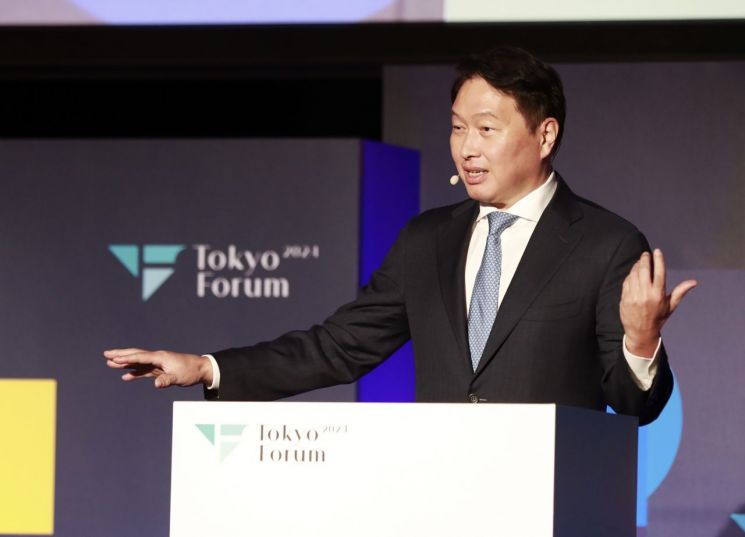
He explained the concept of the Social Performance Incentive (SPC) created by SK Group, saying, "Within SK Group, to encourage the creation of social value, this measurement was linked to Key Performance Indicators (KPIs), enabling us to reduce carbon emissions and save energy to create social value." He added that SK Group spent $200 million annually (approximately 281.3 billion KRW) 15 years ago to introduce the related system.
Chairman Choi elaborated, "Facing a reality where increasing problems cannot be solved, to secure more problem solvers, incentives must be provided to them. The SPC devised by SK will serve as monetary and non-monetary rewards given for the social value created."
He continued, "SK Group has been implementing SPC for over nine years, and next year marks the 10th anniversary of providing funds to companies that create social value. If SPCs become transferable, we can assign market value to SPCs and create a market where SPCs can be exchanged just like carbon credits."
Chairman Choi explained, "In this context, I propose the EPC. Currently, carbon emission trading targets carbon emissions that have already occurred, but EPC provides incentives now by predicting reduction achievements at a future point." He added, "Companies will continuously strive to achieve promised carbon reduction results, and investors can expect future returns and invest in such companies. By using blockchain technology and providing coins linked to the social value created, the coins themselves can be used as a measurement tool to track social value creation and calculate cash rewards for coin holders."
Earlier, in his opening remarks at the forum, Chairman Choi also expressed the opinion that the era of global uncertainty should be addressed with 'design thinking.' He explained that CEOs, who must allocate limited resources efficiently to run optimal businesses, should become 'designers.'
Chairman Choi emphasized the importance of design thinking in business by stating, "CEOs must become designers who efficiently allocate limited resources to meet customer demands and create value." This means that businesspeople need to design their businesses while adapting to rapid social changes.
He also introduced how design thinking has been utilized in shaping SK Group's history and overall business portfolio. He said, "SK Group has a history of over 70 years, expanding its business from textiles to petroleum and telecommunications, and innovating its portfolio with semiconductors and AI. Design thinking has been the foundation for allocating limited resources and embracing new challenges."
He continued, "We have always faced significant challenges in adding and accepting new business areas, but we have successfully managed businesses and created synergies. Design thinking is necessary even in complex businesses that integrate all business areas to create synergy, such as AI business."
He particularly stressed that to encourage people to participate in solving social issues such as carbon emission reduction and social inequality from a societal perspective, goodwill alone is insufficient, and design thinking that provides incentives is necessary. Chairman Choi emphasized, "A newer and more creative approach is needed to build a sustainable future."
Finally, Chairman Choi said, "This forum will also hold a Youth session where university students from Korea and Japan will share new ideas, and expectations are high. We will always listen to the ideas of the younger generation who face new challenges and overcome the impossible."
The Tokyo Forum has been jointly hosted annually since 2019 by the Choi Jong-hyun Academic Foundation and the University of Tokyo in Japan. This year’s forum, held over two days on the 22nd and 23rd under the theme 'Shape the Future, Design for Tomorrow,' is organized by the Choi Jong-hyun Academic Foundation, which was launched in 2018 to mark the 20th anniversary of the late Choi Jong-hyun, former SK Chairman. The foundation is a global knowledge exchange platform that analyzes geopolitical risks and challenges and opportunities brought by scientific and technological innovation and seeks response strategies. This year’s forum, held over two days until the 23rd, features dozens of speakers and panelists, including Chairman Choi, Teruo Fujii, President of the University of Tokyo, Yutaka Matsuo, Professor at the University of Tokyo, as well as entrepreneurs and scholars.
© The Asia Business Daily(www.asiae.co.kr). All rights reserved.
![Clutching a Stolen Dior Bag, Saying "I Hate Being Poor but Real"... The Grotesque Con of a "Human Knockoff" [Slate]](https://cwcontent.asiae.co.kr/asiaresize/183/2026021902243444107_1771435474.jpg)
















