"Actual Use of Nuclear Weapons Is Extremely Difficult"
Ukraine Special Envoy to Visit South Korea Soon
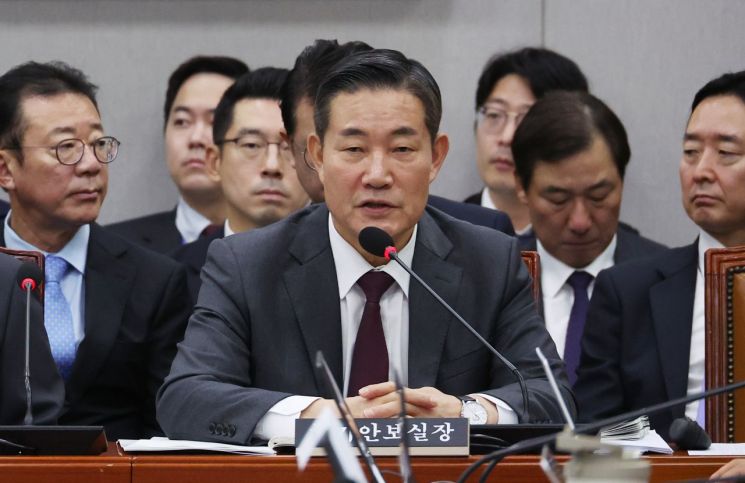
Shin Won-sik, Director of the National Security Office, stated on the 22nd, "It is understood that Russia has provided related equipment and anti-aircraft missiles to North Korea to reinforce the vulnerable air defense system in Pyongyang."
Director Shin made this remark during an appearance on 'SBS News Briefing' in the afternoon, responding to a question about "the price North Korea paid for dispatching troops to the Ukraine war."
He explained, "After North Korea's military reconnaissance satellite failed on May 27, (Russia) had already declared last year that it would support satellite-related technology, and several other military technologies have been partially supplied. It seems there has also been various economic support."
He also expressed the view that actual use of nuclear weapons by Russia would be extremely difficult. Regarding the possibility of the Russia-Ukraine war escalating into a world war, he forecasted, "I do not think the possibility is high."
Regarding the possibility of additional troop dispatches by North Korea to the Russia-Ukraine war, Director Shin responded, "It cannot be completely ruled out, but nothing has been confirmed at this time." In response to reports confirming North Korea's additional export of long-range artillery such as 170mm self-propelled guns and 240mm multiple rocket launchers to Russia, which raised the possibility of additional North Korean artillery personnel deployment, he said, "Long-range artillery is a weapon system currently not possessed by Russia. Whether some or all of the related operating personnel will go remains to be seen, but if all assigned personnel go, it would be up to about 4,000 people." He added, "We are continuously monitoring and tracking this."
Regarding the visit of the Ukrainian special envoy to Korea, he said, "It will be very soon," and reaffirmed the existing stance on the possibility of additional support such as lethal weapons to Ukraine, stating, "We will respond step by step." He explained that due to many variables such as U.S. support for Ukraine and NATO's response, the policy will be decided comprehensively considering solidarity with value-sharing countries and countries with similar positions.
"With Trump's second term, ROK-US-Japan security cooperation will be further strengthened"
Director Shin said regarding the possibility of an increase in South Korea's defense cost-sharing after the launch of the Trump administration's second term, "For the joint interests of South Korea and the U.S., South Korea's national power has grown and its contribution has continuously expanded, and it is very likely to continue that way."
He added, "I believe that after the launch of the Trump administration's second term, ROK-US-Japan security cooperation will be further strengthened," emphasizing, "Although there is a forecast that cooperation might weaken because Trump values deals, rather, because he considers deals and benefits, ROK-US-Japan security cooperation will inevitably be strengthened." He noted that ROK-US-Japan security cooperation is actually the most important cooperative mechanism for the joint interests of the three countries.
When asked about the mutual influence between the ROK-US alliance and ROK-China relations, Director Shin said, "ROK-China relations develop complementarily based on the ROK-US alliance."
He mentioned, "(The ROK-US alliance and ROK-China relations) are not contradictory but have a proportional relationship," adding, "You can see that President Yoon Seok-yeol reaffirmed the principle that based on a strong ROK-US alliance, the complementary ROK-China relations will develop."
Earlier, President Yoon said in an interview with the media during his visit to Brazil for the G20 summit, "For Korea, the U.S. and China are not a matter of choice." This led to analyses suggesting that the government's diplomatic stance might be shifting from a focus on the ROK-US alliance to improving ROK-China relations.
Director Shin said regarding the timing of Chinese President Xi Jinping's visit to Korea, "The most likely time would be at next year's Asia-Pacific Economic Cooperation (APEC) summit in Gyeongju," adding, "Since China will be the APEC chair country the year after next, this possibility is high, and both sides are in close consultation."
© The Asia Business Daily(www.asiae.co.kr). All rights reserved.

















