If No Legal Heirs, Inherited Property Reverts to the State
"A System Needed to Meaningfully Utilize Deceased's Assets"
'Elderly Superpower' Japan, Spread of Inheritance Donation Culture
These days, the number of elderly people living alone is rapidly increasing. Amid the rise in elderly individuals living alone due to population aging and increases in single and unmarried individuals, there are calls to establish a posthumous management system for the inheritance of assets left by unclaimed deceased persons. If there are no legal heirs, the deceased's assets are transferred to the national treasury through a certain procedure. It has been revealed that over the past 10 years (2014?2023), the assets of unclaimed deceased persons transferred to the national treasury amounted to 12.1 billion KRW. According to an analysis of data from the National Tax Service by the office of Ahn Do-geol, a member of the Democratic Party of Korea, on the 11th, the assets of unclaimed deceased persons transferred to the state treasury in 2023 were 1.665 billion KRW.
In 2014, the amount was a small sum of 12 million KRW, but it increased by 13,775% over 10 years. Currently, South Korea is an aged society and is highly likely to enter a super-aged society early next year. The United Nations (UN) classifies societies as aging if the elderly population ratio exceeds 7%, aged if it exceeds 14%, and super-aged if it exceeds 20%. Also, the first baby boom generation, which saw a rapid increase in population after the war, has begun entering what is called Gohi (古稀), or the age of 70. The first baby boom generation was born between 1954 and 1963, numbering over 7 million. The average life expectancy of Koreans is about 83.5 years. In another 10 years, the amount of money inherited by no one and thus taken by the state is expected to surge.
Generally, the deceased's assets are inherited by legal heirs such as spouses or children. However, if there are no heirs, according to Article 1058, Paragraph 1 of the Civil Act, the inherited assets are transferred to the national treasury. If one wishes to transfer assets to a third party who is not a legal heir, a will must be prepared during the person's lifetime with conditions such as ▲handwritten signature ▲date of writing ▲address, rather than a verbal promise. However, very few people leave wills. Ultimately, most of the assets of unclaimed deceased persons go into the government's pocket.
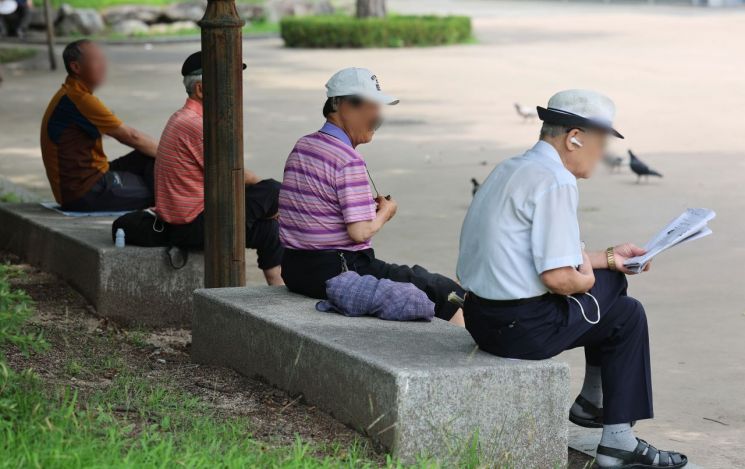
The issue of inheritance assets of unclaimed deceased persons is expected to become a bigger problem in the future due to population aging and increases in single and unmarried individuals. According to Statistics Korea's 'Future Household Projections: 2022?2052' released last September, the proportion of single-person households aged 65 and over will increase from 26.0% in 2022 to 51.6% in 2052. More than half of all single-person households will be elderly living alone. Sadly, in a super-aged society, a significant portion of hard-earned money inevitably returns not to family or children but to the state. Ahn Do-geol said, "Elderly people who have lived alone and struggled to build their assets have their property transferred to the national treasury according to the law after death, regardless of their wishes," adding, "Legal and institutional measures should be established so that the deceased's assets can be used more meaningfully after death."
In Japan, a 'nation of elderly' where 3 out of 10 people are aged 65 or older, the scale of assets of unclaimed deceased persons transferred to the national treasury is hitting record highs every year. According to the Supreme Court of Japan, the assets of unclaimed persons transferred to the national treasury in 2022 amounted to 76.8 billion yen (approximately 696.7 billion KRW). In 2013, it was about 33.6 billion yen, more than doubling in 10 years. In Japan as well, if there are no legal heirs such as spouses, children, or grandchildren, the inherited assets are transferred to the national treasury.
In response, a culture of legacy donations for social contribution activities is spreading in Japan. This is believed to be due to the increase in single-person households and the spread of values that prioritize using assets for society. Donated legacies are used for social contribution projects such as earthquake relief and research on intractable diseases, but they can also be designated for specific organizations or companies. In March 2021, the Higashiyama Zoo and Botanical Gardens in Nagoya City, Japan, expressed gratitude for a legacy donation worth 170 million yen from a woman in her 70s, which enabled them to bring in three lesser pandas and build related breeding facilities. Events that occurred in Japan often happen in Korea 10 to 20 years later. It is time for us to seriously consider the issue of unclaimed deceased persons.
© The Asia Business Daily(www.asiae.co.kr). All rights reserved.
!["The Woman Who Threw Herself into the Water Clutching a Stolen Dior Bag"...A Grotesque Success Story That Shakes the Korean Psyche [Slate]](https://cwcontent.asiae.co.kr/asiaresize/183/2026021902243444107_1771435474.jpg)
















