Seoul High Court Divisions 2, 6, and 7 Assigned... Dispute Over 'False Facts and Intentionality'
Lee Jae-myung, leader of the Democratic Party of Korea, appealed the first trial verdict in the public official election law violation case, in which he was sentenced to imprisonment. Accordingly, the legal battle that determines Lee's political fate will move to the second trial.
According to the legal community on the 21st, Lee's side submitted an appeal to the Seoul Central District Court on the same day. Since the first trial verdict was announced on the 15th and the deadline for submitting the appeal is the 22nd, the prosecution is also expected to file an appeal soon. In criminal cases, an appeal can be filed within seven days from the date of the first trial verdict. The appeal is submitted to the original court, and the statement of reasons for the appeal is submitted to the second trial court. Typically, the grounds for appeal include claims of legal misinterpretation, factual errors, and improper sentencing. It argues that there was a violation of the Constitution, laws, orders, or regulations that influenced the verdict, or that factual errors affected the judgment, making the sentencing based on such judgments unfair.
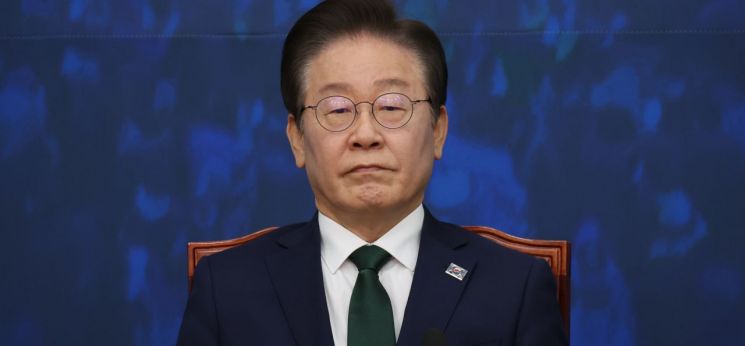 Democratic Party of Korea leader Lee Jae-myung is wearing a stern expression at the Supreme Council meeting held at the National Assembly on the 18th.
Earlier, the 34th Criminal Division of the Seoul Central District Court (Presiding Judge Han Seong-jin), which handled the first trial, recognized Lee's guilt on the charge of false statement under the Public Official Election Act on the 15th and sentenced him to one year in prison with a two-year probation. The court acknowledged that Lee's statements regarding the late Kim Moon-gi, former head of Development Division 1 at Seongnam Urban Development Corporation, including "I did not play golf with Kim Moon-gi during his overseas business trip" and the claim that the change of use privilege for the Korean Food Research Institute site in Baekhyeon-dong, Seongnam, Gyeonggi Province, was made under pressure from the Ministry of Land, Infrastructure and Transport, were all false statements. However, the court acquitted Lee of the statement "I did not know Kim Moon-gi," ruling that this alone could not be considered a denial of acquaintance.
The appeal trial will be assigned to one of the 2nd, 6th, or 7th divisions of the Seoul High Court, which handle election cases. Due to the mandatory regulation that election crime trials must be completed within six months for the first trial and three months each for the second and third trials, the assignment and trial are expected to proceed swiftly.
In the appeal trial, Lee's side and the prosecution are expected to engage in intense legal disputes. Lee's side is likely to actively refute the golf-related statement about former Director Kim, which was recognized as guilty by the first trial court. In particular, Lee's side argues that the first trial court's interpretation that Lee's statement about "manipulating golf photos" meant "manipulating them to appear as if golf was played" was an excessive overinterpretation and violated the principle of prohibition of analogy. Regarding the Baekhyeon-dong statement, they plan to present additional evidence or witnesses to prove that there was pressure or coercion from the Ministry of Land, Infrastructure and Transport. They will also continue to argue that since the statement was made during a national audit, it should not be subject to prosecution.
The prosecution is expected to focus on proving the falsity of the statement "I did not know Kim Moon-gi," which was not recognized as false in the first trial. For the statements acknowledged as guilty, the prosecution will emphasize intentionality and seek to maintain the same judgment in the appeal trial.
If the suspended sentence of imprisonment from the first trial is confirmed by the Supreme Court, Lee will lose his position as a member of the National Assembly and be barred from running for office for ten years, preventing him from running in the presidential election. The Democratic Party will have to return 43.4 billion won in election reimbursement costs to the National Election Commission.
Previously, a similar case where a suspended prison sentence was given for violating election laws and resulted in a ten-year disqualification from candidacy involved Heo Kyung-young, honorary representative of the National Revolutionary Party. Heo, who ran in the 20th presidential election in 2022 and was prosecuted for spreading false information by claiming to be the adopted son of the late Lee Byung-chul, honorary chairman of Samsung Group, had his two-year prison sentence with a three-year probation confirmed by the Supreme Court in June.
© The Asia Business Daily(www.asiae.co.kr). All rights reserved.

![User Who Sold Erroneously Deposited Bitcoins to Repay Debt and Fund Entertainment... What Did the Supreme Court Decide in 2021? [Legal Issue Check]](https://cwcontent.asiae.co.kr/asiaresize/183/2026020910431234020_1770601391.png)














