Holding Company Steps In to Quell Liquidity Crisis Amid Continued Deficits
Merging with Strong Affiliates or Delisting via Tender Offers
All-Out Risk Management Including Appointing Group CFO as CEO
Concerns over liquidity deterioration triggered by Lotte Chemical's corporate bond issue are spreading throughout the business community. Although Lotte Holdings directly intervened to quell rumors of a financial crisis, long-term stagnation has led to a buildup of loss-making affiliates within Korea's top 10 business groups that require risk management.
According to the Financial Supervisory Service's electronic disclosure system on the 22nd, Lotte Chemical recorded a cumulative operating loss of 1.77 trillion won from 2022 through the third quarter of this year. In particular, the deficit widened in the third quarter, with a quarterly operating loss of 413.6 billion won and a net loss of 513.8 billion won.
Lotte Group explained, "Since 2018, the chemical industry has suffered from supply-demand deterioration due to cumulative new capacity expansions and profit declines due to China's improved self-sufficiency." They added, "As Lotte Chemical's losses accumulated, some public corporate bonds failed to meet financial covenants related to performance within bond management contracts." Although Lotte Group stated, "The company has secured sufficient liquidity, so there is no problem with principal and interest repayment on corporate bonds," market anxiety is unlikely to subside easily. A senior financial official said, "Companies are currently in a very difficult situation, and the financial market is very tense."
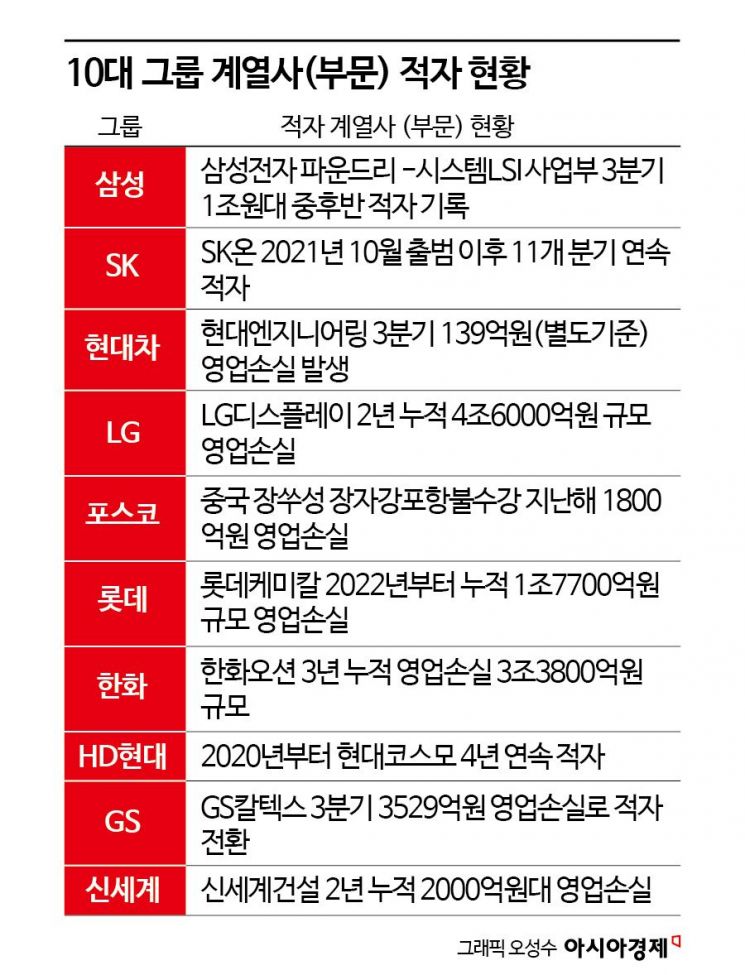
With ongoing concerns over interest rates and exchange rates, and significant uncertainty ahead of the inauguration of the second Trump administration, Korea's financial and industrial sectors are on high alert. Notably, many companies within the top 10 groups have accumulated losses due to interest rate hikes, capital market stagnation, and worsening business conditions. Even if core businesses are strong, most groups hold substantial stakes in loss-making affiliates, making them vulnerable to issues related to affiliate funding support.
Investment after investment... Loss-making businesses that cannot be abandoned due to future growth potential
Samsung and SK Groups each maintain loss-making business sectors considered 'money pits' but are indispensable due to expectations for future growth and the need to diversify their business portfolios. Samsung Electronics is estimated to have incurred losses in the trillion-won range in its Foundry and System LSI divisions in the third quarter. Persistent losses in specific business units are eroding overall performance. The semiconductor business posted quarterly operating profits just under 4 trillion won, but excluding one-time costs, the memory semiconductor business generated operating profits around 7 trillion won. In other words, profits from the memory business offset losses in the foundry business. The foundry division continues to incur losses as it struggles to secure large-scale production orders from global big tech companies such as Nvidia, AMD, and Qualcomm. Samsung is focusing investments on foundry and other system (non-memory) semiconductor businesses to reduce its memory-heavy sales concentration, which accounts for over 70% of semiconductor sales, but clear results have yet to materialize.
Within SK Group, SK On, an affiliate engaged in the secondary battery business, has been regarded as a 'pain point' within the group. SK On began with an operating loss of 310.2 billion won in the fourth quarter of 2021 and has continued a streak of losses for 11 consecutive quarters. Notably, in the second quarter of this year, it recorded a quarterly loss of 460.1 billion won, the largest ever. However, in the third quarter, SK On posted an operating profit of 24 billion won, marking its first escape from the loss cycle, though it remains cautious. SK On has implemented emergency management measures, including the elimination of some C-level positions in July and voluntary retirement in September, continuing its austerity management. Group-level rebalancing efforts to normalize SK On have also been underway. SK On's parent company, SK Innovation, completed its merger with SK E&S. SK On merged with SK Trading International (SKTI), and a merger with SK Entum is scheduled for February next year. These three merged companies are considered SK Group's 'cash cows' with stable cash-generating capabilities. Although a loss-making company, SK On is receiving group-level management and support as a promising future business.
Unavoidable economic downturn... Deployment of 'experts' to block group financial risks
Loss-making affiliates affected by the economic downturn are being assigned financial experts to manage risks early and prevent them from escalating into group-wide issues. Within Hyundai Motor Group, Hyundai Engineering, a construction affiliate, is struggling due to the economic downturn. Hyundai Engineering is an unlisted company, but Hyundai Construction holds 38.62% of its shares, Chairman Chung Eui-sun owns 11.72%, Hyundai Glovis 11.67%, Kia 9.35%, Hyundai Mobis 9.35%, and Honorary Chairman Chung Mong-koo 4.68%, making it a key Hyundai Motor Group affiliate. In the third quarter, it recorded a net loss of 18.5 billion won, turning from a net profit of 35.3 billion won in the same period last year. On a separate basis excluding subsidiary performance, it posted an operating loss of 13.9 billion won. The separate basis quarterly net loss was about 52.7 billion won, contrasting with a net profit of 17 billion won in the third quarter of last year. Hyundai Motor Group recently appointed Ju Woo-jung, Vice President and Head of Kia's Finance Division, known as a 'financial expert' within the group, as CEO of Hyundai Engineering. Through this appointment, Hyundai Motor Group plans to accelerate organizational restructuring alongside efforts to overcome Hyundai Engineering's poor performance.
Preventing risk transfer through bold sales, mergers, or delisting
POSCO Group is preparing to sell the Zhangjiagang Pohang Stainless Steel Plant in Jiangsu Province, China, which posted a loss of about 180 billion won last year. Established in 1997, the plant has an annual crude steel capacity of 1.1 million tons. POSCO Holdings (58.6%) and POSCO China (23.9%) hold a combined 82.5% stake, while China's second-largest steelmaker, Shagang Group, owns 17.5%. Last year, Zhangjiagang's stainless steel business recorded a loss of $130 million (about 181.2 billion won) due to delayed economic recovery in China and oversupply. This more than doubled the previous year's loss of $59 million (about 82.2 billion won). Since Chairman Chang In-hwa took office in March this year, POSCO Holdings has been conducting group-wide restructuring of 125 low-profit and non-core assets.
HD Hyundai Oilbank recently decided to absorb and merge HD Hyundai Cosmo, a joint venture with Japanese refiner Cosmo Oil. As losses at HD Hyundai Cosmo ballooned, the company undertook intensive efficiency measures. Hyundai Cosmo expanded its business based on chemical operations, recording sales of 2.9893 trillion won and operating profit of 168.1 billion won in 2018. However, it posted an operating loss of 83.3 billion won in 2020 and continued a four-year streak of losses through last year. The cumulative operating loss during this period reached 318.3 billion won. This was due to Chinese chemical companies increasing BTX production, causing product prices to plummet. BTX is a raw material for plastic containers, synthetic resins, and polyester fibers. By the end of last year, the company's deficit reached 268.5 billion won, making the loss unsustainable and prompting a merger with the parent company to rebalance product production.
Shinsegae Construction, with Emart as its largest shareholder, is expected to be delisted in the first quarter of next year. The company has accumulated operating losses in the 200 billion won range over the past two years. This year, it recorded a cumulative operating loss of 109 billion won through the third quarter. Large-scale losses have accumulated due to poor sales performance amid a real estate market downturn and increased financial burdens from rising interest rates. Earlier, Emart conducted a tender offer in the second half of this year to voluntarily delist Shinsegae Construction. It is reported to have secured over 90% of voting rights excluding treasury shares, including existing holdings.
Major affiliates within groups also trapped in the unavoidable economic downturn 'loss quagmire'
LG Display, a major affiliate of LG Group, has also accumulated massive losses, recording operating losses of 2.085 trillion won two years ago and 2.51 trillion won last year. It has posted operating losses for three consecutive quarters this year, with a cumulative loss of 643.7 billion won. LG Display produces OLED panels for Apple iPads and other tablets and laptops. Demand for consumer IT devices has not sufficiently recovered, and one-time costs from voluntary retirement of production workers in June have impacted performance. Due to accumulated losses, LG Display's interest-bearing debt increased from 12.74 trillion won in December 2021 to 16.6 trillion won by the end of 2023. Its debt ratio also nearly doubled from 158.46% to 307.72% during the same period.
Hanwha Group's Hanwha Ocean has accumulated operating losses of 3.38 trillion won over three years. Despite the recent shipbuilding boom, one-time costs such as production schedule adjustments and outsourcing expenses to resolve production delays caused by strikes during the Daewoo Shipbuilding & Marine Engineering era have hindered performance recovery. From the third quarter of this year, Hanwha Ocean succeeded in turning a profit and is actively improving its business structure. It plans to eliminate low-priced orders that delayed recovery within the year and focus on a selective order strategy centered on high profitability to accelerate structural improvements. GS Group's operating profit in the third quarter fell to half of the same period last year. GS Caltex's performance deteriorated due to inventory losses from falling oil prices and worsening refining margins, resulting in a 49% decrease in operating profit. GS Caltex posted a loss of 352.9 billion won in the third quarter.
© The Asia Business Daily(www.asiae.co.kr). All rights reserved.
![Clutching a Stolen Dior Bag, Saying "I Hate Being Poor but Real"... The Grotesque Con of a "Human Knockoff" [Slate]](https://cwcontent.asiae.co.kr/asiaresize/183/2026021902243444107_1771435474.jpg)











