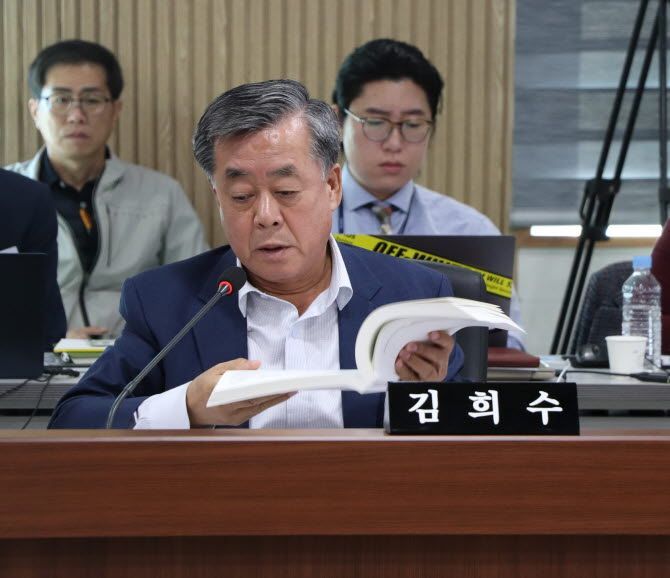
Gyeongbuk Provincial Council member Kim Hee-soo (People Power Party, Pohang 2) announced on the 21st that during the 2024 administrative audit, he urged the preparation of improvement measures regarding the price differences in purchasing heating and cooling units, the increase in leftover food amounts and disposal costs in school meals, and the restroom modernization project.
Councilor Kim criticized the fact that the unit purchase price of heating and cooling units varies by several times during the procurement process for each school.
According to data submitted by the Gyeongbuk Office of Education, although the model RNW110PA2U heating and cooling unit is the same, School A purchased it at 6,436,000 KRW through a three-party unit price contract method, while School B purchased it at 1,650,000 KRW using the MAS Stage 2 method, resulting in about a fourfold difference.
Kim Hee-soo pointed out, “There is a need for institutional improvement regarding the significant price differences when purchasing the same model of heating and cooling units by utilizing methods such as joint purchasing through the Public Procurement Service or adjusting the order timing to place consolidated orders.”
He also revealed that although the number of students using school meals has decreased, the amount of leftover food has increased. In Gyeongbuk, 922 schools with 297,019 users provided meals in 2022, while in 2023, the number of schools decreased by three to 919, and the number of meal users decreased by 8,771 to 288,248 compared to the previous year.
However, the amount of leftover food increased from 8.2 million kg in 2022 to 8.59 million kg in 2023, an increase of 390,000 kg compared to the previous year, and disposal costs rose from 2.1 billion KRW in 2022 to 2.3 billion KRW in 2023. Food waste causes various environmental problems such as energy waste, greenhouse gas emissions, odor generation, and water pollution.
Councilor Kim Hee-soo emphasized, “More than 2 billion KRW is wasted annually on leftover food disposal costs, which is a serious problem,” and stressed the need for “active efforts by schools and the Office of Education to survey students’ preferences and accurately manage data on food waste to reduce leftover food amounts and costs.”
Additionally, the Gyeongbuk Office of Education is promoting a restroom modernization project. According to the data on the installation status of sanitary fixtures in schools submitted by the Office of Education, 18.7% of elementary schools, 25.9% of middle schools, and 24.7% of high schools still use squat toilets. School restrooms are spaces frequently used by students throughout the day, making hygiene and safety extremely important.
Councilor Kim Hee-soo urged, “Installing Western-style toilets or bidets alone does not constitute a restroom modernization project, but nowadays, Western-style toilets and bidets are commonly used even in homes,” adding, “To create a hygienic and comfortable environment for children, restroom environments must be actively improved.”
© The Asia Business Daily(www.asiae.co.kr). All rights reserved.

















