Experts, "Focus on Balanced Development and Overcoming Local Extinction"
Based on 'Power Self-Sufficiency Rate' Rather Than 'Geographical Proximity'
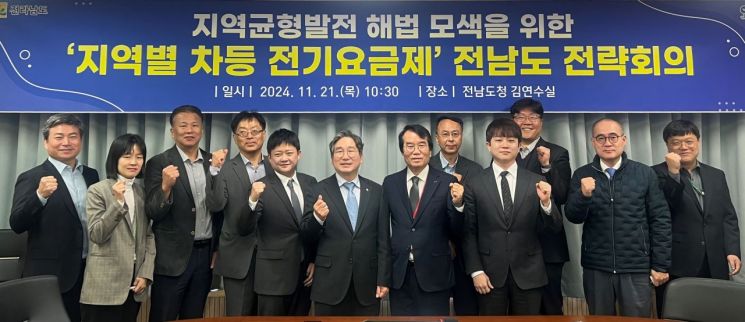 On the 21st, Jeonnam Province held an expert strategy meeting to discuss countermeasures related to the government's introduction of a regionally differentiated electricity tariff system. Provided by Jeonnam Province
Jeonnam Province held an expert strategy meeting on the 21st to analyze the impact of the government's introduction of a regionally differentiated electricity tariff system on Jeonnam and to discuss the design direction of a differentiated electricity tariff system favorable to Jeonnam.
The meeting was attended by representatives from the Korea Energy Agency, Korea Power Exchange, Jeonnam Research Institute, Jeonnam Technopark, Green Energy Research Institute, Professor Lee Soon-hyung of Dongshin University, and Professor Lee Jae-hyung of Mokpo National University, who discussed Jeonnam Province's response measures.
The government plans to first implement differentiated electricity prices in the wholesale market where power producers sell electricity to Korea Electric Power Corporation (KEPCO) starting in 2025, and then expand this to the retail market where KEPCO sells electricity to businesses and households from 2026.
Additionally, the government is seriously considering dividing the regional wholesale price system into three segments: the metropolitan area, non-metropolitan areas, and Jeju Island. Through this, the government aims to relocate power plants to the metropolitan area and disperse power-intensive companies such as data centers and secondary battery manufacturers to provincial regions.
However, by broadly dividing the wholesale price application into the metropolitan area, non-metropolitan areas, and Jeju Island, there is controversy over reverse discrimination against regions with high power self-sufficiency rates, and consistent opinions have been raised that this contradicts the purpose of the differentiated tariff system, which is to set lower electricity prices in regions that produce more electricity.
In this regard, Professor Lee Soon-hyung of Dongshin University pointed out, "If wholesale electricity prices are set based on geographical proximity, the wide division units may fail to properly realize the purpose of introducing regional electricity tariffs, and Jeonnam, which has a high power self-sufficiency rate, will be relatively disadvantaged."
Kang Sang-gu, Director of the Energy Industry Bureau of Jeonnam Province, stated, "Introducing a regionally differentiated electricity tariff system is an opportunity to achieve balanced regional development and overcome local extinction without separate national fiscal input, and a philosophical approach in this context is necessary," adding, "A drastic electricity tariff differentiation incentive of up to 20% should be provided only to depopulated areas to encourage power-intensive companies to relocate to provincial regions."
Jeonnam Province plans to actively respond by gathering expert opinions to establish optimized regional differentiated electricity tariff standards and to cooperate with cities and provinces with high power self-sufficiency rates to ensure that the government plan is designed in line with the original purpose of the differentiated tariff system, which is to increase regional power self-sufficiency.
© The Asia Business Daily(www.asiae.co.kr). All rights reserved.

















