Damage Amounting to 45.4 Billion KRW in the First Half of This Year
Legal Loopholes in the Telecommunications Fraud Damage Refund Act
"My boat is broken and needs repair. I'll send the luggage, so could you send me some customs clearance fees?"

Recently, there has been a sharp increase in 'romance scam' victims, where perpetrators approach unspecified individuals through social networking services (SNS), build rapport, and then demand money. As the scam methods become more sophisticated, the scale of damage is also growing, but due to loopholes in current laws, protecting victims remains challenging.
According to the National Police Agency, from February to June this year, there were 628 reported cases of romance scams, with damages amounting to approximately 45.4 billion KRW. This figure is more than three times the 13.8 billion KRW in damages reported to the National Intelligence Service (NIS) over five years from 2019 to 2023. Last year, the NIS 111 Center received 126 romance scam reports, nearly four times the 38 cases reported in 2019, and damages increased more than sixfold from 830 million KRW to 5.512 billion KRW during the same period.
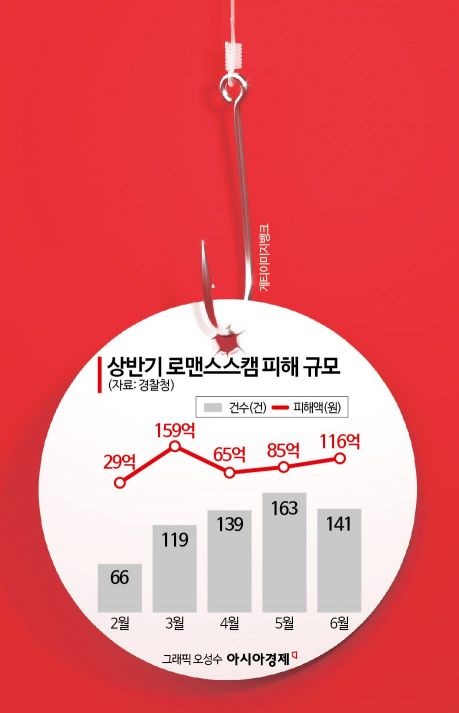
Romance scams exploit modern societal characteristics such as the increase in single-person households and the development of SNS. Perpetrators typically post fake photos and fabricated backgrounds on their profiles to gain trust and identify targets. They then engage in long-term messaging, developing an 'online romantic relationship,' and begin demanding money under various pretexts. The scammers often impersonate trustworthy professions such as soldiers, international students, or entrepreneurs, but avoid phone or video calls, communicating only via text to conceal their identities.
Although romance scams have become a prominent new form of cybercrime, investigative agencies still face difficulties in protecting victims. Unlike voice phishing, romance scams do not fall under the current legal definition of 'telecommunication financial fraud.' Therefore, temporary measures such as freezing scam-related accounts are not possible.
The current Act on the Refund of Telecommunications Fraud Damage excludes acts that 'masquerade as the supply of goods or provision of services' from telecommunication financial fraud. Recently evolved romance scam tactics often involve sending goods and then requesting payment for shipping or customs clearance fees, which is considered a transaction involving goods. This clause prevents freezing of scam-related accounts. Jang Bo-eun, head of the International Crime Investigation Division at the Seoul Metropolitan Police Agency, said, "With the emergence of this new crime called romance scam, the existing clause in the telecommunications fraud refund law makes it difficult to protect victims," adding, "We believe legal amendments are needed to specifically include romance scams."
However, experts also express concerns that broadly allowing account freezing measures could cause 'reverse damage.' Attorney Kwak Jun-ho of Law Firm Cheong explained, "In principle, freezing someone else's bank account requires a court decision, but in urgent cases like voice phishing, quick measures such as freezing accounts are allowed to prevent further damage. If such measures are broadly permitted without court oversight, it could be exploited by other crimes." He added, "It seems more important for government authorities to publicize the scam methods of romance scams and prevent further victimization."
Heo Min-sook, a legislative researcher at the National Assembly, said, "I agree with concerns that broadly allowing account transaction suspensions could cause other damages. However, doing nothing amid legislative gaps is problematic. Creating specific provisions addressing the types of scams in romance scams could be a viable approach," she advised.
© The Asia Business Daily(www.asiae.co.kr). All rights reserved.


















