"Amendments to the Capital Markets Act, Including Improvements to Merger Ratio Calculation Methods, Are Sufficient"
The Korea Economic Association and the presidents of 16 major domestic groups including Samsung, SK, Hyundai Motor, and LG issued an emergency statement for the first time in nine years. They requested the suspension of legislative discussions on the Commercial Act amendment proposed by the Democratic Party of Korea. They strongly opposed the amendment, expressing concerns that key provisions such as the expansion of directors' duties related to shareholder interests, separate election of audit committee members, and mandatory cumulative voting could cause significant disruptions to overall corporate management if codified into law.
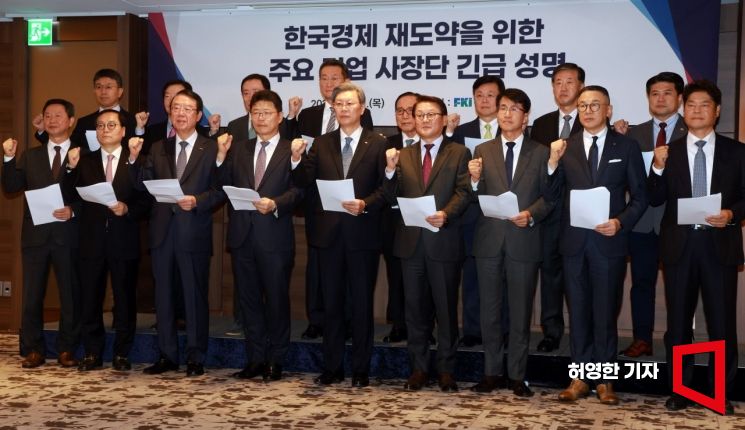 Hosted by the Korea Economic Association, the "Urgent Statement by CEOs of Major Companies for the Rejump of the Korean Economy" was announced on the 21st at Lotte Hotel in Seoul. After the reading of the statement by Kim Chang-beom, Executive Vice Chairman (fifth from the left in the front row), the attending CEOs posed for a commemorative photo with a fighting pose. Photo by Heo Young-han
On the 21st, the Korea Economic Association held a press conference at Lotte Hotel in Sogong-dong, Jung-gu, Seoul, where 16 presidents from major companies including Samsung, SK, Hyundai Motor, and LG jointly announced the "Emergency Statement of Major Companies for the Re-advancement of the Korean Economy." Attendees included Park Seung-hee, President of External Cooperation (CR) at Samsung Electronics; Lee Hyung-hee, President and Chairman of the Communication Committee at SK Supex Council; Kim Dong-wook, Vice President of Hyundai Motor Company; Cha Dong-seok, President of LG Chem; and Lee Dong-woo, Vice Chairman of Lotte Holdings, among other executives from the 16 groups.
The presidents expressed concerns that "if the amendment to the Commercial Act, which includes the expansion of directors' fiduciary duties, passes, many companies will suffer from excessive litigation and attacks by foreign speculative capital, making it difficult to operate boards of directors normally and causing significant difficulties in discovering new growth engines." They emphasized, "Corporate competitiveness will inevitably be severely damaged, ultimately leading to a value-down of our stock market."
Kim Chang-beom, Executive Vice Chairman of the Korea Economic Association, explained, "It is unusual for the presidents of 16 groups to jointly express their position, but this is because they judged the amendment to the Commercial Act as a critical issue for the Korean economy."
Previously, the Democratic Party of Korea proposed an amendment to the Commercial Act adding that "directors must protect the interests of the majority shareholders and treat the interests of all shareholders fairly," and adopted it as party policy. While the intent is to clarify directors' responsibilities and strengthen shareholder protection, companies strongly oppose it, arguing that it could increase legal disputes and risks of management rights infringement.
The presidents declared full opposition to the three key provisions of the Commercial Act amendment?expansion of directors' duties related to shareholder interests, separate election of audit committee members, and mandatory cumulative voting?citing concerns that these could cause significant disruptions to overall corporate management.
While acknowledging the need to improve systems to protect minority shareholders during corporate restructuring, they argued that targeted improvements under the Capital Markets Act would be more appropriate than amendments to the Commercial Act.
Vice Chairman Kim stated, "We must protect the interests of minority shareholders who could be harmed by specific issues by changing the merger ratio calculation method to reflect actual value. The expansion of directors' fiduciary duties and the majority shareholder interest protection provisions included in the Democratic Party's amendment should be excluded from legislative discussions."
The business community and financial investment sectors unanimously voiced that regulating external forces' intervention in directors' major decision-making authority through the basic law (Commercial Act) is excessive. They expressed concerns that an increase in damages lawsuits and audit committees dominated by external forces aligned with their interests would narrow directors' scope of management activities. They warned that even the board's inherent authorities such as asset disposal and transfer, borrowing, appointment and dismissal of key executives, and establishment or relocation of branches could be infringed upon.
Yoo Jung-joo, Corporate System Team Leader at the Korea Economic Association, said, "If the amendment to the Commercial Act materializes, there will be a massive wave of damages lawsuits against the board and rampant accusations of breach of trust. This will not only restrain the current board's management decisions but also cause difficulties in future board appointments, severely disrupting management."
They also noted that the risk of management rights infringement could increase not only from minority shareholders but also from activist funds and institutional investors. Song Seung-hyuk, Financial Industry Team Leader at the Korea Chamber of Commerce and Industry, said, "The expansion of directors' fiduciary duties would generally enable direct shareholder claims against directors, which are currently recognized only in a limited way under the existing Commercial Act. With directors' fears growing, unreasonable demands from small shareholders as well as activist funds will increase, making it difficult for the board and even the general shareholders' meeting to reject such demands."
The business community is urging the opposition parties to withdraw the Commercial Act amendment, labeling it a "runaway amendment." Earlier on the 14th, eight economic organizations (Korea Economic Association, Korea Chamber of Commerce and Industry, Korea International Trade Association, Korea Federation of SMEs, Korea Employers Federation, Korea Federation of Medium-sized Enterprises, Korea Listed Companies Association, and KOSDAQ Association) warned that the amendment law could become a "runaway promotion law" that allows foreign speculative capital to aggressively seize management rights of domestic companies. The eight organizations stated, "Premature amendment of the Commercial Act will lead to excessive litigation against directors and be exploited as a tool for foreign speculative capital to attack management rights, severely damaging the competitiveness of domestic companies as a 'foreign speculative capital runaway promotion law.'"
© The Asia Business Daily(www.asiae.co.kr). All rights reserved.

















