New Medical Device Market Immediate Entry Support Measures
Strengthening Safety Through Clinical Evaluation in Approval Process
Device Classification Assigned After 3-Year Evaluation of Immediate Entry
The government has introduced a comprehensive reform plan to accelerate the market entry of new innovative medical devices. Starting from the second half of next year, the approval period will be reduced by more than one year to allow new devices to enter the market immediately, while enhancing safety through clinical evaluation. Mechanisms will be put in place to remove problematic devices from the market, and if the need for introduction is significant, health insurance coverage will be applied quickly to reduce the burden on patients.
 The scene of the '2024 MediExpo Korea' held at EXCO in Buk-gu, Daegu. Unrelated to the article content. Photo by Yonhap News.
Keeping Pace with the Rapid Development of Medical Devices
The Ministry of Health and Welfare, the Ministry of Food and Drug Safety, and the Office for Government Policy Coordination announced on the 21st, during the 49th Ministerial Meeting on National Issues chaired by Prime Minister Han Duck-soo, that they discussed the 'Improvement Plan for Market Entry Procedures of New Medical Devices' and established a 'System for Immediate Market Entry of Medical Technologies.'
The government previously had an advanced entry system for new medical technology evaluation to support the market entry of new medical devices. This system allowed medical devices to be used in the field for a certain period before undergoing new medical technology evaluation to verify safety and efficacy. After passing this evaluation, decisions were made on whether to support the device through health insurance, finalizing coverage and non-coverage.
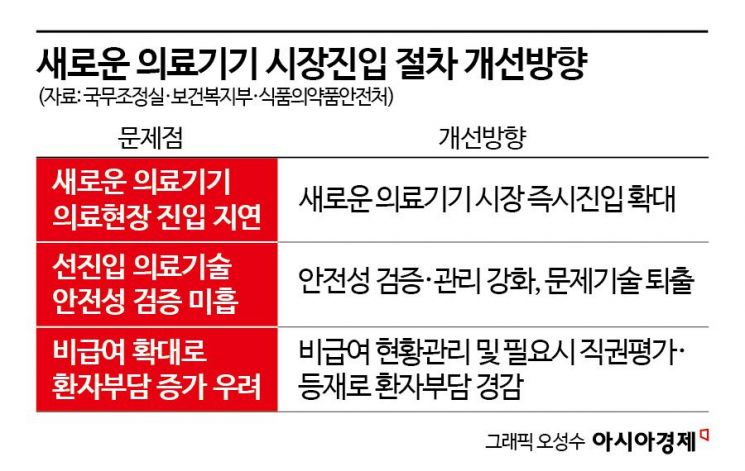
However, this system had limitations such as not keeping up with the speed of development of new and diverse medical devices, insufficient safety verification during the advanced entry period, and increased patient burden due to devices being used as non-covered items during this period. Jeong Byung-gyu, Director of Regulatory Innovation Planning at the Office for Government Policy Coordination, explained, "Because safety guarantees were weak, the system was insufficient, including restrictions on items allowed for advanced entry."
In response, the government has improved the entire process including medical device approval, new medical technology evaluation, and health insurance listing, and introduced a new system for immediate market entry of medical technologies. Specifically, three improvement directions were established: ▲expanding immediate market entry for new medical devices ▲strengthening safety verification and management, and removing problematic technologies ▲managing non-covered items and, if necessary, conducting ex officio evaluation and listing to reduce patient burden.
Oh Sang-yoon, Director of Medical Resource Policy at the Ministry of Health and Welfare, said, "As Korea's technological capabilities improve, technologies developed for the first time domestically are emerging. Companies developing these technologies must conduct clinical trials domestically, but there were barriers, which led to the advanced entry system." He added, "We have prepared a system where health insurance coverage is applied after sufficient clinical verification during the advanced entry period."
Reviewing Over 140 Items for Implementation in the Second Half of Next Year
The government will promote the market entry of new medical devices where industry difficulties are high and rapid utilization of technological benefits is necessary. For innovative devices that did not previously exist, immediate market entry for three years will be allowed without separate procedures. Approximately 140 items are being reviewed for immediate entry, including digital therapeutics, in vitro diagnostic medical devices, artificial intelligence (AI) diagnostic support devices, and medical robots.
Seong Hong-mo, Director of Medical Device Policy at the Ministry of Food and Drug Safety, explained, "Digital therapeutics are products that help people with cognitive or physical activity impairments improve through training via apps. AI diagnostic support devices are products that statistically indicate suspected lesions or the possibility of disease occurrence, and these will be applied first in this system."
Additionally, the approval process and existing technology verification period before immediate market entry will be integrated and shortened. The period, which previously took up to 490 days, will be reduced to within 140 days at most and within 80 days at minimum. The government plans to provide pre-consultation to interested companies to help shorten this period before market entry.
Since medical devices will be used immediately in the market, safety evaluation at the approval stage before immediate entry will also be strengthened. Clinical evaluation will be conducted before approval, comprehensively analyzing clinical trials, experience, and literature according to international standards. The government plans to specify target diseases and usage methods during this approval process. Furthermore, side effects and accidents will be continuously monitored, and technologies with high risk levels will be subject to suspension of use.
To reduce patient burden caused by the expansion of non-covered items, the government will monitor the usage status of non-covered immediate entry technologies semiannually. If clinical importance is high or cost burden is significant, and patient burden reduction is deemed necessary, new medical technology evaluation will be conducted early during the immediate entry period (3 years) either upon company application or ex officio, to decide on health insurance coverage.
After the immediate entry period ends, the technology will be classified into grades based on a comprehensive reassessment of its value through new medical technology evaluation. If the grade is low, the technology may naturally be phased out from the market. The government plans to inform the public about technology usage status and clinical necessity, and apply health insurance coverage to excellent technologies to reduce patient burden.
Director Jeong emphasized, "The great significance of this reform is that a comprehensive improvement plan has been presented covering the entire process from medical device approval to actual hospital use and health insurance listing." He also noted, "There are many improvements needed in the Medical Service Act, Medical Device Act, and subordinate laws. Preparations are underway to implement the new system from the second half of next year."
© The Asia Business Daily(www.asiae.co.kr). All rights reserved.
![Clutching a Stolen Dior Bag, Saying "I Hate Being Poor but Real"... The Grotesque Con of a "Human Knockoff" [Slate]](https://cwcontent.asiae.co.kr/asiaresize/183/2026021902243444107_1771435474.jpg)

















