The Korea Institute of Energy Research (hereinafter KIER) announced on the 21st that Dr. Kim Woo-yeon’s research team from the Hydrogen Research Group has developed a new concept nickel-cobalt composite catalyst that accelerates the production and commercialization of turquoise hydrogen.
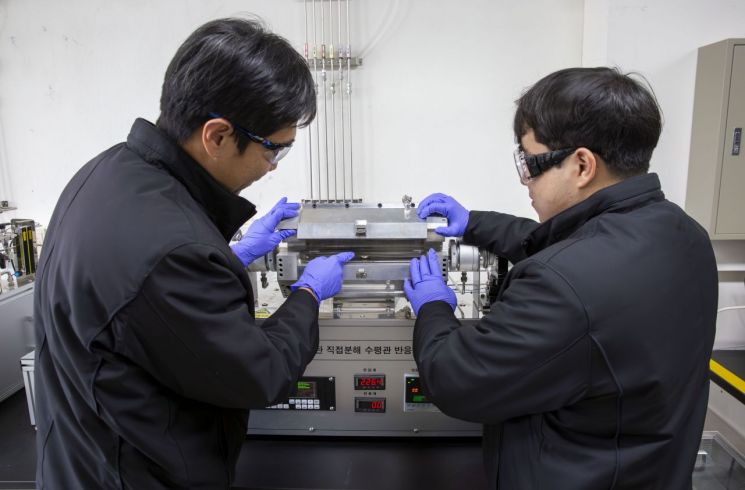 Dr. Kim Woo-yeon’s research team is experimenting with methane thermal decomposition reactions using a nickel-cobalt composite catalyst. Provided by Korea Institute of Energy Research
Turquoise hydrogen is a technology that produces hydrogen and carbon by decomposing hydrocarbons such as methane (CH4), with the advantage of no carbon dioxide emissions during the hydrogen production reaction process.
In 2021, the government announced a plan to supply 28 million tons of clean hydrogen domestically by 2050 through the ‘1st Hydrogen Economy Implementation Basic Plan.’ Recently, hydrogen research has been actively conducted focusing on hydrogen production methods that can reduce greenhouse gases.
Clean hydrogen refers to hydrogen that contributes to carbon neutrality by maintaining greenhouse gas emissions during the production process below a certain level. Currently, in Korea, hydrogen is recognized as clean hydrogen if the greenhouse gas emissions are 4 kg or less per 1 kg of hydrogen produced.
Turquoise hydrogen is a type of clean hydrogen produced by decomposing methane, the main component of natural gas, at high temperatures to produce hydrogen and solid carbon. Although hydrogen is produced based on fossil fuels, the biggest advantage of turquoise hydrogen is that no carbon dioxide is emitted during the production process, allowing clean hydrogen production without a separate carbon dioxide capture and storage process.
However, the commercialization of turquoise hydrogen technology has been delayed due to the heat supply issues required for the reaction. Nickel- and iron-based catalysts are mainly used for turquoise hydrogen production, but they have low reactivity at low temperatures. Therefore, to stably produce turquoise hydrogen, a high temperature of around 900 degrees Celsius must be maintained, and there are also few ways to utilize the carbon produced along with hydrogen after the reaction.
To overcome these catalyst drawbacks, the research team developed a new concept catalyst by adding cobalt to a nickel-based catalyst. The newly developed catalyst enables hydrogen production at higher efficiency at lower temperatures compared to existing catalysts.
For example, cobalt is used as a catalyst in the production of carbon-based products to enhance electrical activity and improve durability. Based on this, the research team added cobalt to the existing nickel catalyst and conducted experiments to optimize the content and ensure reproducibility, confirming that the highest hydrogen productivity was achieved at a ratio of 8% nickel and 2% cobalt.
The developed catalyst showed more than 50% higher hydrogen productivity than previously developed catalysts within the first 30 minutes of activation even at a low temperature of 600 degrees Celsius. Additionally, while the initial activation maintenance time of existing catalysts is 90 minutes, the catalyst developed by the research team maintained initial activation for 150 minutes, which is 60% longer than the existing one.
Initial activation refers to the active state observed immediately after the catalyst reaction begins and serves as the primary indicator in evaluating catalyst candidates. The higher the initial activation reactivity and the longer the maintenance time, the better the catalyst is evaluated.
The research team also confirmed the formation of carbon nanotubes on the catalyst surface after the reaction. Carbon nanotubes are materials widely used in electrode materials for secondary batteries and construction materials, showing the potential to produce high value-added carbon materials alongside hydrogen production.
Dr. Kim Woo-hyun said, “This research result is a groundbreaking achievement that can simultaneously produce hydrogen and carbon nanotubes, satisfying both productivity and economic feasibility. The research team plans to focus on developing mass production technology applying the developed catalyst and conducting performance evaluations to secure core material technology and reaction system design technology.”
Meanwhile, this research was conducted with the support of the basic project of the Korea Institute of Energy Research. The research results were published this month in ‘Fuel Processing Technology,’ a globally renowned journal in the field of chemical engineering.
© The Asia Business Daily(www.asiae.co.kr). All rights reserved.

















