No Consideration of Supreme Court Filing
As the 'Ordinance on Supporting the Revitalization of Village Education Communities in Gyeongnam' was finally abolished, Park Jong-hoon, Superintendent of Gyeongnam Office of Education, expressed his feelings, saying it was "devastating."
After the plenary session ended, Superintendent Park immediately held a press conference in the briefing room of the provincial Office of Education, stating, "The greatest pillar supporting the education that saves our children's future, the region, and the villages has been completely cut off."
He also said, "It is neither reasonable nor common sense that the ordinance was abolished just three years after its enactment and barely three months after its revision."
However, he expressed that he would not file a lawsuit with the Supreme Court.
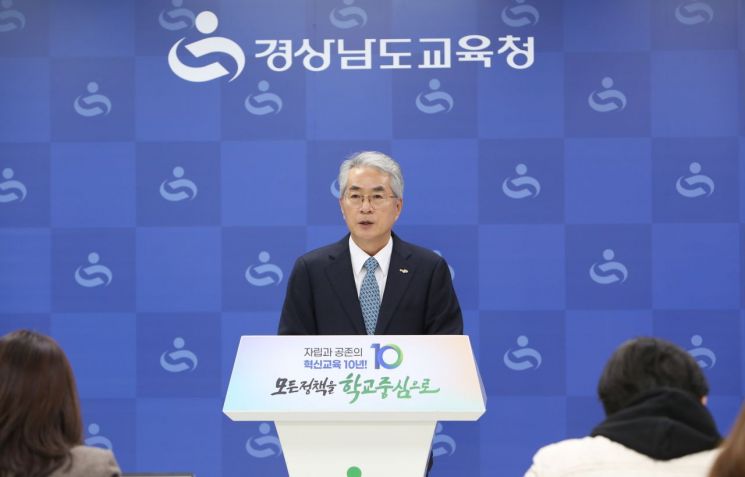 Park Jong-hoon, Superintendent of Education of Gyeongnam, is expressing his position on the final abolition of the ordinance supporting the activation of the Gyeongnam village education community. Photo by Lee Se-ryeong
Superintendent Park said, "There was no procedural legitimacy to be found in the decision of the Provincial Council," and added, "Instead, I only saw actions that go against global educational trends, contradict the direction of South Korea's educational policies, show indifference to the efforts of other provinces, and retreat from future education for children."
He criticized the ruling party in the Provincial Council, the People Power Party, for deciding to support the ordinance's abolition as a party stance before the plenary session and announced plans to make this a nationwide issue.
He said, "It is precisely uneducational and a violation of the political neutrality of education to abolish an ordinance for the future of education for children as a party stance," and added, "I will ask whether the central party shares this view and make this issue national."
Regarding the claim made by pro-abolition council members during the ordinance debate that even if the ordinance is abolished, the projects would not be canceled but could be operated by local governments directly managing the budget, he strongly criticized this as well.
Superintendent Park said, "If you think badly, it can be interpreted as taking good projects away from the Superintendent and giving them to mayors and county heads, transferring the Office of Education's projects to local governments," and sharply criticized, "Saying that the projects can continue without the ordinance greatly undermines the value of the ordinance as a law and local regulation."
He also said, "We will never let this pass as it is," and "We will fight until the council raises their hands."
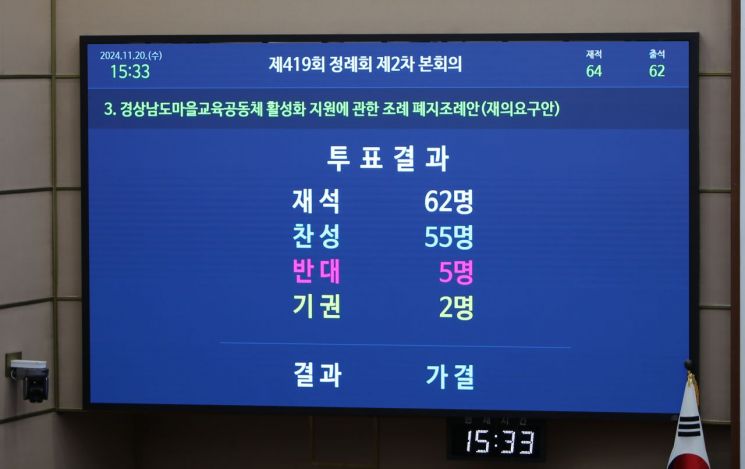 The ordinance on supporting the revitalization of the Gyeongnam Village Education Community has been abolished. Photo by Se-ryeong Lee
The Ordinance on Supporting the Revitalization of Village Education Communities in Gyeongnam was enacted in July 2021 to create an educational ecosystem where schools, villages, the Office of Education, and local governments in the community cooperate and unite. It served as the legal basis for budget management related to operating future education districts, establishing and running Happy Village Schools, and supporting educational cooperatives.
However, controversies arose over the violation of educational neutrality due to village instructors declaring support for Superintendent Park during his candidacy, the involvement of a person linked to the so-called Changwon Spy Group incident as a village instructor, the implementation of ideological and value education, inadequate hiring and management standards to secure instructor expertise, and children's safety issues.
The ordinance abolition bill was passed at the first plenary session of the 418th extraordinary session of the Gyeongnam Provincial Council on the 15th of last month. After Superintendent Park requested reconsideration, it was put to a vote again but ultimately was not reinstated.
On the 20th of this month, at the second plenary session of the 149th extraordinary session, the abolition was confirmed by a secret ballot with 55 votes in favor, 5 against, and 2 abstentions out of 62 members present.
Earlier, the provincial Office of Education proposed reform measures including adding provisions to maintain educational neutrality, revising and deleting politically charged terms in the ordinance, consulting local governments on regional village learning centers, and operating a permanent monitoring team. However, these were criticized as a belated response by the Provincial Council.
Superintendent Park personally visited education support offices across the province to gather opinions on the ordinance abolition, requested reconsideration, and tried to persuade council members to revive the ordinance. However, he was ultimately unable to convince them amid criticism that the reform measures were not properly implemented.
© The Asia Business Daily(www.asiae.co.kr). All rights reserved.


















