Mayor Lee Wan-seop: "Will Strive to Fully Restore Historical Landscape"
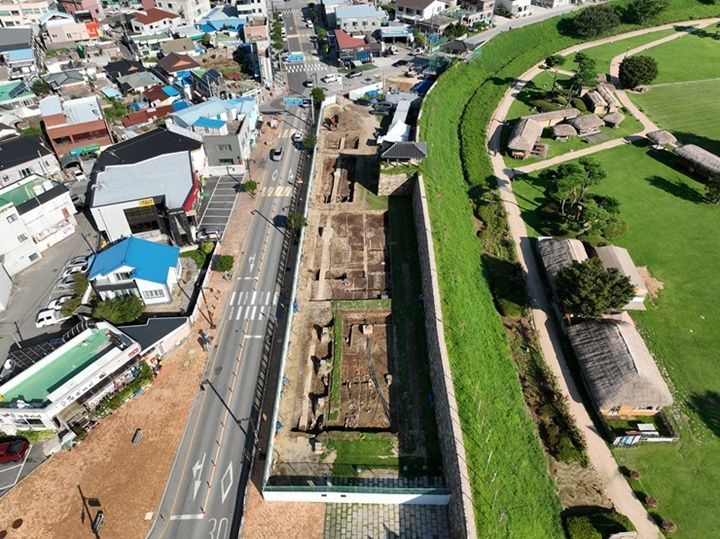 The moat of Jinnammun Gate at Haemieupseong Fortress in Seosan, Chungnam, excavated for restoration. /Seosan City
The construction methods and detailed status of the defensive facility, the haija (moat), at Haemieupseong Fortress in Seosan, Chungnam?which served as the command post for all military forces in Chungcheong Province during the Joseon Dynasty?have been revealed through an excavation survey.
On the 19th, Seosan City announced that it held the final report meeting for the 'Excavation Survey of the Jinnammun Haija Section at Seosan Haemieupseong Fortress' in the main conference room of City Hall, where the results were shared and restoration plans were discussed.
More than 20 people attended the report meeting, including Mayor Lee Wan-seop of Seosan, Lee Kyung-bok, Head of Research at the Chungnam Institute of History and Culture, Lee Chang-ho, Head of the Survey and Research Division, and members of the Seosan City Council.
Lee Chang-ho, Head of the Survey and Research Division, presented the results of the excavation survey of the haija section, which was constructed on flat land near Jinnammun, the main gate of Haemieupseong Fortress.
The cross-section of the haija is nearly vertical and built with stacked stones, with both inner and outer walls identified. It is constructed about 9 to 15 meters away from the fortress wall, with a width of 3.7 to 4 meters and a depth of 1.8 to 2.5 meters.
Differences in the stones used for the walls in each section suggest that different construction methods were employed by section. It is believed to be a dry moat (ganhaeja) with a well-leveled base layer, but the topography indicates that water likely flowed through the area.
 Commemorative photo of attendees at the final briefing held on the 19th in the city hall conference room. /Seosan City
The construction period has been confirmed as after the fortress wall was built, but due to severe damage caused by modern and contemporary facilities, further investigation is needed to determine when the haija was filled in, according to the research team.
The excavation of the haija section was carried out to accurately assess the current state for restoration, following the discovery of the first and second construction phases of the Jinnammun haija during a 2016 trial survey conducted as part of the 2015 Haemieupseong Fortress Haija Restoration and Maintenance Plan.
To precisely identify the current status of the Jinnammun haija, a key reference for the original restoration, the city signed an agreement with the Chungnam Institute of History and Culture last October and conducted an excavation survey of 2,400 square meters of the haija section.
Mayor Lee Wan-seop said, "With the current status of the haija confirmed through this excavation, we now have a foundation for its future restoration. We will strive to fully restore the historical landscape of Seosan Haemieupseong Fortress, which served as the military and administrative center of the Chungcheong region during the Joseon Dynasty and represents Naepo culture."
Meanwhile, the city investigated the northern hill area and the haija in front of Jinnammun in 2005 and restored part of the northern haija section in 2013.
© The Asia Business Daily(www.asiae.co.kr). All rights reserved.