Only 33% of This Year's Legal Government Support Fund of 12 Trillion Won Distributed
National Health Insurance Finance to Turn Deficit in 2028... Health Insurance Premium Hike Inevitable
The government has failed to provide over 8 trillion won in statutory national treasury support funds to the National Health Insurance Service (NHIS) this year. Criticism is mounting that while the government is pouring massive health insurance finances to resolve the medical-policy conflicts and healthcare gaps triggered by the expansion of medical school quotas, it is neglecting its obligation to disburse the national treasury support funds.
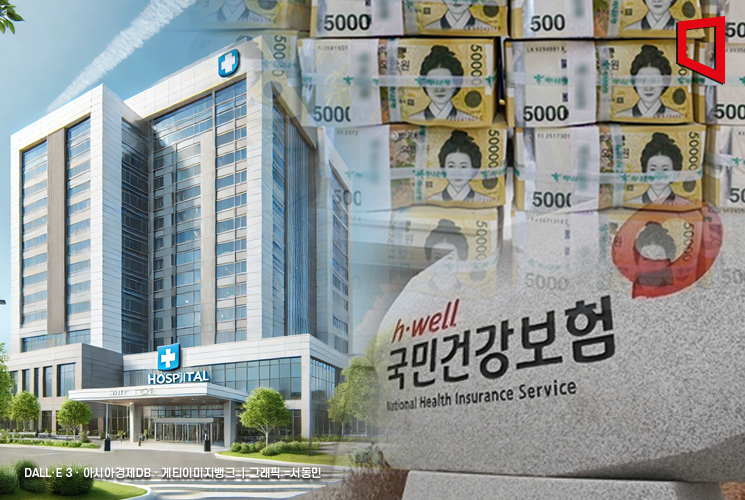
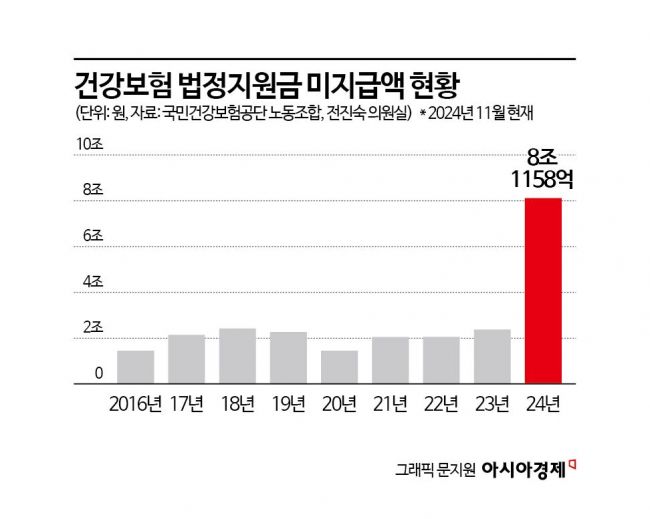
According to the NHIS Labor Union on the 21st, the government has disbursed a total of 4.05 trillion won in health insurance national treasury support funds in five installments this year.
Out of the total statutory health insurance support fund of 12.1658 trillion won that the government is supposed to pay to the NHIS in 2024, only 33% has been paid as of November, leaving an unpaid amount of a staggering 8.1158 trillion won. Although the government plans to disburse the unpaid amount by the end of the year, concerns remain that it will be difficult to pay the full amount due to the severe government fiscal deficit.
Based on the Health Insurance Act and the Health Promotion Act, the government has been required since 2007 to provide an amount equivalent to 20% of the expected health insurance premium revenue for the year to enable the NHIS to operate health insurance finances stably. Of this, 14% is funded from the general account (national treasury), and 6% is sourced from the Health Promotion Fund raised by tobacco taxes (cigarette burden charges). Accordingly, from 2007 through last year, the government was supposed to provide 135.9567 trillion won, equivalent to 20% of health insurance premium revenue, but the actual support amount was only 115.8674 trillion won. The unpaid statutory support funds over 17 years exceed 20 trillion won in total.
The NHIS labor union pointed out, "The government has again failed to properly disburse the national treasury support this year, and the budget proposal for next year allocates only 10.6211 trillion won, which is about 12.1%, instead of the statutory 14% support rate of 12.259 trillion won for health insurance national treasury support."
Moreover, if national treasury support is excluded from health insurance revenue, deficits continue every year. According to the '2023-2032 Health Insurance Financial Outlook' report published last year by the National Assembly Budget Office, the accumulated health insurance reserves will begin to be depleted starting in 2028, and by 2032, the cumulative deficit is expected to reach 61.6 trillion won.
If the government's national treasury support for health insurance decreases, insurance premiums paid by subscribers will inevitably have to increase. However, the government has frozen the health insurance premium rate at 7.09% for 2025, the same as this year. The Ministry of Health and Welfare explained, "Considering the ongoing high inflation, high interest rates, and the stable operation of health insurance finances, we decided to freeze the rate for the second consecutive year," but the medical community expects that since the premium rate has not been increased for two years, the increase in 2026 will be larger accordingly.
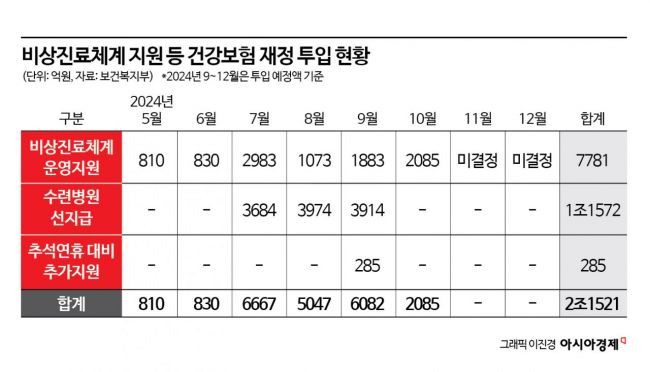
The bigger problem is that the government is using health insurance finances to manage the medical crisis. The cumulative health insurance funds injected from February to September for emergency medical system operations and advance payments to training hospitals facing management difficulties have already exceeded 2 trillion won, and the scale of funds is expected to increase further due to ongoing support projects for the restructuring of tertiary general hospitals.
Recently, the National Assembly Budget Office suggested in its 'Analysis of Resource Allocation by 12 Major Sectors in the 2025 Budget Proposal' report that "excessive use of health insurance finances to resolve the medical gap crisis could increase the burden on the public" and proposed considering the use of national treasury funds instead of health insurance finances.
The report pointed out, "When responding to the medical gap crisis and pursuing medical reform tasks, rather than excessively using health insurance finances, it is necessary to consider utilizing national treasury funds after the National Assembly's budget review process," and added, "It is necessary to establish government and related agency-level compensation plans for health insurance finances already used or planned to be used for medical gap response and medical reform, as well as appropriate measures to control the increase in health insurance expenditures."
© The Asia Business Daily(www.asiae.co.kr). All rights reserved.
![Clutching a Stolen Dior Bag, Saying "I Hate Being Poor but Real"... The Grotesque Con of a "Human Knockoff" [Slate]](https://cwcontent.asiae.co.kr/asiaresize/183/2026021902243444107_1771435474.jpg)


















