An international research institute has released a report stating that South Korea's level of climate change response ranks among the lowest, excluding oil-producing countries.
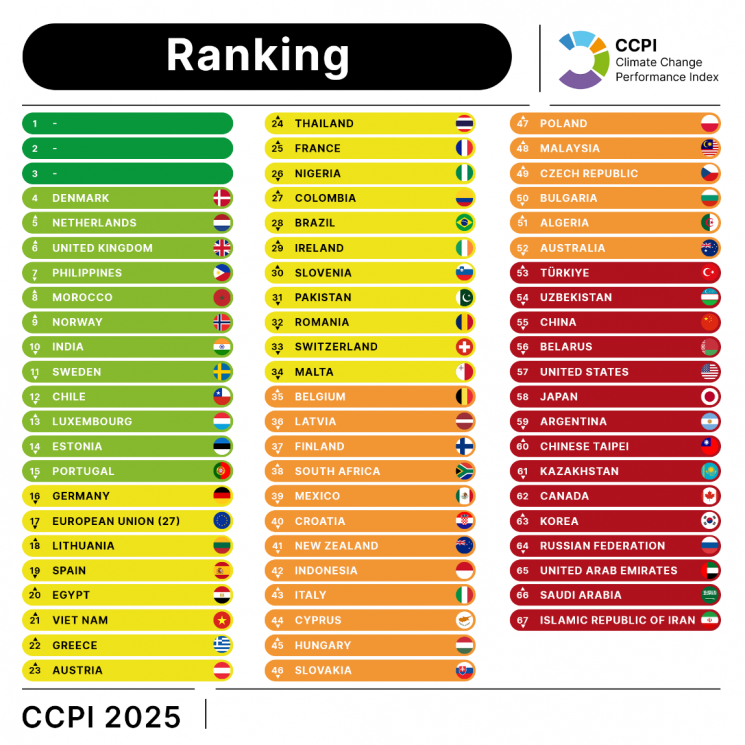
The German non-profit research institute Germanwatch, the climate research organization NewClimate Institute, and the global environmental group Climate Action Network announced on the 20th the Climate Change Performance Index (CCPI) for 64 countries, revealing that South Korea ranked 63rd.
The Climate Change Performance Index is an indicator created by evaluating each country's climate response in four areas: greenhouse gas emissions, renewable energy transition, energy use, and climate policy. It has been published annually since 2005, analyzing a total of 64 countries including the 63 comparable countries plus the European Union (EU). The top three ranks are left vacant to indicate that no country is currently on track to meet the Paris Climate Agreement goals, with rankings assigned from 4th to 67th place.
South Korea rose one step from 64th place last year but still remained in the bottom tier. Countries ranked below South Korea include Iran (67th), Saudi Arabia (66th), United Arab Emirates (65th), and Russia (64th), all oil-producing nations. Among countries that do not directly produce major greenhouse gas sources such as oil or gas, South Korea had the lowest score.
Among the categories, energy use ranked 64th, showing poor performance. Considering the need to limit global temperature rise to below 2 degrees Celsius, the report evaluated the South Korean government's 2030 energy use targets as insufficient. The greenhouse gas emissions category ranked 59th, the second lowest, followed by climate policy (57th) and renewable energy transition (50th).
The report explained, "South Korea is generally receiving low evaluations in renewable energy adoption and greenhouse gas emission reductions," suggesting "the need for comprehensive policy reforms." It also referenced the South Korean Constitutional Court's climate lawsuit ruling on August 29, stating that "(the court) pointed out that the absence of greenhouse gas reduction plans beyond 2030 infringes on the fundamental rights of current and future generations."
Jan Burck, Senior Advisor at Germanwatch, along with other report authors, noted, "South Korea's Nationally Determined Contribution (NDC) includes expanding the share of renewable energy to 70% by 2050 and gradually phasing out coal use," but added, "experts recommend that this target be revised to better align with the Paris Agreement and that coal and gas-based energy be phased out by 2035."
The report also gave a negative evaluation of the ‘Daewanggorae Project,’ a deep-sea gas field development project in the East Sea. It continued, "While South Korea's joining of the global methane pledge to reduce methane emissions by 30% compared to 2020 is commendable in international climate politics," it emphasized, "there are ongoing demands to halt funding and exploration of new oil and gas projects such as the Daewanggorae gas field."
Meanwhile, the country with the best 4th place ranking was Denmark. The Netherlands followed in 5th place, and the United Kingdom rose 14 places from 20th last year to 6th. The United States ranked 57th due to the lack of a federal government-level fossil fuel phase-out target and its massive greenhouse gas emissions. China was ranked 55th, receiving a "very low" rating in greenhouse gas emissions and energy use categories, placing it in the lower tier.
Janet Milongo, Senior Manager of Energy Transition at Climate Action Network, commented on the report, stating, "If any person or country is left behind in the (energy) transition, it will be perceived as climate injustice," adding, "This is a crucial time for the role of public finance in enabling a rapid, just, and equitable transition."
© The Asia Business Daily(www.asiae.co.kr). All rights reserved.
![Clutching a Stolen Dior Bag, Saying "I Hate Being Poor but Real"... The Grotesque Con of a "Human Knockoff" [Slate]](https://cwcontent.asiae.co.kr/asiaresize/183/2026021902243444107_1771435474.jpg)
















