Chin Han-gye "Suddenly a State Audit... Looking for Grounds to Attack"
Limitations of a 'Half-hearted Investigation' if Ruling Party Skips State Audit
Speaker of the National Assembly Woo Won-sik and the Democratic Party of Korea are pushing for a parliamentary investigation into the death of Chae Sang-byeong, while the ruling party, including the faction loyal to Han Dong-hoon (the "Chinhan" faction), is taking a lukewarm stance, waiting only for the investigation results from the High-ranking Officials' Crime Investigation Agency (PCA).
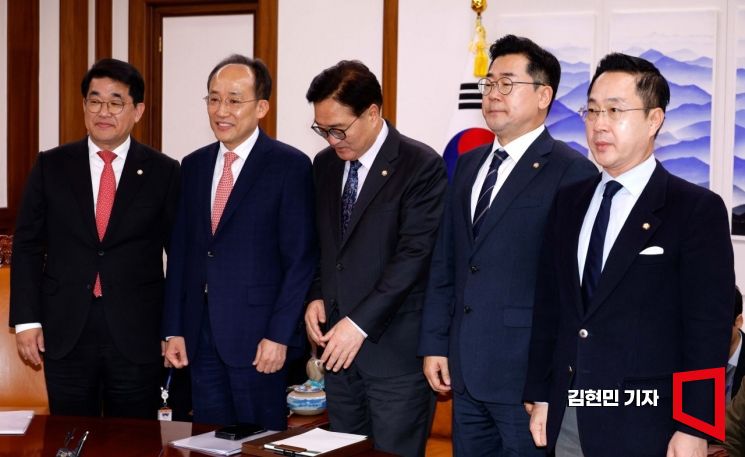 Speaker Woo Won-sik and the floor leaders of the ruling and opposition parties are meeting in the Speaker's office at the National Assembly on the 18th. From the left, Bae Jun-young, Senior Deputy Floor Leader of the People Power Party, Choo Kyung-ho, Floor Leader, Speaker Woo, Park Chan-dae, Floor Leader of the Democratic Party of Korea, and Park Sung-jun, Senior Deputy Floor Leader. Photo by Kim Hyun-min
A first-term lawmaker from the Chinhan faction said in a phone interview with Asia Economy on the 20th, "Suddenly pushing for a parliamentary investigation into Chae Sang-byeong seems like the Democratic Party, currently on the defensive, is looking for an opportunity to attack the People Power Party," adding, "There is no reason for Representative Han to respond to that. Since the PCA results have not yet come out, it is appropriate to wait for the results before discussing it."
Speaker Woo sent an official letter to both ruling and opposition parties the day before, asking for their opinions on the parliamentary investigation into Chae Sang-byeong. Earlier, People Power Party Floor Leader Choo Kyung-ho had expressed opposition to the parliamentary investigation pushed by Speaker Woo and the opposition party. After a meeting with the Speaker and the floor leaders of both parties on the 18th, he said, "The police investigation results have been released, the PCA investigation is ongoing, and related hearings and parliamentary audits have been conducted thoroughly in the relevant standing committees, so I cannot agree on the necessity of a parliamentary investigation."
>
People Power Party leader Han Dong-hoon has not issued a specific stance regarding the push for the parliamentary investigation into Chae Sang-byeong. When running for party leader, Han had pledged to promote a third-party special prosecutor law for Chae Sang-byeong. However, since taking office, Han has responded only by saying "there is no change in position" rather than actively pushing for the special prosecutor law.
As the ruling party shows opposition to the parliamentary investigation, the possibility of the opposition party pushing it forward alone has increased. Democratic Party Floor Leader Park Chan-dae said at the party's floor strategy meeting the day before, "We passed the special prosecutor law twice, but it was blocked by the president's opposition and failed. Time keeps passing, but we cannot keep delaying the parliamentary investigation," adding, "It is the National Assembly's duty to reveal the truth through a parliamentary investigation as soon as possible and to clear Chae Haebyeong's grievances."
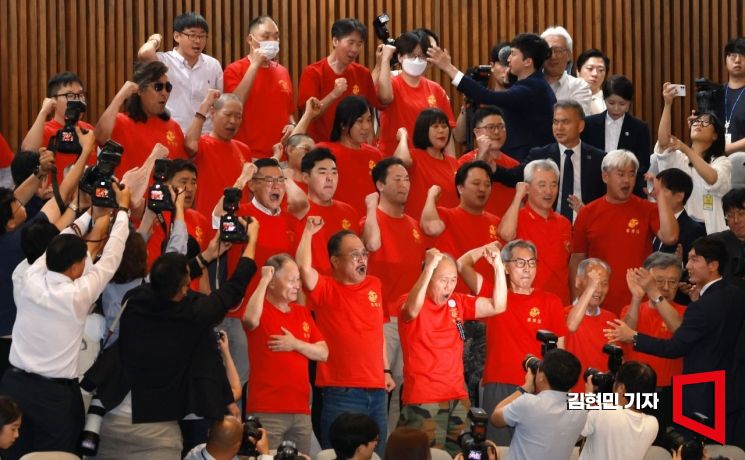 On the 25th, at the plenary session held in the National Assembly, members of the Marine Corps Reserve Corps protested by shouting slogans after the 'Special Prosecutor Law for Chae Sang-byeong' reconsideration bill was rejected. Photo by Hyunmin Kim kimhyun81@
According to the National Assembly Audit and Inspection Act, the National Assembly can conduct a parliamentary investigation through a special committee or a standing committee when requested by at least one-quarter of the total members. To this end, the Speaker consults with the representatives of each negotiation group to form an investigative special committee or refers the matter to a standing committee to finalize the investigative committee. The investigative special committee is composed according to the proportion of members from each negotiation group. If a particular negotiation group refuses to participate in the investigation, its members can be excluded. This is why an investigative special committee can be formed solely by the opposition party. Since the introduction of the parliamentary investigation system, the only case where a parliamentary investigation proceeded without bipartisan agreement was the 1999 International Monetary Fund (IMF) crisis.
If the investigative special committee is formed solely by the opposition party, the limitation of a "half-baked parliamentary investigation" may become apparent. Without the ruling party's cooperation in summoning witnesses and other matters, the effectiveness may be reduced. From the ruling party's perspective, it may also be burdensome to have only the opposition party's claims emphasized without their participation in the investigative special committee. A People Power Party official explained in a phone call, "The floor leadership will carefully devise a strategy, such as entering the investigative special committee to defend or not entering at all, and then decide."
© The Asia Business Daily(www.asiae.co.kr). All rights reserved.
![Clutching a Stolen Dior Bag, Saying "I Hate Being Poor but Real"... The Grotesque Con of a "Human Knockoff" [Slate]](https://cwcontent.asiae.co.kr/asiaresize/183/2026021902243444107_1771435474.jpg)

















