IMF Annual Consultation Results Announced This Year
Growth Rate Adjusted Reflecting Q3 Performance
Request for Response to Rapid Aging
"Active Sound Fiscal Policy Needed"
The International Monetary Fund (IMF) has downgraded its economic growth forecasts for South Korea for this year and next year. The projection for this year was lowered from 2.5% to 2.2%, and for next year from 2.2% to 2.0%. This adjustment reflects the weaker-than-expected third-quarter Gross Domestic Product (GDP) figures. The IMF assessed that there is high uncertainty surrounding South Korea's economic outlook and significant downside risks.
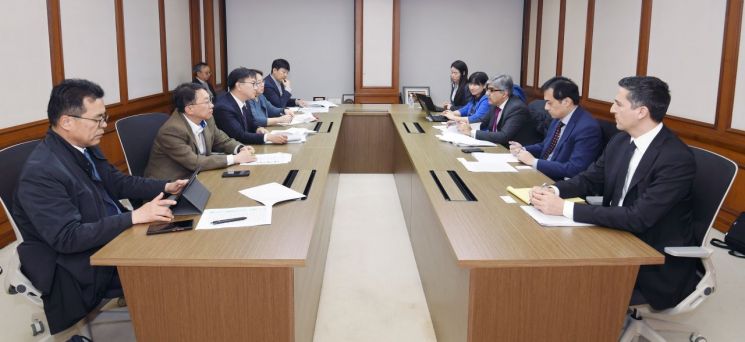 Kim Beom-seok, Vice Minister of Strategy and Finance (third from the left), is meeting with Rahul Anand, Head of the International Monetary Fund (IMF) Korea Mission, on the 19th at the Export-Import Bank of Korea in Yeongdeungpo-gu, Seoul. Photo by Ministry of Strategy and Finance
The IMF Korea Mission announced these results of this year’s IMF annual consultation at the Government Seoul Office on the 20th. The annual consultation is a meeting held every year under the IMF Articles of Agreement to review the overall economic situation of member countries, including macroeconomics, fiscal, and financial conditions. The mission, which arrived in Korea on the 7th for the consultation, met with key ministries such as the Ministry of Economy and Finance, Ministry of Trade, Industry and Energy, and Ministry of Land, Infrastructure and Transport, as well as the Bank of Korea, Financial Services Commission, Financial Supervisory Service, and private companies.
Rahul Anand, head of the IMF Korea Mission, said on the day, “(South Korea’s) economic growth this year is expected to reach 2.2%, partly offset by weak domestic demand recovery but supported by strong semiconductor exports.” He also explained, “As the economic growth rate converges to the potential growth rate and the output gap narrows, real GDP is projected to increase by 2.0% next year.”
The IMF had forecast South Korea’s economic growth at 2.5% for this year and 2.2% for next year last month, but lowered the growth rates by 0.3 percentage points and 0.2 percentage points respectively within about a month. A Ministry of Economy and Finance official said, “At that time, the third-quarter GDP results were not reflected, and the figures were lowered after including them this time.” The third-quarter real GDP growth rate released last month was 0.1%, significantly below the Bank of Korea’s August forecast of 0.5%.
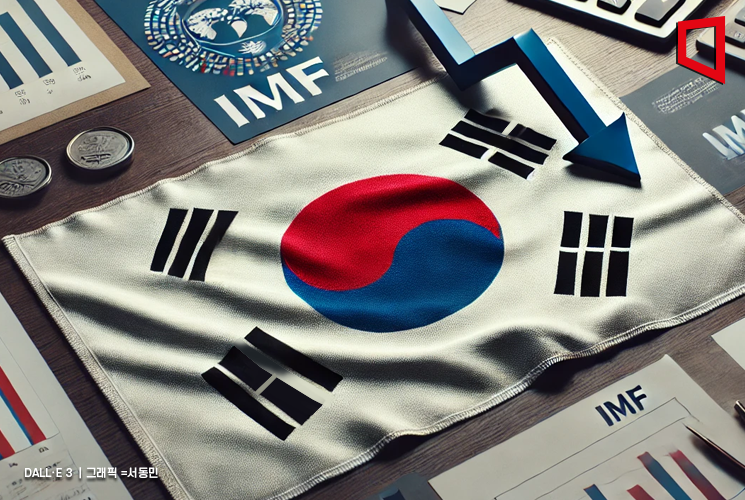
Anand stated, “Inflation fell by 1.3% year-on-year in October, and is expected to approach the target level of 2.0% next year,” adding, “There is high uncertainty surrounding the economic outlook, and the risks are tilted more toward the downside.” He also evaluated, “Although inflation is approaching the Bank of Korea’s target of 2%, considering the high uncertainty, a gradual normalization of monetary policy seems appropriate.”
Regarding foreign exchange market intervention, he said, “It should be conducted only in cases to prevent disorderly market conditions and should be limited.” He noted, “The government’s budget plan for next year, which maintains a sound fiscal stance and adjusts spending priorities, is appropriate,” but pointed out, “However, a more proactive sound fiscal stance will be necessary to prepare capacity to respond to long-term spending pressures.”
Anand welcomed “selective policy efforts to address real estate-related financial risks,” and mentioned, “Authorities should continue monitoring vulnerabilities and be prepared to take preemptive measures.” He added, “As monetary policy gradually normalizes, additional prudential measures may be considered if necessary.”
The IMF diagnosed that strengthening resilience in the changing global environment is a key task for the South Korean economy. Anand said, “Addressing labor force decline due to rapid aging, improving capital allocation efficiency, and enhancing productivity remain important tasks to expand growth potential,” adding, “Strengthening reforms in response to changing environments such as geopolitical fragmentation, technological changes, and climate change will also help enhance resilience.”
He also emphasized, “Strong economic policies are needed to strengthen resilience amid domestic and international environmental changes,” and stressed, “Maintaining South Korea’s competitiveness is key to responding to changes in the global trade environment.” Furthermore, he pointed out, “Policy priorities include strengthening innovation, diversifying supply chains, and promoting service exports.”
The IMF plans to prepare a report based on the results of this annual consultation and submit it to the IMF Executive Board after management approval.
© The Asia Business Daily(www.asiae.co.kr). All rights reserved.
![Clutching a Stolen Dior Bag, Saying "I Hate Being Poor but Real"... The Grotesque Con of a "Human Knockoff" [Slate]](https://cwcontent.asiae.co.kr/asiaresize/183/2026021902243444107_1771435474.jpg)

















