Response from Seoul Western Labor Office to Fan Complaints
"Equal Contracting Parties, Contractual Obligation Fulfillment Relationship"
The Ministry of Employment and Labor stated that it is difficult to consider Hani, a member of the group NewJeans, as a worker, and therefore the alleged bullying within the parent company HYBE does not constitute workplace harassment.
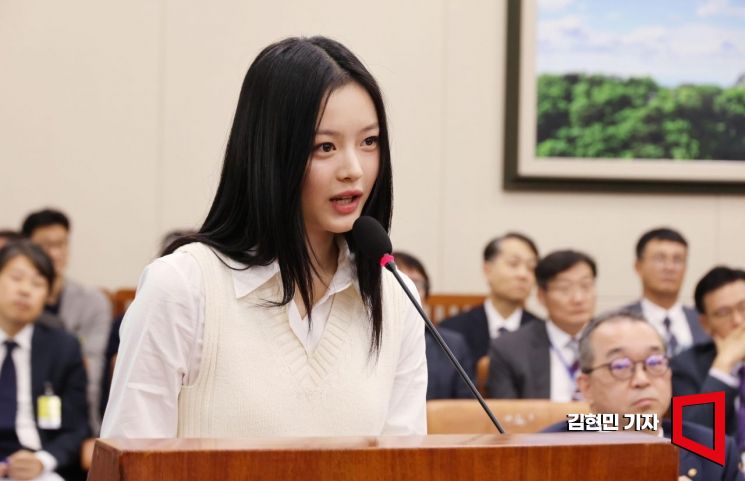 NewJeans' Hani is speaking as a witness at the Environment and Labor Committee's audit held at the National Assembly on the 15th. Photo by Hyunmin Kim kimhyun81@
On the 20th, the Seoul Western Branch of the Seoul Regional Employment and Labor Office of the Ministry of Employment and Labor announced regarding a complaint filed by NewJeans fans alleging that NewJeans member Palm Hani was subjected to workplace harassment, "The prohibition of workplace harassment applies only if the victim is a worker under the Labor Standards Act. After investigating the case, it was concluded that Palm Hani, an artist under ADOR, is difficult to be regarded as a worker under the Labor Standards Act, and the case was administratively closed."
NewJeans member Hani claimed during a YouTube live broadcast last September that while waiting in the hallway of the HYBE building, she greeted a passing celebrity and manager from another label, but the manager told her to "ignore" her.
After watching the video, a NewJeans fan filed a complaint with the Ministry of Employment and Labor through the National Petition System, stating, "The bullying allegations within HYBE against NewJeans must be thoroughly investigated for the truth."
The Seoul Western Branch of the Seoul Regional Employment and Labor Office, which investigated the complaint, stated, "Considering the content and nature of the management contract Palm Hani signed, it is difficult to regard her as a worker under the Labor Standards Act who provides labor for wages under a subordinate relationship."
The reason given was, "Hani’s activities are carried out freely with her consent or expression of will. It is merely a relationship where both parties, as equal contracting parties, fulfill their contractual obligations, making it difficult to see that there was any direction or supervision from the company."
Earlier, on the 13th, NewJeans members sent a certified letter to their agency ADOR demanding an apology for Hani and stating, "If the demands to correct violations of the exclusive contract are not accepted, we will terminate the exclusive contract."
Additionally, reasons cited included "the company’s employment rules and internal regulations or systems that apply to regular employees were not applied," "there are no fixed working hours or workplace, and commuting times cannot be set," and "the costs necessary for entertainment activities were jointly borne by the company and Palm Hani."
It was also pointed out that "the amounts paid to Hani are difficult to be seen as wages for labor but rather as profit sharing," "each party pays their own taxes and files business income tax instead of earned income tax," and "she bears the risks of profit and loss from entertainment activities herself."
The Western Branch concluded by referring to a Supreme Court ruling from September 2019, which stated that the nature of exclusive contracts for entertainers corresponds to civil law agency contracts or similar contracts of mandate, reaffirming that it is difficult to regard them as workers under the Labor Standards Act.
Last month, Hani appeared at a National Assembly audit hearing and tearfully testified, saying, "I became convinced that the company dislikes us (NewJeans)."
However, until now, the prevailing view has been that entertainers are not workers subject to the Labor Standards Act, which prohibits workplace harassment such as bullying.
Article 76, Paragraph 2 of the Labor Standards Act defines workplace harassment as "acts that use superiority in status or relationships at work to cause physical or mental pain beyond the appropriate scope of work to other workers or to worsen the working environment," and prohibits such acts.
To be subject to this, one must be a worker under the Labor Standards Act. Both courts and the government have judged since 2010 that entertainers are "exceptions" who sign exclusive contracts with agencies rather than being workers.
However, after Hani testified as a witness at the National Assembly’s Environment and Labor Committee audit, both ruling and opposition parties unanimously demanded improvements to the system to address the legal blind spots regarding artists’ "worker status," drawing attention to whether supplementary measures will be established in the future.
© The Asia Business Daily(www.asiae.co.kr). All rights reserved.
!["The Woman Who Threw Herself into the Water Clutching a Stolen Dior Bag"...A Grotesque Success Story That Shakes the Korean Psyche [Slate]](https://cwcontent.asiae.co.kr/asiaresize/183/2026021902243444107_1771435474.jpg)
















