③The Trump Administration's Unofficial Power Broker Is Musk
On the 6th (local time), just one day after the U.S. presidential election, President-elect Donald Trump received a congratulatory call from Volodymyr Zelensky, the President of Ukraine. Elon Musk, the 'entrepreneur' nominated as head of the Department of Government Efficiency (DOGE) in the second Trump administration, was present during the call. President Zelensky, who has been at war with Russia for nearly three years, reportedly expressed his gratitude to Musk for supporting Ukraine with Starlink services in his congratulatory message.
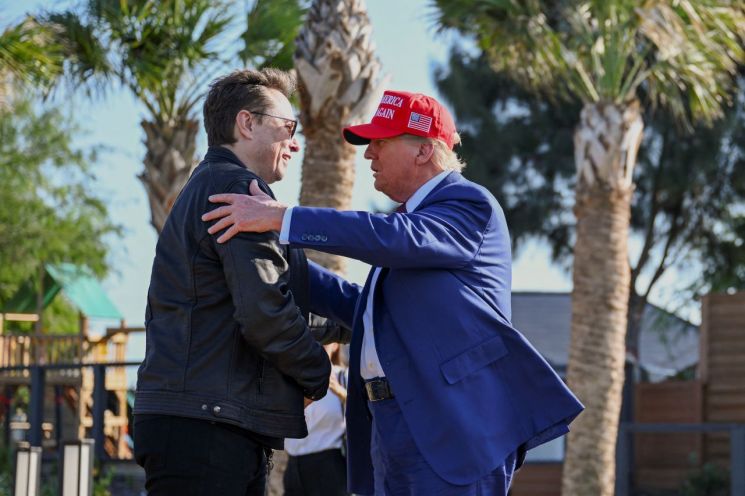 Elon Musk (left in the photo) and President-elect of the United States Donald Trump Photo by Reuters Yonhap News
Musk has effectively 'participated' in the Ukraine war from its early stages. Through the Starlink satellite communication service, small Ukrainian units were able to share real-time drone information and maintain communication in areas where mobile phone service was disrupted. However, Musk later expressed dissatisfaction with the costs incurred by SpaceX and cut off services in some areas, including the Crimean Peninsula, leading the U.S. Department of Defense to step in to cover the expenses.
As the world's richest entrepreneur, Musk's powerful influence in a globally watched war is a representative example. The biography of Musk released last September revealed encrypted text messages exchanged between him and Deputy Prime Minister Fedorov at the time. Nearly two years and nine months later, Musk is once again involved in the Ukraine situation as a key figure beside President-elect Trump, who holds real power in the U.S.
Musk: The Unofficial Power Behind the Trump Administration?
Musk has shown a different approach from typical entrepreneurs who 'do not publicly comment on or intervene in political and diplomatic issues.' He posted his political opinions on his social networking service (SNS) and intervened directly when necessary. In September 2021, he said, "I prefer not to get involved in politics," but by November 2022, ahead of the midterm elections, he changed his stance, recommending voting for the Republican Party considering the president was a Democrat. Experts analyze that Musk showed changes around the time he acquired the social networking service X (formerly Twitter).
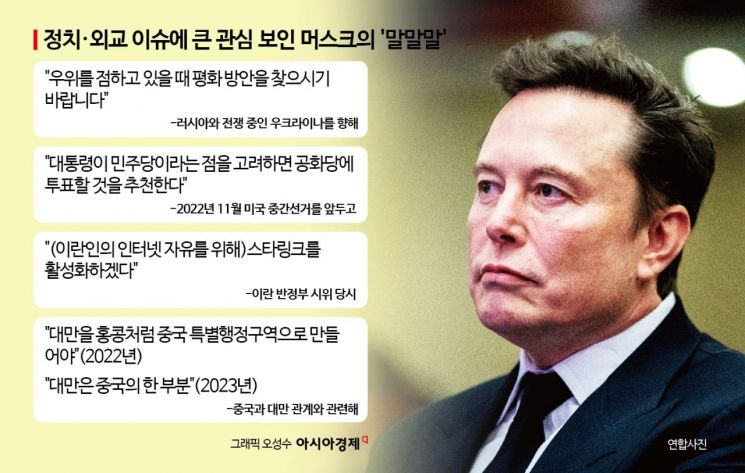
Operating on a global stage, Musk has always shown great interest in international affairs. In the year of the midterm elections, he entered the Ukraine war. When the Iranian government controlled the internet in some regions to suppress anti-government protests that same year, Musk posted that he would provide Starlink satellite internet services to Iran, drawing attention. When asked about Tesla's electric car factory in China, he sparked controversy by saying he wished Taiwan would be operated as a special administrative region like Hong Kong.
Now, effectively a government official, the world's perception of Musk is changing. There is a growing recognition that his outspoken opinions on geopolitical issues will practically influence U.S. foreign policy. His close presence beside President-elect Trump, who communicates with world leaders, further strengthens this perception.
The Wall Street Journal (WSJ) recently reported, citing multiple sources after Trump's election, that Musk has been secretly communicating regularly with Russian President Vladimir Putin since late 2022. They discussed not only business but also international political issues, and Putin reportedly requested Musk not to provide Starlink services for Taiwan. There were also reports of Iranian officials meeting with Musk to discuss Iran's nuclear program and improving relations with the U.S.
Both the Russian and Iranian governments denied these foreign media reports as "fake news" just one day after they surfaced. The U.S. Democratic Party responded by calling for a federal investigation into Musk, considering SpaceX's multi-billion-dollar contracts with the Department of Defense and U.S. intelligence agencies.
'Economic Diplomat' Musk Loved by Right-Wing Leaders
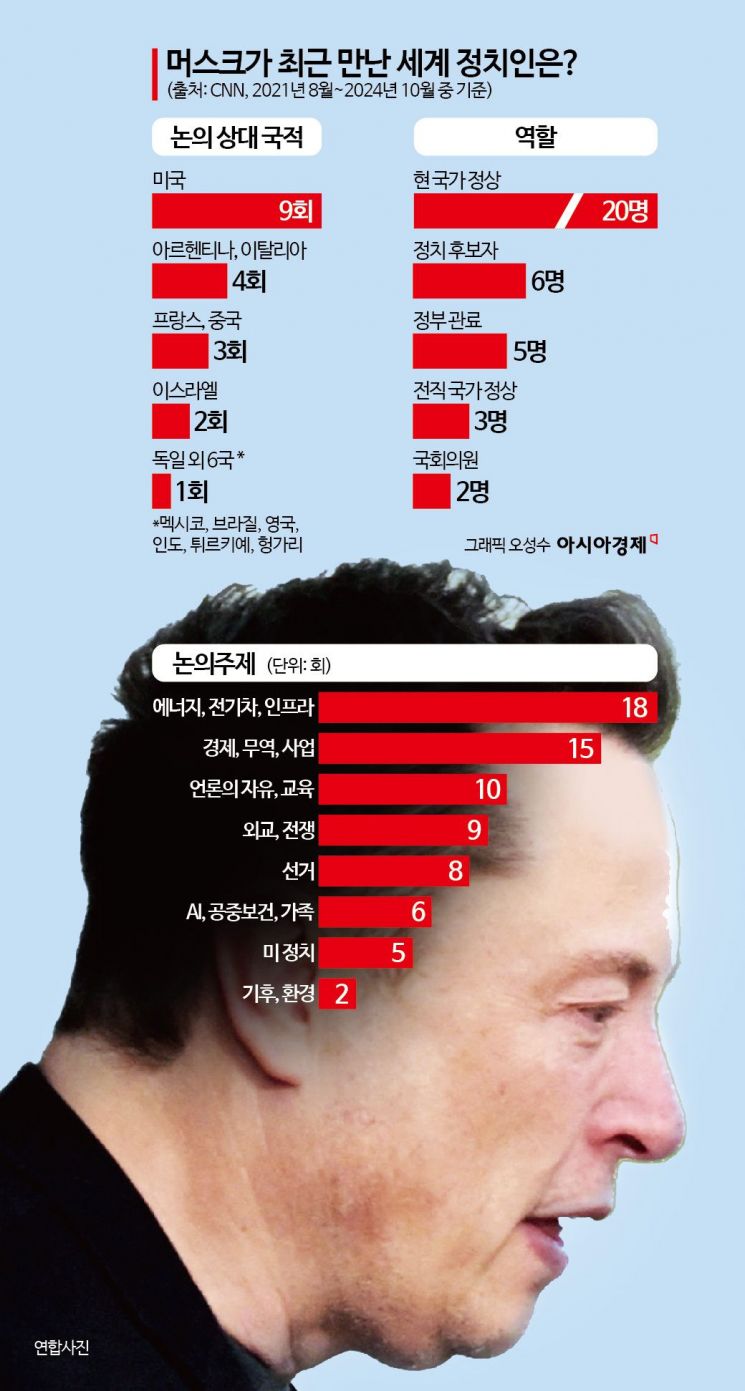
Over the past three years, Musk has met dozens of times with national leaders and politicians. CNN counted that from August 2021 to last month, Musk met or conversed at least 32 times with politicians from 13 countries, including the U.S. Among them were 20 sitting heads of state, 6 political candidates, as well as government officials, former heads of state, and members of parliament. Considering private meetings or calls were excluded, the actual number of Musk's encounters with politicians worldwide is likely higher. Musk reportedly discussed topics related to energy, electric vehicles, infrastructure, economy, trade, and business with these politicians.
James Lewis, director of the Strategic Technologies Program at the Center for Strategic and International Studies (CSIS), told CNN, "Musk is trying to become a global influencer. There seems to be a bigger purpose beyond just getting people to use X. Most CEOs avoid politics, but everything Musk does carries a political tone."
Musk has enjoyed communicating with national leaders. He actively leveraged his position and power as the head of global companies like Tesla, SpaceX, and X to connect communication opportunities to his own interests. Based on investment decisions or public endorsements desired by various leaders, he facilitated tariff reductions or the enactment of necessary legislation.
In particular, Musk strengthened relationships with right-wing national leaders such as Argentine President Javier Milei, expanding his political and business influence. He and President Milei, who is regarded as an 'extreme right-wing libertarian,' have publicly expressed mutual admiration on social media. The two are discussing investments related to lithium development, a key mineral for electric vehicle batteries. Even recently, after the presidential election, Musk praised President Milei's decision to reduce tariffs. Other leaders supported by Musk include Turkish President Recep Tayyip Erdo?an, Chinese President Xi Jinping, and Italian Prime Minister Giorgia Meloni.
The New York Times (NYT) described this as "Musk's Diplomacy," stating, "He courted right-wing world leaders to pursue his interests. When Musk shows support, many right-wing heads of state gain international prestige and promotional benefits."
Diplomatic Constraints Are Difficult Due to Musk's Company's Unique Technology and Influence
The reason entrepreneur Musk can communicate on equal footing with national leaders is not only due to his companies' financial power but also their technology and influence. Just as Starlink played a key role in the Ukraine war, it is believed that technologies from Tesla, SpaceX, and influence over public opinion through X give Musk significant leverage. Marietje Schaake, a researcher at Stanford University's Cyber Policy Center, told German public broadcaster Deutsche Welle, "The technology Musk possesses is very important and has tremendous influence in terms of access to information and geopolitics, and it is at a critical stage."
The government finds it difficult to simply ignore Musk's actions, given his years of building relationships with national leaders. In fact, the current U.S. administration under Joe Biden has reportedly faced awkward situations due to Musk's eccentric behavior and unilateral decisions but found it challenging to directly restrain him. Representative examples include Musk suddenly demanding Starlink usage fees during the Ukraine war and causing major turmoil after acquiring Twitter. The U.S. political media outlet Politico analyzed that Musk's close ties with China and Russia, which the U.S. seeks to counter, are also problematic for the government, and that the unique technological capabilities of Musk's companies make it difficult to impose diplomatic constraints on him.
© The Asia Business Daily(www.asiae.co.kr). All rights reserved.



















