Small and Medium Venture Business Research Institute, Seminar on 'US Presidential Election and SME Response Strategies'
Warning on Protectionism and Strengthened Regulations on China
Significant Impact on Semiconductor, Automobile, Battery, and Other Industries
With President Donald Trump successfully securing a second term in the 47th U.S. presidential election, export shocks are expected for small and medium-sized enterprises (SMEs) that heavily depend on the U.S. and China. Experts analyzed that expanding support for export companies and diversifying export destinations are necessary.
On the 19th, the Korea Institute of Startup & Entrepreneurship Development held a seminar titled "SME Response Measures According to the U.S. Election Results" at Lunamiele Parkview Hall in Yeouido, Seoul. The seminar featured presentations by Um Bu-young, a research fellow at the Korea Institute of Startup & Entrepreneurship Development; Kim Jong-deok, director at the Korea Institute for International Economic Policy; and Kim Jeong-hyun, senior researcher at the Korea Institute for Industrial Economics & Trade, followed by a comprehensive expert discussion.
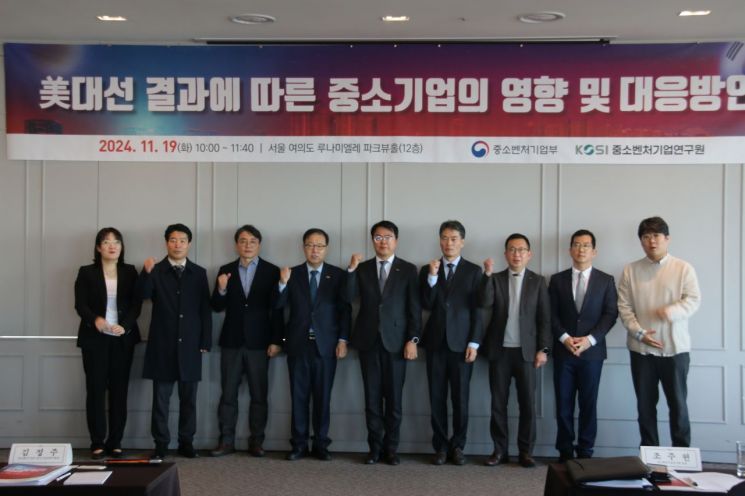 The Small and Medium Business Administration Research Institute held a seminar titled "Impact of the U.S. Presidential Election Results on Small Businesses and Response Strategies" on the 19th in Yeouido, Seoul. Photo by the Small and Medium Business Administration Research Institute
On this day, experts unanimously predicted that the "Trump 2nd term" administration would inevitably impact domestic SMEs. In particular, since Trump emphasized imposing high tariffs of up to 60% on Chinese goods, it is analyzed that the Chinese economy will contract, causing difficulties for domestic SMEs.
Research fellow Um explained, "Since 2017, during the first Trump administration, exports to China have gradually decreased," adding, "It appears that the U.S.'s strengthened sanctions against China contributed to the economic downturn in China. A similar pattern is expected."
Um identified three major industries likely to be severely affected in the future: semiconductors, automobiles, and batteries.
He said, "In the case of semiconductors, immediate sanctions will have limited direct impact on SMEs, but potential market entry plans for SMEs aiming to enter the U.S. may be jeopardized. If rules of origin are tightened in the future, SMEs in materials, parts, and equipment (SoBuJang) that heavily depend on China are expected to be affected."
He also predicted that the impact of sanctions on China would be greater on SMEs than on large corporations. Um explained, "An analysis of the 2018 tariffs imposed by the first Trump administration on China shows that due to China's economic slowdown and reduced imports of final and intermediate goods, SMEs experienced greater export fluctuations than large companies."
Kim Jong-deok, director at the Korea Institute for International Economic Policy, also expressed concerns about export declines for Korean companies due to tariff-centered protectionism.
Kim said, "Most countries with large trade surpluses with the U.S. have free trade agreements (FTAs) with the U.S., so Korea, which has an FTA with the U.S., may be included among countries subject to general tariffs. If the U.S. imposes general tariffs (20% on Korea, 60% on China), Korea's total exports could decrease by up to $44.8 billion (approximately 62.5 trillion KRW) in the worst-case scenario."
Kim Jeong-hyun, senior researcher at the Korea Institute for Industrial Economics & Trade, pointed out that the ripple effects caused by decreased exports of large corporations should also be considered an important factor. He analyzed, "In some industries such as metal products, chemicals, and automobiles, the damage caused by reduced exports of large corporations will be greater. If large corporations relocate production bases to the U.S. and procure intermediate goods locally, SMEs producing intermediate goods will suffer significant damage."
On this day, experts emphasized government response measures including ▲promoting market entry of startups and venture companies into the U.S. ▲expanding support for export companies ▲diversifying export items and countries ▲and activating online exports.
Director Kim stated, "It is necessary to develop new markets beyond China and the U.S., and establishing strategic plans for this is important," adding, "Diversifying export items and exploring new trade routes will be key long-term tasks for SME survival."
© The Asia Business Daily(www.asiae.co.kr). All rights reserved.

















