Proactive Adoption of Precision Medicine and New Medical Technologies... Comprehensive Overhaul of Clinical Processes
Realizing Management Stabilization through Revenue Diversification for Reinvestment in Innovative Healthcare
Practicing Severance Spirit with 100% Employment Rate of Persons with Disabilities... Expanding Social Responsibility
Yonsei Medical Center announced that it will actively introduce innovative medical technologies such as new medical technologies and new drugs to set a new standard for top-tier general hospitals. To this end, the hospital also plans to shift its functions to focus on the treatment of ultra-complex diseases.
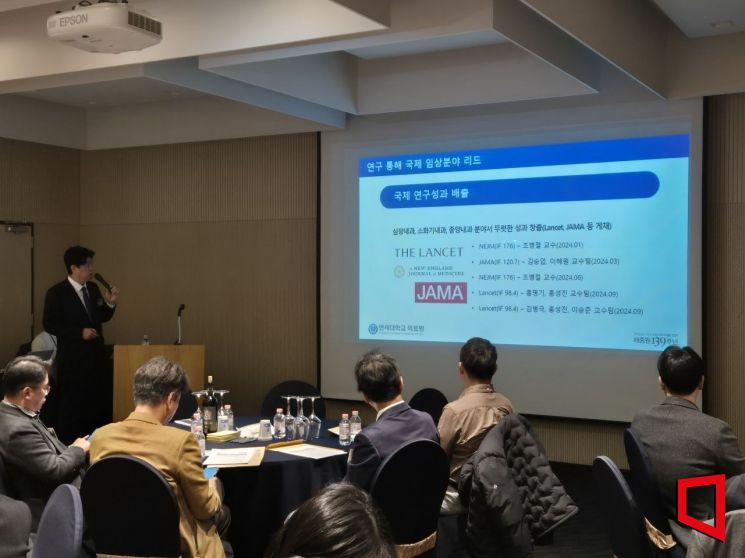 Geum Ki-chang, Director of Yonsei Medical Center, is holding a press conference on the 19th at Baekyangnuri, Yonsei University, Seodaemun-gu, Seoul, announcing plans to transform the hospital's functions into a foundation for treating highly complex diseases. Photo by Choi Tae-won
On the 19th, Geum Ki-chang, President of Yonsei Medical Center, held a press conference at Baekyangnuri, Yonsei University, Seodaemun-gu, Seoul, stating, "Yonsei Medical Center has been proactively introducing new medical technologies to treat patients with severe and intractable diseases," and added, "Going forward, we will actively adopt innovative medical care and establish an essential medical system to go beyond the role of a tertiary general hospital and set a new standard for hospitals treating patients with ultra-complex diseases."
The hospital's functions will also shift to focus on the treatment of ultra-complex diseases. To this end, each hospital under the medical center is transitioning its infrastructure to focus on severe diseases by reducing the proportion of general and short-term beds, and a task force for establishing a specialist-centered medical system has been formed. President Geum explained, "We plan to lead global clinical research and proactively introduce innovative medical technologies to completely overhaul the system so that patients with ultra-complex severe diseases will never be unable to receive treatment at Severance."
◆ Building Hardware to Enhance Research Capabilities... Accelerating the Training of Physician-Scientists = The center is also embarking on facility construction to improve research capabilities. First, the medical school will be expanded and relocated to the Allen Building site at Yonsei University. The new medical school building will have six basement floors and seven above-ground floors, with a total floor area of 77,815 square meters. The usable area will increase by 50% compared to the existing medical school. The building will include small lecture rooms for discussion-based classes, a training center to replace clinical practice, and a digital information center. Additionally, a convergence research space will be created to secure convergence research and global research competitiveness.
Based on facility investment, the training of physician-scientists and convergence research will also be activated. Yonsei University College of Medicine has been operating a full-cycle program for undergraduate students, graduate students, and junior faculty to train physician-scientists for over ten years. Up to last year, 327 people have participated in the program.
◆ Stabilizing Management through Diversification of Revenue Structure = To transition the system to focus on ultra-complex diseases and invest in future medical care, management stabilization is a priority. President Geum said, "Due to changes in the medical environment, medical profits are currently in the negative. It is now difficult to prepare for future medical care with clinical revenue alone," adding, "We will create various revenue structures beyond clinical income as future growth engines for introducing innovative medical care and essential medical systems."
Due to medical crises and other factors, Yonsei Medical Center expects a loss of over 120 billion KRW in medical revenue in the first half of this year alone. Participation in the pilot project for restructuring tertiary general hospitals also makes future management losses inevitable. Accordingly, Yonsei Medical Center plans to expand various revenue structures, including research technology fields.
To enhance R&D (Research & Development) planning services and research contract capabilities, a research and development support group has been newly established, and the research support system is being advanced. Support funds for junior faculty, operation of a dedicated patent office system, training of experts related to patents and technology transfer, and consulting for faculty startups are provided. As a result, 305 patents were filed by October this year. There were 23 technology transfers, with contract amounts reaching 11.7 billion KRW.
Yonsei University Biohealth Technology Holdings Company formed a donation-type fund called 'Severance MD Private Investment Association,' composed of current and former alumni, last year and began activities as an investment institution. It has managed about 9 billion KRW in investment funds so far and invested in 11 companies. The total value of the invested companies currently reaches 203.5 billion KRW.
The donation management system will also be revised. Strategies will be developed by institution and purpose to ensure that necessary donations reach the field, and a 'Major Fundraising Campaign' will be conducted over the next seven years.
◆ Practicing the Severance Spirit... Expanding Social Responsibility = Yonsei Medical Center will practice the Severance spirit and further expand its social responsibility. First, to fulfill social responsibility, it aims to achieve a 100% employment rate of persons with disabilities. According to current law, Yonsei Medical Center must employ 371 persons with disabilities. Currently, 211 are employed, and the plan is to employ 279 by the end of this year.
It is also working on training medical personnel in medically vulnerable countries. Currently, in collaboration with Youngone Corporation, the establishment of a medical center encompassing medical and educational institutions is underway in Bangladesh. The medical center, whose groundbreaking ceremony was held in January at Youngone Corporation's proposal, aims to open in 2026. It will include a pilot hospital with 100 beds, a general hospital with 500 beds, a medical school, and a nursing school. In Qingdao City, Shandong Province, China, the Qingdao Severance Rehabilitation Hospital (tentative name), a 300-bed facility with one basement floor and eight above-ground floors, will open in October next year.
© The Asia Business Daily(www.asiae.co.kr). All rights reserved.

















