Gyeonggi Province is strengthening its response system for emerging infectious diseases by enhancing community infectious disease surveillance and rapid response systems, as well as expanding expert collaboration networks.
On the 19th, Gyeonggi Province held the ‘2024 Infectious Disease Management Committee Regular Meeting’ at the Gyeonggi Provincial Government Office to review the infectious disease response system and explore ways to strengthen policies.
The Infectious Disease Management Committee consists of 15 health and medical officials, including Kim Seong-jung, Deputy Governor of Gyeonggi Province, Kim Wan-gyu, a member of the Gyeonggi Provincial Assembly, medical organizations, and infectious disease professors. The committee plays a practical public-private governance role in the infectious disease field by preparing implementation plans for infectious disease prevention, reviewing entrusted projects of the Infectious Disease Management Support Group, and providing advice on key matters for infectious disease prevention and management.
At the meeting, domestic and international infectious disease trends were analyzed, and the current status of major infectious diseases such as malaria, tuberculosis, and AIDS was reviewed. The importance of influenza and COVID-19 vaccinations was also emphasized, and strategies to increase vaccination rates were shared.
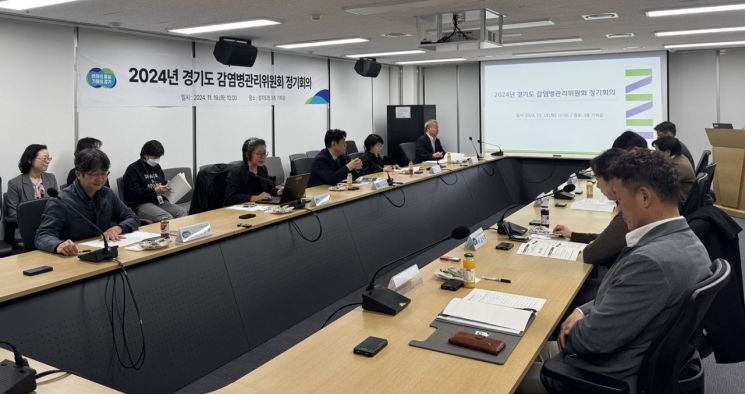 Gyeonggi Province held a regular meeting of the Infectious Disease Control Committee on the 19th to discuss current issues. Photo by Gyeonggi Provincial Government
The incidence rate of infectious diseases in Gyeonggi Province (cases per 100,000 people) was 274.3 as of the end of October, showing an increasing trend every year. As of October 1, the number of tuberculosis patients in Gyeonggi Province was 3,175 this year, a 5.2% decrease compared to the same period last year, with patients aged 65 and older accounting for 50.2%. Malaria cases in the province were 333 as of the end of September, a 23.3% decrease from 434 cases last year.
In particular, at this regular meeting, the 2025 operation plan for the Gyeonggi Province Infectious Disease Management Support Group was announced. To strengthen the response system for emerging infectious diseases, the Support Group plans to establish an analysis system by monitoring domestic and international infectious disease trends on a daily, weekly, and yearly basis. They will also revamp the existing Support Group website to provide useful information to residents, such as linking a chatbot with customized infectious disease information and details on vaccination types by age group.
Additionally, they will support malaria eradication projects, tuberculosis management projects, AIDS and sexually transmitted disease prevention, and provide support for field epidemiological investigations.
Yu Young-cheol, Director of the Gyeonggi Province Health and Wellness Bureau, stated, "This meeting was an important occasion to further enhance our capabilities in infectious disease prevention and response," and emphasized, "We will continue to actively promote strengthening the infectious disease management system and preventive activities to make Gyeonggi Province safe from infectious diseases."
© The Asia Business Daily(www.asiae.co.kr). All rights reserved.
![Clutching a Stolen Dior Bag, Saying "I Hate Being Poor but Real"... The Grotesque Con of a "Human Knockoff" [Slate]](https://cwcontent.asiae.co.kr/asiaresize/183/2026021902243444107_1771435474.jpg)
















