Korea Economic Association Conducts Awareness Survey of 1,000 Citizens Aged 18 and Over
Lower Income Groups Also Support "Inheritance Tax Relief"
A survey revealed that 7 out of 10 Koreans perceive the country's inheritance tax rate as too high and believe regulations should be eased. Even among the lowest 20% income group, known as the 1st quintile, 2 out of 3 people (64%) support easing the inheritance tax. Contrary to some political claims that easing inheritance tax is a 'tax cut for the wealthy,' lower-income groups also view the current tax system as too strict. The top inheritance tax rate is 50%. When applying the 20% surcharge on shares held by major shareholders, the effective tax rate for major shareholders reaches 60%, which is among the highest levels in the OECD.

The Korea Economic Association commissioned the polling agency Mono Research to conduct a survey of 1,000 citizens aged 18 and older, recently completed and announced on the 19th, titled 'Public Perception of Inheritance Tax Reform.' The results showed that 76.4% of respondents said, "The current inheritance tax rate in Korea is high." Among them, 34% said it was "very high."
Regarding the appropriate level for Korea's top inheritance tax rate (50%), 86.4% of respondents said it should be "lower than the current top rate." The most common response was "20-30%" (26.5%). The average appropriate top tax rate among respondents was 27.3%.
Overall, 73.4% of respondents answered positively toward tax reform aimed at easing inheritance tax. Among them, 34.7% were "very positive." Only 5.4% responded "very negative." The government announced a tax law amendment to ease inheritance tax regulations in July and submitted the inheritance and gift tax law amendment to the National Assembly in September.
The government’s amendment proposes lowering the top inheritance tax rate from 50% to 40% and abolishing the 20% surcharge on shares held by major shareholders. It also includes adjusting the taxable base for the top tax rate from exceeding 3 billion KRW to exceeding 1 billion KRW, and changing the lowest tax rate (10%) bracket from up to 100 million KRW to up to 200 million KRW.
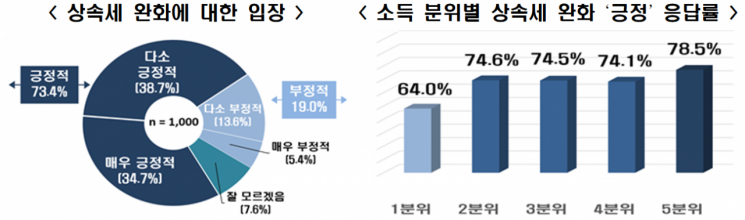 Positive Response Rate for Inheritance Tax Relief by Income Bracket. Provided by Hankyung Association
Notably, even among the 1st to 3rd income quintiles (bottom 0-60%), more people viewed easing inheritance tax positively. According to the survey on perceptions of inheritance tax reform by income quintile, the percentage of respondents who answered "positive" toward easing inheritance tax was 64% in the 1st quintile (lowest 20% income), 74.6% in the 2nd quintile, 74.5% in the 3rd quintile, 74.1% in the 4th quintile, and 78.5% in the 5th quintile (highest 20% income).
The Korea Economic Association explained, "That over 60-70% of people in the 1st to 3rd income quintiles, which are middle class and below, think easing inheritance tax is necessary means that the perception has taken root among the public that inheritance tax is no longer a tax only paid by the wealthy but also by the middle class."
The most cited reason for supporting easing inheritance tax was the excessive burden of double taxation with income tax (40.3%). The next most common opinion was that the tax system has not been reformed for a long time (24 years since 1999) and thus does not reflect increases in income and asset prices (29.3%).
Other reasons mentioned included that the high inheritance tax burden hinders business succession, causing losses in employment and investment (13.2%), easing inheritance tax would contribute to consumption activation (10.4%), and that the high inheritance tax burden discourages efforts to raise corporate stock prices, leading to stock market contraction (6.5%).
Regarding the impact of inheritance tax reform, 62.8% of respondents said "easing would have a positive effect on the economy." Additionally, 54.9% said "the current inheritance tax negatively affects the stock market." The Korea Economic Association explained, "Those who argue that inheritance tax negatively affects the stock market base their claim on the fact that as stock prices rise, the inheritance tax burden increases, reducing the willingness of corporate owners to boost stock prices."
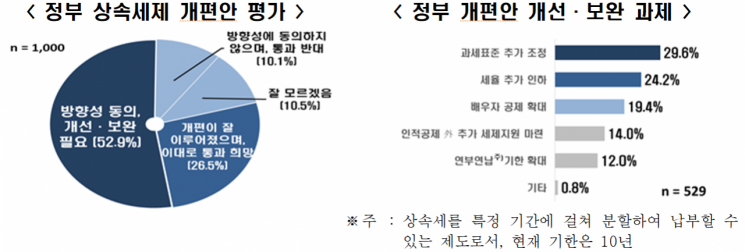
Three out of four Koreans support the government's tax reform direction to ease inheritance tax. Among respondents, 26.5% said, "The reform was well done, and I hope it passes as is." About half (52.9%) said, "I agree with the reform direction but believe improvements and supplements are needed." Only 10.1% opposed the reform direction and its passage.
Suggested improvements and supplements included further adjustment of the taxable base (29.6%), additional tax rate reductions (24.2%), and expansion of spousal deductions (19.4%). Under current law, spousal inheritance amounts are exempted from taxation between 500 million KRW and 3 billion KRW depending on the amount inherited.
Lee Sang-ho, head of the Economic and Industrial Division at the Korea Economic Association, emphasized, "As a result of maintaining the inheritance tax system reformed in 1999 for 24 years, Korea has become one of the countries with the highest top tax rates among OECD member countries. Through realistic reforms such as lowering the inheritance tax rate, we must promote private economic vitality and revitalize the contracted capital market."
© The Asia Business Daily(www.asiae.co.kr). All rights reserved.
![Clutching a Stolen Dior Bag, Saying "I Hate Being Poor but Real"... The Grotesque Con of a "Human Knockoff" [Slate]](https://cwcontent.asiae.co.kr/asiaresize/183/2026021902243444107_1771435474.jpg)


















