Two Baltic Sea Submarine Cables Cut
"Russia Forms Specialized Unit for Submarine Cable Attacks"
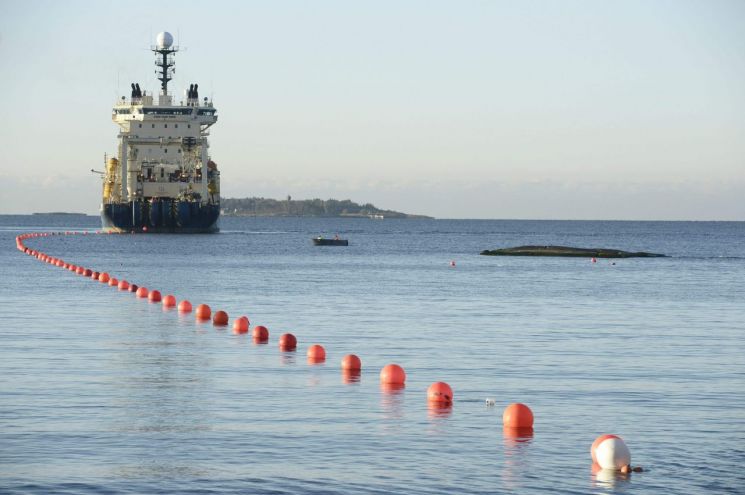 The Baltic Sea submarine internet cable between Finland and Germany being laid in October 2015. The cable was confirmed to have been cut on the 18th (local time), and there are suspicions that Russia is behind it. Photo by AFP Yonhap News
An incident occurred in the Baltic Sea, the border between Russia and NATO countries, where an undersea internet cable was suddenly cut. The exact cause has not yet been determined, but Western countries point to Russia, which has been increasing military activities near the Baltic Sea recently, as the culprit. As Russia is expected to continue its 'hybrid' strategy mixing military and non-military provocations across Europe, including the Baltic Sea, even after the ceasefire in the Ukraine war, European countries are deeply concerned.
On the 18th (local time), Finnish state-owned telecommunications company Cinia announced that a section of the 1,200 km undersea cable connecting Finland and Germany was cut, and it appears to have been deliberately severed by someone. They also added that the damage caused by this cable cut has not yet been confirmed, and the cable restoration will take 5 to 15 days.
Swedish telecommunications company Telia also announced that an undersea cable connecting Lithuania and Sweden was cut the day before. This cable is located about 100 kilometers away from the Finland-Germany undersea cable and also showed signs of deliberate cutting by someone.
The physical inspection to determine the exact cause of this undersea cable cutting incident is currently underway. The foreign ministries of Germany and Finland issued a joint statement raising the possibility of Russian involvement. The two foreign ministries stated, "the suspicion of deliberate (cable) damage alone reflects the instability of our times. A thorough investigation is underway," and added, "Europe's security is threatened not only by Russia's aggressive war against Ukraine but also by hybrid warfare from malicious actors."
The reason the two countries essentially view Russia as behind this incident is that Russian military activities in the Baltic Sea have continued to increase. According to CNN, last year Sweden, Denmark, Norway, and Finland jointly tracked about 50 Russian spy ships in the Baltic Sea area, and there have been multiple warnings that Russia could attack undersea cables and offshore wind farms.
There are also claims that Russia has created a dedicated unit to destroy undersea cables. CNN, citing U.S. officials, reported, "As part of a hybrid strategy that simultaneously conducts military and non-military activities to provoke the enemy, the Russian military prepared an operation to destroy undersea cables in the Baltic Sea," and "To this end, they separately organized the Deep Sea Research Directorate (GUGI), composed of surface ships, submarines, and naval drones."
Due to concerns about Russia's destructive activities, the Swedish government recently canceled plans to build offshore wind farms along the Baltic Sea coast. Swedish Defense Minister Peter Hultqvist said at a press conference, "Out of 14 planned wind farms, only one was approved, and the rest were all rejected," adding, "Proceeding with offshore wind farm construction projects in the Baltic Sea region could lead to unacceptable national security consequences."
© The Asia Business Daily(www.asiae.co.kr). All rights reserved.
![Clutching a Stolen Dior Bag, Saying "I Hate Being Poor but Real"... The Grotesque Con of a "Human Knockoff" [Slate]](https://cwcontent.asiae.co.kr/asiaresize/183/2026021902243444107_1771435474.jpg)
















