Selected in Ministry of Industry Contest, Secured 10 Billion KRW National Funding... Total 17.4 Billion KRW Including National Funds by 2028
Establishment of 'Robot End-Effector Demonstration Support Center' and Equipment Introduction at Pukyong National University and Dongseo University to Support Companies
Mayor Park Hyung-jun, "Actively Supporting Local Mechanical Parts and Robot Industry to Proactively Respond to Rapidly Changing Domestic and International Market Conditions"
Busan City has secured 10 billion KRW in national funding after its ‘Manufacturing Industry Robot End-Effector Demonstration Infrastructure Construction Project’ was finally selected in the Ministry of Trade, Industry and Energy’s ‘Industrial Innovation Infrastructure Construction Project’ competition.
The Ministry of Trade, Industry and Energy’s ‘Industrial Innovation Infrastructure Construction Project’ aims to support technological innovation activities of small and medium-sized enterprises by establishing shared research and development (R&D) infrastructure essential for industrial technology development. The project call was held from May 27 to July 16.
To apply for the competition, the city formed a consortium with Busan-based institutions such as the Korea Institute of Robot Convergence (Busan Research Center), the Industry-Academic Cooperation Foundation of Pukyong National University, and the Industry-Academic Cooperation Foundation of Dongseo University, as well as specialized organizations in the robotics field including the Korea Electronics Technology Institute, the Korea Testing Laboratory, and the Korea Robot Industry Association, to plan the ‘Manufacturing Industry Robot End-Effector Demonstration Infrastructure Construction Project.’
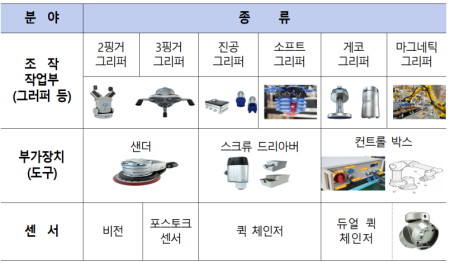
The robot end-effector can be defined as the robot’s gripper, essentially the ‘hand of the robot.’ The gripper serves as the ‘end-effector’ that maximizes the robot’s utilization at the end of the process.
This selection is especially meaningful as it is the result of efforts to implement the ‘Busan Manufacturing Industry Smartization Expansion Strategy’ prepared at the ‘39th Emergency Economic Measures Meeting’ held in January.
Recently, production methods in industrial sites have shifted to small-lot, multi-product manufacturing tailored to consumer needs. In line with this production method, demand for robots is rapidly increasing, making the development of customized ‘end-effectors’ for each process, which are the core devices of robot operations, essential in industrial sites.
Since last year, the city has been preparing to apply for the project through cooperation among government, industry, academia, and research institutes, and through continuous efforts including close collaboration with local lawmakers and related organizations, it achieved the final selection.
With this selection, the city, together with the industry-academia-research consortium, will invest a total project cost of 17.4 billion KRW (10 billion KRW national funding, 4.8 billion KRW city funding, 2.6 billion KRW private investment) from November this year until 2028 to establish the ‘Robot End-Effector Demonstration Support Center’ at Pukyong National University and Dongseo University, introducing equipment and supporting companies.
The Korea Institute of Robot Convergence (Director Yeo Jung-gu), the project’s lead institution, will build end-effector performance evaluation and demonstration equipment to support companies with testing, evaluation, certification, demonstration, and overseas certification support.
The Industry-Academic Cooperation Foundation of Pukyong National University, which formed the consortium for project execution, will provide design and analysis support and prototype production assistance for robot end-effector commercialization, while the Industry-Academic Cooperation Foundation of Dongseo University will implement digital twin (DT)-based product virtualization processes and prototype production support through equipment installation such as high-performance spatial LiDAR scanners.
Digital twin (DT) refers to creating a virtual model by representing an object identically within a computer system.
The Korea Electronics Technology Institute, a top-level domestic research institute specializing in robot components, will develop testing and evaluation methods through the establishment of performance evaluation equipment. The Korea Testing Laboratory will support reliability evaluation procedure development, performance, reliability, safety accredited testing services, and K-Mark certification through its dedicated robot system demonstration equipment and laboratory operations.
The Korea Robot Industry Association, a domestic standardization organization in the robotics field, will play roles such as technical guidance, standard proposal, and network operation.
By providing one-stop services from design to commercialization centered on the end-effector support center?including performance reliability testing and verification, process demonstration, standardization, and certification support of end-effector products?it is expected that the global competitiveness of data-driven robot end-effector and SI specialized companies will be strengthened.
The establishment of the end-effector support center is expected to lead the global competitiveness of Korea’s end-effector industry by supporting performance and reliability verification and demonstration of the entire system, including related sensors, accessories, controllers, and software, along with the end-effector itself.
An SI company refers to a company that plans, designs, and manufactures systems by understanding user requirements.
Mayor Park Hyung-jun said, “Through this project, we expect to significantly enhance the competitiveness and productivity of the convergence parts and materials industry (robots, smart manufacturing, advanced machinery, etc.), one of our city’s nine advanced strategic industries.” He added, “Busan City will actively support local SMEs to proactively respond to the rapidly changing global market, including digital transformation (DX), and nurture the advanced robotics industry as a future new growth engine, establishing it as a mecca industry of Busan.”
© The Asia Business Daily(www.asiae.co.kr). All rights reserved.


















