Q3 Non-Performing Loan Ratio Decreased Compared to Previous Quarter
But 'Kkangtong Loans' with Unpaid Interest Increased
SME Delinquency Rate Rises and Bankruptcies Increase
The asset soundness of regional banks is deteriorating. Although the amount of funds overdue for more than three months among total loans has decreased, so-called ‘empty-can loans’?loans on which even interest is not received?have actually increased. This is because small and medium-sized enterprises (SMEs) and individual business owners are unable to repay their debts on time amid a regional economic downturn.
According to the Financial Supervisory Service’s electronic disclosure system on the 19th, the balance of non-performing loans classified as fixed or below at six regional banks (Gyeongnam, Gwangju, Busan, iM Bank, Jeonbuk, Jeju) is approximately KRW 1.3271 trillion. The ratio of fixed or below non-performing loans to total loans is 0.63%. Both the balance and ratio have decreased compared to KRW 1.4287 trillion (0.68%) in the second quarter but are higher than KRW 1.2339 trillion (0.6%) in the first quarter. Loan receivables are broadly classified into five categories based on soundness: normal, precautionary, fixed, doubtful recovery, and estimated loss. The sum of fixed, doubtful recovery, and estimated loss loans is called fixed or below non-performing loans. These are loans overdue for more than three months and difficult to recover. The higher the balance of fixed or below non-performing loans, the more non-performing assets there are, so a decrease in this figure indicates improved soundness of regional banks.
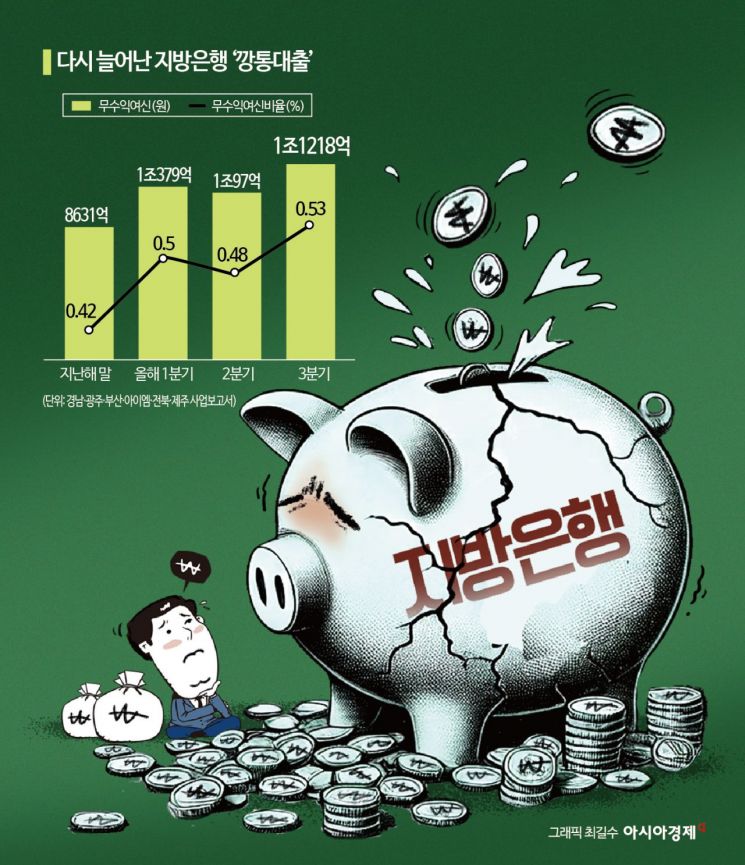
However, other indicators show that the soundness of regional banks has worsened. The amount of non-earning loans at the six regional banks in the third quarter of this year is about KRW 1.1218 trillion. The ratio of non-earning loans to total loans is 0.53%. At the end of last year, the balance and ratio of non-earning loans were KRW 863.1 billion and 0.42%, respectively. These increased to KRW 1.0379 trillion and 0.5% in the first quarter, then decreased to KRW 1.0097 trillion and 0.48% in the second quarter, but have risen again. Both the balance and ratio have increased compared to the first quarter.
The increase in non-earning loan balances was led by Busan Bank and iM Bank. Among them, Busan Bank saw the largest increase in non-earning loans. As of the third quarter, Busan Bank’s non-earning loans amounted to KRW 383.4 billion, accounting for 0.62% of total loans. This is an increase of KRW 102.5 billion and 0.16 percentage points from the previous quarter (KRW 280.9 billion, 0.46%). iM Bank’s non-earning loans rose from KRW 291.9 billion to KRW 310.5 billion, with the ratio increasing from 0.5% to 0.53%. Jeonbuk Bank’s balance also increased from KRW 89.5 billion to KRW 91.5 billion compared to the previous quarter, but since the total loan amount also grew, the ratio remained at 0.51%. The regional bank with the highest non-earning loan ratio is Jeju Bank at 1.26%. Although this is 0.03 percentage points lower than the previous quarter’s 1.29%, it remains the highest among the six regional banks.
Non-earning loans refer to loans on which neither principal nor interest is received. The figure is calculated by adding loans overdue on principal repayment for more than three months and loans on which interest has not been accrued. Since no interest income is generated, these loans are classified as more severe than fixed or below non-performing loans and are called ‘empty-can loans.’ In other words, while the overall amount of overdue loans at regional banks has decreased, their quality has worsened.
This deterioration in soundness is analyzed to be due to the regional economic downturn, which has caused SMEs, including individual business owners, to fail to repay their debts on time. The loan portfolios of regional banks are mostly composed of SMEs. In the case of Busan Bank, which saw the largest increase in empty-can loans, SMEs account for 90% of the total corporate loan balance (KRW 38.3393 trillion) as of the third quarter this year. Among these, loans related to SMEs and individual business owners with amounts under KRW 3 billion account for 48%. According to the Bank of Korea’s regional overdue loan rates for deposit banks, the nationwide overdue loan rate for SMEs was 0.78% in August. Regions with higher rates include Seoul, Busan, Daegu, Gwangju, and Jeju. Busan Bank, iM Bank, and Jeju Bank, which have seen increases in empty-can loans, operate based in these regions.
Not only are repayments delayed, but the number of bankruptcies among regional companies is also increasing. According to the Monthly Court Statistics Report, from January to September this year, the number of corporate bankruptcies filed at regional courts excluding the metropolitan area (Seoul, Uijeongbu, Incheon, Suwon) was 420 cases. This is higher than the 396 cases during the same period last year.
© The Asia Business Daily(www.asiae.co.kr). All rights reserved.

















