Cabbage and Radish Prices Drop 33% and 17% in Two Weeks Due to Kimjang Shipment
Additional Reductions from Government and Retailer Discounts
Kimjang Costs Rise About 10% Compared to Last Year
The prices of kimchi-making vegetables, which had been soaring, are rapidly stabilizing as the shipment of autumn cabbage and autumn radish intensifies and retailers begin discount sales. However, despite the price stabilization, overall prices are expected to remain higher than last year's relatively cheap kimchi-making season.
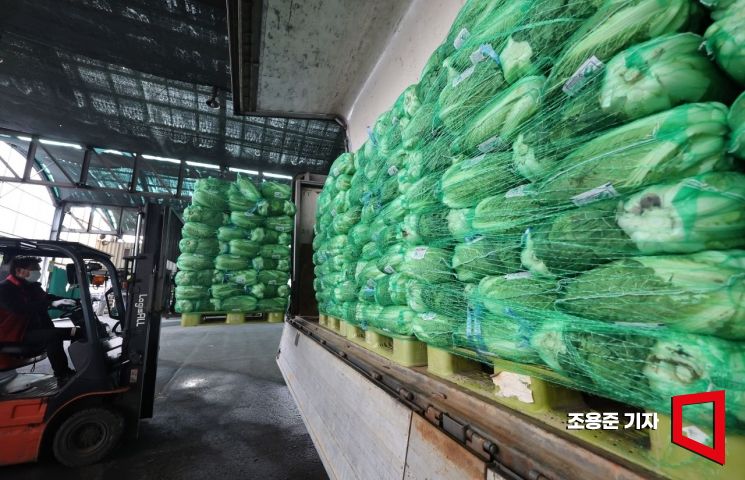
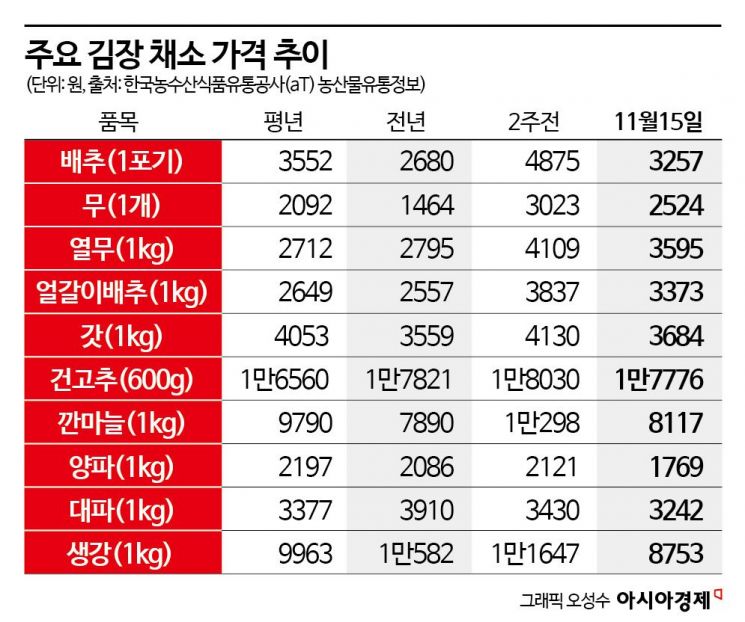
According to the Agricultural Products Distribution Information (KAMIS) of the Korea Agro-Fisheries & Food Trade Corporation (aT) on the 18th, the retail price of one head of cabbage was 3,257 won as of the 15th, down 33.2% from two weeks ago (4,875 won). However, compared to the same period last year (2,680 won), it is 21.5% higher. The price of radish is also falling. The price of one radish was 2,524 won, down 16.5% from two weeks ago (3,023 won). However, radish prices are still 72.4% higher than the same period last year (1,464 won) and 20.7% higher than the average year (2,092 won).
Besides cabbage and radish, prices of other kimchi-making vegetables are also stabilizing. As of the 15th, the price of 1kg of young radish leaves was 3,595 won, down 12.5% from two weeks ago (4,109 won), and during the same period, the prices of young napa cabbage and mustard greens also fell by 12.1% and 10.8%, respectively. However, despite the recent rapid price stabilization, all three items are priced higher than last year's kimchi-making season, reflecting the recent inflation trend.
The prices of seasoning vegetables, which are supplementary ingredients, are also generally declining. The price of peeled garlic (1kg) dropped 21.1%, from 10,289 won on the 15th to 8,117 won, and ginger (1kg) also fell below the 10,000 won mark, from 11,647 won to 8,753 won. Additionally, the prices of onions (1,769 won) and green onions (3,242 won) fell by 16.6% and 5.5%, respectively. However, the price of dried red chili peppers (600g) only decreased slightly by 1.4%, from 18,030 won to 17,776 won, showing a relatively small decline.
The prices of major kimchi-making vegetables such as cabbage and radish are falling compared to October due to the expansion of shipment areas and increased shipment volumes. In particular, the average retail price of cabbage in October was 8,240 won, which was 33.5% higher than the previous year (6,170 won) and a staggering 50.6% higher than the average year (5,472 won), due to reduced summer cabbage supply caused by poor crop conditions in highland areas from the heatwave. However, as the shipment of autumn cabbage intensifies in preparation for the kimchi-making season, prices are gradually stabilizing.
Earlier, there were concerns that the supply of autumn cabbage for kimchi-making might become difficult due to the heatwave lasting until mid-September. Furthermore, heavy rains in mid-September caused damage to cabbage-producing areas such as Haenam County in Jeollanam-do, increasing worries about supply instability. However, farmers replanted the withered plants and strengthened growth management, leading to a recovery in autumn cabbage crop conditions and increased supply.
Moreover, retail prices are further decreasing due to government discount support and retailers' own discounts. Emart, in preparation for the kimchi-making season, offered 390,000 heads of autumn cabbage at prices in the 1,600 won range per head and plans to sell an additional 300,000 heads at prices in the 1,400 won range. Nonghyup is also offering up to 38% discounts on kimchi ingredients such as salted cabbage and salted seafood at Hanaro Mart.
Other kimchi-making vegetables such as radish and green onions are also being shipped in earnest in preparation for the kimchi-making season, so the supply relative to demand for kimchi-making vegetables is expected to be stable. Radish, which saw price increases due to delayed growth and reduced production, is expected to maintain price stability as autumn radish shipments increase from mid-month. The relatively small price decline of dried red chili peppers is expected to be influenced by increased late-season harvest volumes compared to last year and a decrease in imports this month compared to the previous year, which will affect the wholesale price decline of domestically produced dried red chili peppers.
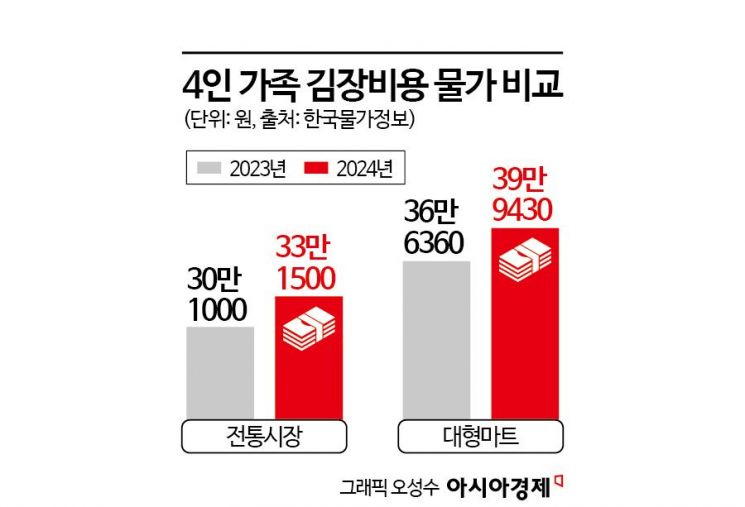
However, although the crop conditions of vegetables including cabbage have recovered this month and prices that had soared due to the heatwave are rapidly stabilizing, prices remain high compared to last year's relatively cheap prices. According to the price survey agency Korea Price Information, the kimchi-making cost for a family of four this year is expected to be 331,500 won at traditional markets, a 10.1% increase from last year (301,000 won), setting a record high. The kimchi-making cost at large supermarkets is also expected to rise 9.0% to 399,430 won from 366,360 won last year.
Lee Dong-hoon, team leader at Korea Price Information, said, "Recently, cabbage production has increased in several regions, increasing supply, and large supermarkets are selling cabbage at prices in the 1,000 won range per head due to government measures, but considering quality differences depending on production time and region, prices are still higher than last year." He added, "Since the cabbage transplanting period was delayed due to abnormal summer weather this year, it would be wise to make kimchi 1 to 2 weeks later than usual to purchase good cabbage with well-filled leaves and reduced moisture, which is suitable for kimchi-making."
© The Asia Business Daily(www.asiae.co.kr). All rights reserved.



















