On November 15, over 100 local residents attended, but the Democratic Party of Korea Mapo District Committee did not participate
Recommendation lacks enforceability and penalties, allowing residents to freely adopt it
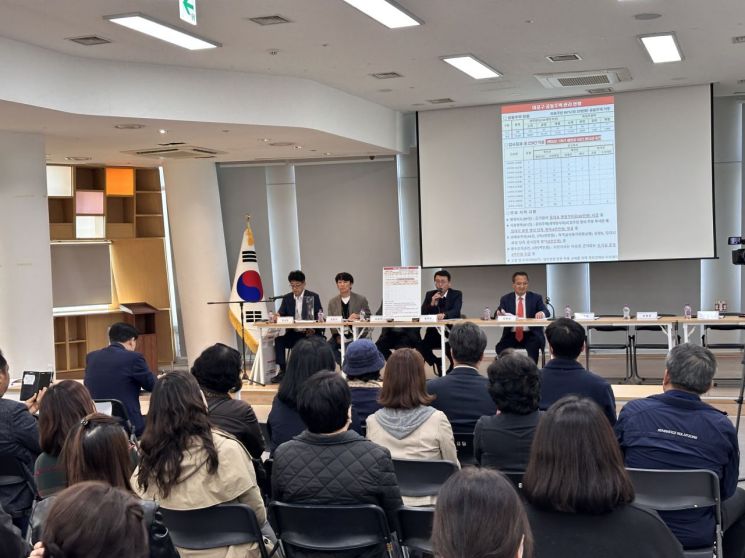
On November 15th, a public forum on the "Mapo-gu Apartment Complex Management Regulation Recommendation" was held in the auditorium on the 12th floor of the Mapo-gu Office.
This forum was initially agreed upon verbally by Mapo-gu and the Democratic Party of Korea Mapo-gu Regional Committee (hereinafter referred to as the "Mapo-gu Regional Committee") regarding the organizer (citizen group), timing (mid-November), number of discussants (four each), and venue (Mapo-gu Office). However, on the day of the forum, the Mapo-gu Regional Committee did not participate, resulting in the event being attended only by the organizing citizen group, Mapo-gu officials, and about 100 spectators.
During the preparation process, the Mapo-gu Regional Committee requested changes such as changing the organizer to Mapo-gu, payment for discussants, and posting banners about the forum in approximately 150 apartment complexes.
However, Mapo-gu and the organizers explained that if Mapo-gu hosted the event, there could be suspicions about fairness, and that providing budget support from the district to the citizen group organizing the forum would be illegal under election laws, according to the election commission's interpretation, so they could not provide support.
A Mapo-gu official expressed regret, stating that it was difficult to understand the absence of the Mapo-gu Regional Committee from a forum that had already been announced to residents.
On that day, the district, noting the high interest of residents, proceeded with discussions on the management regulation recommendations under the guidance of the moderator.
In recent years, as complaints related to apartment complexes surged, the need for guidelines tailored to local conditions for apartment complex management emerged in Mapo-gu.
In particular, from 2022 to 2023, regular and special audits conducted on 14 apartment complexes uncovered 338 violations, highlighting the urgent need for measures to enhance transparency and efficiency in apartment complex management.
Accordingly, Mapo-gu repeatedly requested revisions to the Apartment Complex Management Act and Seoul City guidelines but, as these were not accepted, it developed the "Mapo-gu Apartment Complex Management Regulation Recommendation" by considering local circumstances and expert opinions.
The recommendation includes key provisions aimed at preventing conflicts and enhancing transparency within apartment complexes, such as strengthening electronic voting to increase decision-making transparency, limiting consecutive terms for chairpersons of resident representative meetings in large complexes with over 1,000 households, and prohibiting political activities under the name of resident representative meetings.
Furthermore, Mapo-gu addressed criticisms that the recommendation restricts political freedom and suffrage guaranteed by the Constitution, as well as concerns raised by Seoul City and the Ministry of Land, Infrastructure and Transport regarding the uniformity of apartment complex operations, as follows.
The Apartment Complex Management Act and related regulations clearly define the roles of resident representative meetings, including the establishment and amendment of management regulations and approval and settlement of management fees budgets. The Mapo-gu recommendation only restricts political activities conducted under the name of resident representative meetings, not the political activities of general residents.
There have been cases where organizations managing apartment complexes, such as resident representative meetings, election management committees, and management offices, have been used as political tools during various elections by campaigning for specific candidates, causing harm to residents. To prevent such harm, the recommendation includes a duty of political neutrality.
Additionally, some provisions of Seoul City's management regulation guidelines do not reflect local circumstances, causing numerous complaints. The Mapo-gu recommendation was created to supplement these issues and is effectively non-binding, allowing apartment residents to choose whether to follow it. Forcing residents to adhere only to Seoul City's guidelines could cause confusion in apartment complex management and restrict residents' democratic choice.
Building on this forum, Mapo-gu plans to actively promote the recommendation at the upcoming December "Resident Representative Meeting Operation and Ethics Education."
Mapo-gu has also filed a constitutional dispute petition with the Constitutional Court, judging that Seoul City excessively infringes on local autonomy granted by the Constitution and the Apartment Complex Management Act regarding the "Mapo-gu Apartment Complex Management Regulation Recommendation."
© The Asia Business Daily(www.asiae.co.kr). All rights reserved.

















