The National Institute of Forest Science announced on the 18th that it has succeeded in producing pine mushrooms for two consecutive years using pine mushroom-infected seedlings (artificial cultivation technology) in areas damaged by wildfires.
Previously, to restore pine mushrooms in wildfire-damaged areas, the Institute established a pine forest in the wildfire-damaged area of Goseong in 1997. Then, after transplanting pine mushroom-infected seedlings to a test site in 2007, pine mushrooms were produced for two consecutive years from last year to this year, 16 years later.
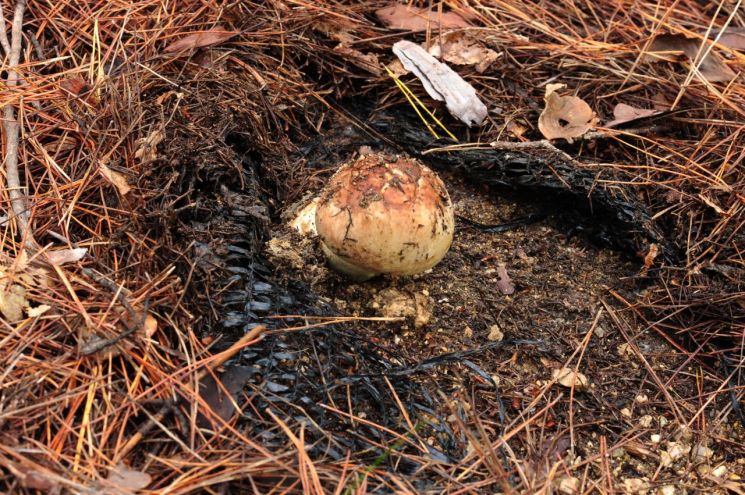 Pine mushrooms harvested from the wildfire-affected area. Provided by the National Institute of Forest Science
The production of pine mushrooms in the wildfire-damaged area of Goseong is evaluated as an encouraging result showing that pine mushroom mountains can be restored and expanded when pine mushroom-infected seedlings are used after establishing a pine forest in wildfire-damaged areas.
The Institute expects that this will reduce concerns about the decline of pine mushroom mountains in wildfire-damaged areas and secure and maintain income sources for forest households.
Artificial cultivation research of pine mushrooms began in the 1970s, and the pine mushroom-infected seedling method was established after the 2000s. The pine mushroom-infected seedling method refers to a technique where pine mushroom fungi are infected into the roots of young pine trees and then moved to mountains with pine trees to cultivate mushrooms.
For artificial cultivation of pine mushrooms, the Institute applied the pine mushroom-infected seedling method at the Hongcheon test site and produced one pine mushroom in 2010.
Since then, it succeeded in producing 5 in 2017, 1 each in 2018 and 2019, 21 in 2020, 2 in 2021, 11 each in 2022 and 2023. This year, 17 pine mushrooms were produced. Having produced pine mushrooms for eight consecutive years through artificial cultivation, the technology is considered established.
Researcher Jang Young-seon of the National Institute of Forest Science said, “With pine mushrooms produced for two consecutive years in the wildfire-damaged area of Goseong, research on the creation and expansion of pine mushroom mountains using pine forests and pine mushroom-infected seedlings in wildfire-damaged areas is expected to accelerate. Since pine mushroom-infected seedlings are currently the only method to expand pine mushroom mountains, active participation of mountain owners who possess pine mushroom mountains is necessary for technology dissemination and seedling cultivation.”
© The Asia Business Daily(www.asiae.co.kr). All rights reserved.

















