Hankyung Association-Sangik Association Joint Forum Held
General R&D Deduction Rate for Large Corporations 0~2%
"Lower than OECD Average of 15%"
There has been a proposal to raise the corporate R&D tax credit rate for large enterprises from the current maximum of 2% to 10%, and for medium-sized enterprises from 8% to 15%. The argument is that since these rates are lower than the OECD average of 15%, tax support should be strengthened to boost private innovation and the discovery of new growth engines.
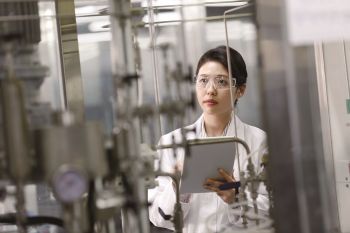 A researcher is examining a product at Kumho Petrochemical's Central Research Institute in Hwaam-dong, Daejeon. Photo by Kumho Petrochemical
On the 18th, the Korea Economic Association made this claim at the "National Assembly Forum on Tax Policy for Improving the Private R&D Investment Environment and Industrial Technology Innovation Growth" held at the National Assembly Members' Office Building. The forum was hosted by Song Eon-seok, chairman of the National Assembly Planning and Finance Committee, and jointly organized by the Korea Economic Association and the Korea Industrial Technology Promotion Association (KOTPA).
Lim Dong-won, senior research fellow at the Korea Economic Association, pointed out in his presentation titled "Problems and Improvement Measures of Korea's R&D Tax System" that Korea's tax credit rates are lower than those of major foreign countries. He stated that the general tax credit rate for large enterprises in Korea is 0-2%, and for medium-sized enterprises, it is 8%.
This is lower than the levels of major foreign countries. As of last year, France's R&D tax credit rate was 36%. Germany (19%), the United Kingdom (18%), and Japan (17%) also have higher rates than Korea. The average tax credit rate among OECD member countries is 15%, which is 7.5 times higher than Korea's maximum 2% for large enterprises.
As tax support for large and medium-sized enterprises' R&D has decreased, the driving force for private R&D investment has weakened. For large enterprises, the maximum rate was 6% until 2013 but dropped to a maximum of 2% after 2018. According to the Korea Institute of S&T Evaluation and Planning (KISTEP), the average annual growth rate of private R&D investment declined from 12.7% during 2000-2009 to 9.3% during 2011-2015, and further to 7.4% during 2018-2022. As of 2022, R&D by large and medium-sized enterprises accounted for 75.7% of total private R&D investment.
Senior research fellow Lim argued, "Considering that major foreign countries provide high levels of support for R&D regardless of company size, the general R&D tax credit rates for large and medium-sized enterprises should be expanded to 10% for large enterprises and 15% for medium-sized enterprises."
Lim also pointed out that the level of support for general industrial sectors is insufficient compared to national strategic technologies (up to 40% credit for large and medium-sized enterprises) and new growth and original technologies (up to 30% credit for large and medium-sized enterprises), which is a limitation of Korea's R&D tax system. As of last year, only 322 companies applied for the new growth and original technology R&D tax credit, and only 34 companies applied for the national strategic technology R&D tax credit.
He said, "Although national strategic technology and new growth and original technology R&D receive high credit rates, the limited scope of eligible technologies reduces their effectiveness. In an era of rapid technological convergence, it is important to expand general R&D credits to establish a broad R&D support system."
Companies urged that tax support should be combined with subsidy support. Kim Dae-sung, vice president of SK Ecoplant, stated in a panel discussion, "To alleviate the risk burden of corporate R&D and encourage active R&D investment, indirect support such as tax incentives should be combined with direct support like subsidies."
Accounting experts proposed the introduction of a cash refund system for tax credits. Jo Yong-rip, an accountant at Woori Accounting Corporation, said, "From a corporate perspective, since R&D projects carry a high risk of failure, it is desirable to recover funds as quickly as possible. Immediate cash refunds of unused tax credits would help ease corporate financial burdens."
There was also an opinion that tax support for joint research should be strengthened. Kim Jong-hoon, executive director of KOTPA, argued, "It is necessary to provide exceptional support with a high tax credit rate (30%) for joint and commissioned R&D between large and small-medium enterprises, as well as joint and commissioned R&D between companies and overseas universities and research institutions."
Kim also suggested strengthening support for R&D personnel. The current R&D personnel income tax exemption and reduction system includes ▲ income tax exemption for research activity expenses of dedicated research personnel (up to KRW 200,000 per month) ▲ income tax exemption for job invention rewards for research personnel (up to KRW 7 million per year) ▲ income tax reduction for outstanding personnel returning to Korea (50% reduction for 10 years).
He said, "The income tax exemption and reduction benefits for R&D personnel should be expanded to twice the current level to support companies in securing R&D personnel smoothly."
© The Asia Business Daily(www.asiae.co.kr). All rights reserved.
!["The Woman Who Threw Herself into the Water Clutching a Stolen Dior Bag"...A Grotesque Success Story That Shakes the Korean Psyche [Slate]](https://cwcontent.asiae.co.kr/asiaresize/183/2026021902243444107_1771435474.jpg)
















