Air Cargo Rates Up 32.5% Compared to Late February
Strong Demand in Chinese E-commerce Volume Continues
"Traditional Cargo Handling May Be Delayed Due to Surging Demand"
High Rates Expected to Persist Through Year-End Peak Season
Volumes of Chinese e-commerce from Ali and Temu have pushed air cargo freight rates to this year's highest levels. With the year-end online shopping peak approaching, the strong air cargo freight rates are expected to continue for the time being.
According to the global air cargo freight rate trends announced by Hong Kong's TAC Index on the 18th, the Baltic Air Freight Index (BAI00) recorded 2367.00 as of the 11th, marking the highest level this year. It rose about 1% compared to the previous week, setting a new record high for the year. Compared to the annual low of 1787.00 recorded on February 26, it increased by 32.5%. The steady upward trend has returned to the level seen at the end of last year when the shipping industry faced the Red Sea risk.
The strength in air freight rates is largely attributed to delays in maritime transport and the impact of Chinese e-commerce. Due to the prolonged Red Sea situation, container ships have been rerouted via the South Africa route, extending maritime transport time by about two weeks. The Shanghai Containerized Freight Index (SCFI), a representative maritime freight indicator, has more than doubled compared to last year. Additionally, the volume of goods entering the country from platforms like Ali and Temu has significantly increased.
According to Incheon International Airport Corporation, last month the cargo volume at Incheon International Airport was 255,133 tons for international flights, a 6.7% increase compared to the same period last year. In particular, air cargo volume from China was 47,128 tons, expanding by 7.5% year-on-year. Korean Air, which showed strong performance in the third quarter, explained that "Chinese e-commerce volumes are flooding in to the extent that traditional cargo handling has to be postponed."
With the year-end online shopping peak approaching, air cargo freight rates are expected to continue their high-level trend for the time being. It is forecasted that customs clearance volumes will increase by about 40% this month alone due to China's Guanggunjie and the US Black Friday.
Despite the strong air freight index, industry insiders say that the burden of delivery costs on consumers is not significant. A logistics industry official explained, "Just as the increase in fuel costs does not directly lead to higher courier fees, the rise in air freight rates will not be immediately passed on as international shipping fees paid by Chinese e-commerce users. However, individuals sending items between each other may feel some impact."
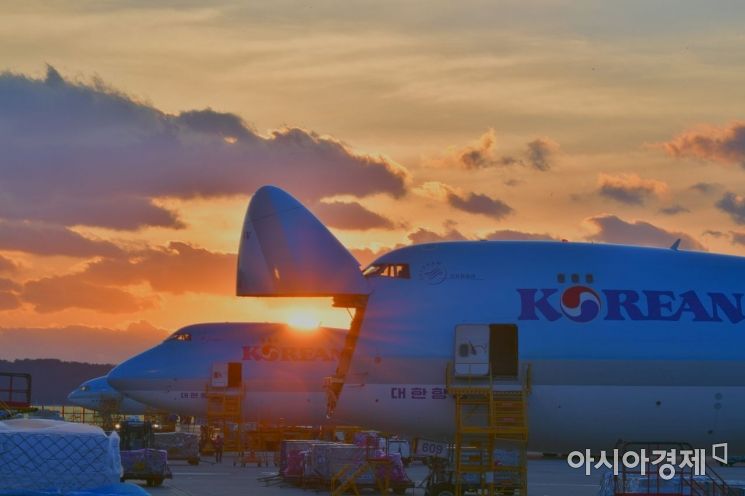 On the 27th, employees are busy loading air cargo in subzero weather at the Korean Air Cargo Terminal of Incheon International Airport. / Yeongjongdo - Photo by Jinhyung Kang aymsdream@
© The Asia Business Daily(www.asiae.co.kr). All rights reserved.
![Clutching a Stolen Dior Bag, Saying "I Hate Being Poor but Real"... The Grotesque Con of a "Human Knockoff" [Slate]](https://cwcontent.asiae.co.kr/asiaresize/183/2026021902243444107_1771435474.jpg)
















