Discussion on Ukraine War, North Korean Nuclear Issue, US-China Relations
As if for Trump to Hear
Biden "Diplomacy with Global Allies and Solidarity"
Si "US-China Must Coexist in Long-term Peace"
Two months before the end of their terms, U.S. President Joe Biden and Chinese President Xi Jinping held their final summit on the 16th (local time) in Lima, Peru, discussing the Ukraine war, the Korean Peninsula issue, and U.S.-China relations. This summit, likely the last before the second term of Donald Trump begins in January next year, saw both sides making remarks seemingly mindful of the incoming U.S. President-elect Trump. President Xi warned that the U.S.'s efforts to contain China "will not go as planned."
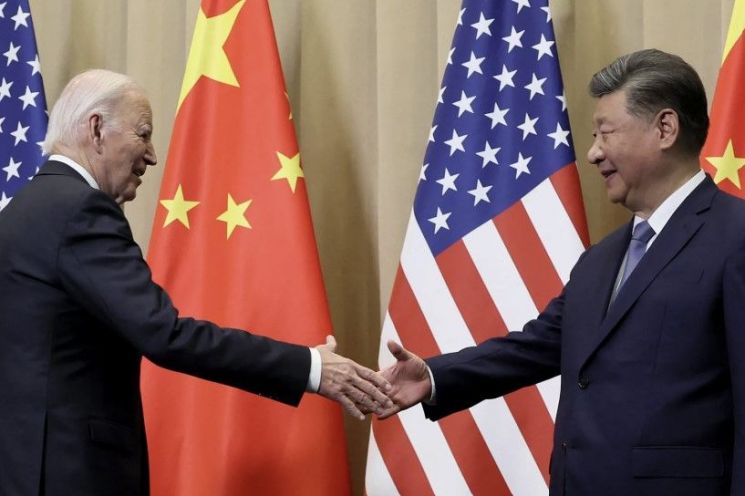
At the U.S.-China summit held on the sidelines of the Asia-Pacific Economic Cooperation (APEC) summit the previous day, President Biden condemned North Korea's deployment of troops to Russia, stating, "China, which has influence and capabilities over North Korea and Russia, should use them to prevent escalation of conflicts and the spread of clashes through additional North Korean deployments." He also described the North Korea-Russia military cooperation as a "highly dangerous development," expressing concerns over North Korea's provocations toward South Korea, including missile launches and a seventh nuclear test.
In response, President Xi said, "China's position and actions regarding the Ukraine issue have always been just," adding, "China will not allow war and chaos to occur on the Korean Peninsula, nor will it stand idly by if its strategic security and core interests are threatened." While agreeing on preventing heightened tensions on the Korean Peninsula, this statement is interpreted as a warning against strengthening military cooperation among South Korea, the U.S., and Japan under the pretext of North Korean provocations.
Both sides also made remarks mindful of the tough stance on China expected from President-elect Trump, who will take office in January next year. President Biden emphasized, "We must not let competition between the U.S. and China escalate into conflict," adding, "That is our responsibility." He further stated, "Investing in the sources of our national strength and connecting with partners and allies worldwide are central to the Biden administration's diplomatic policy approach," reiterating his diplomatic policy of rallying alliances to check China. This was interpreted as a statement conscious of the incoming Trump administration, which is expected to strengthen isolationism.
President Xi also said, "The experiences of the past four years should be summarized and lessons remembered," adding, "Containing China is neither wise, possible, nor will it go as intended." He continued, "The U.S. and China should make wise choices based on the happiness of their peoples and the common interests of the international community, continue to seek the right path for the two great powers to coexist properly, and maintain long-term peaceful coexistence."
As U.S.-China conflicts, which began with a trade war during Trump's first term, expanded into a high-tech hegemony competition under the Biden administration, President Xi's remarks are interpreted as a warning to revise China policy directions in the upcoming Trump second term. However, President-elect Trump has filled the new administration's foreign and security policy team with hardliners on China. Senator Marco Rubio has been nominated as Secretary of State, and Representative Mike Waltz as White House National Security Advisor. Both are known for emphasizing hawkish policies toward China, suggesting that the U.S.-China confrontation is expected to become even more pronounced during Trump's second term.
The U.S. daily newspaper The New York Times (NYT) evaluated the summit atmosphere, stating, "The two leaders seemed to be speaking to someone not present in the meeting room?Donald Trump, who promised a more aggressive approach to China if re-elected in January next year."
© The Asia Business Daily(www.asiae.co.kr). All rights reserved.
![Clutching a Stolen Dior Bag, Saying "I Hate Being Poor but Real"... The Grotesque Con of a "Human Knockoff" [Slate]](https://cwcontent.asiae.co.kr/asiaresize/183/2026021902243444107_1771435474.jpg)
















