Joint Leading Campaign by Autonomous Police Committee, National Police Agency, and Education Office
11 Institutions Including Youth Shelters Conduct Street Counseling in Crowded Areas
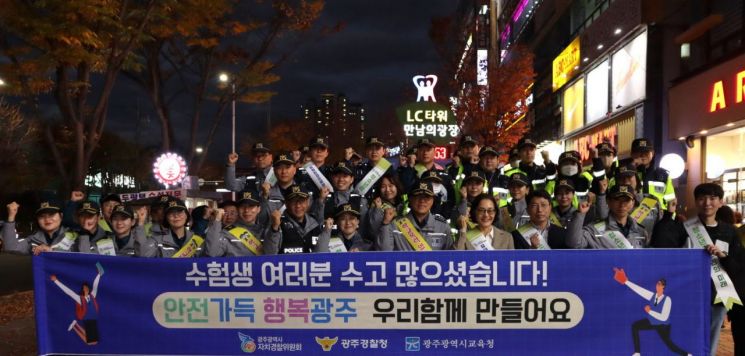 The Gwangju Autonomous Police Committee conducted youth guidance and protection activities and campaigns on the afternoon of the 14th in the Cheomdan district area of Gwangsan-gu, together with the Gwangju Police Agency, Gwangsan Police Station, and Gwangju Metropolitan Office of Education. Photo by Gwangju City
Gwangju City has taken the lead in youth guidance and protection activities for teenagers who have completed the College Scholastic Ability Test (CSAT), in collaboration with the Office of Education and the Police Agency.
On the afternoon of the 14th, when the CSAT was held, Gwangju City conducted a “mobile street counseling (outreach)” activity in the Chungjang-ro and Cheomdan District areas to prevent youth runaway incidents.
The Gwangju Autonomous Police Committee, together with the Gwangju Police Agency, Gwangsan Police Station, and Gwangju Office of Education, carried out youth guidance and protection activities and campaigns in the Cheomdan District area of Gwangsan-gu. This campaign was conducted to prevent delinquency and misconduct and to protect youth from harmful environments, as out-of-school activities among examinees and other youths increased after the CSAT.
The campaign involved focused guidance activities for youth alongside School Police Officers (SPOs), and to prevent the recently increasing addictive crimes, counseling centers (Gambling Counseling 1336, Drug Counseling 1342) were promoted and promotional materials were provided. Additionally, while patrolling the streets, if drinking or smoking was detected, the youth were handed over to their guardians on the spot and sent home.
The city also conducted youth street counseling (outreach) at youth-dense areas such as the National Asia Culture Center and the May 18th Democratic Square, in cooperation with five youth shelters and six youth counseling and welfare centers. Outreach means “going out and approaching,” and it involves visiting youth-dense areas to prevent at-risk youth from engaging in delinquency and running away, while informing them about the functions of youth shelters to help prevent exposure to harmful environments when youths are out on the streets.
During the street counseling, a bus-type mobile shelter was deployed to provide snacks, resting spaces, and brief counseling, supporting the information needs of youth. Also, at the Life Design Center near Chungjang-ro, promotional booths for youth support organizations were operated, and through the provision of goods, information on returning home, linking to shelters, and connecting to youth welfare services was provided to help youths cope with crisis situations.
Yoon Mi-kyung, Director of the Child and Youth Division of Gwangju City, said, “Through mobile street counseling, we will encourage early return home of youths and strive to find at-risk youths who need protection so that they can be supported and protected within the social safety net.”
Meanwhile, Gwangju City operates six youth shelters (five shelters and one temporary protection center) to protect at-risk youths. Youth shelters provide temporary housing for youths who have left home due to family circumstances, and youths aged 9 to 24 can apply for admission and enter after counseling.
© The Asia Business Daily(www.asiae.co.kr). All rights reserved.

















