The official real estate price realization rate (the ratio of official price to market price) will be frozen for the second consecutive year next year. It will be maintained at the 2020 level (69% for apartment buildings), which was before the Moon Jae-in administration introduced the official price realization roadmap, for the third year in a row.
Although the government previously announced plans to scrap the roadmap, the passage of related legislation has become uncertain, leading to the decision to freeze the rate. Therefore, next year's official prices will only reflect market price fluctuations.
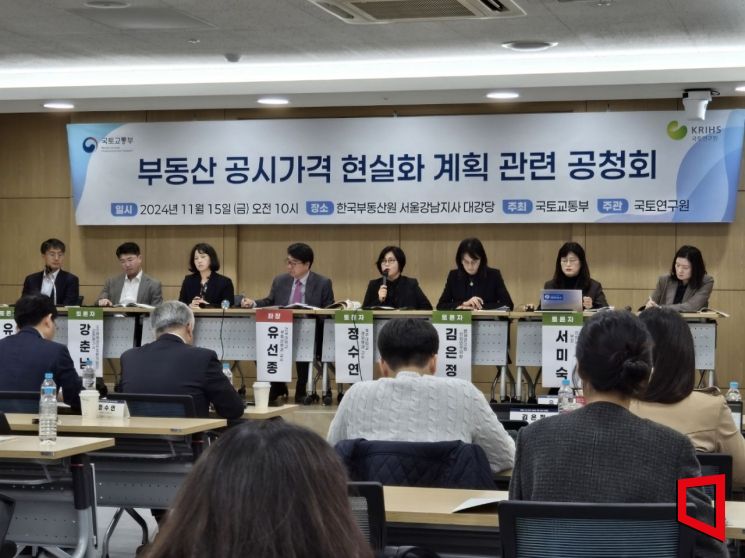 On the morning of the 15th, a panel discussion is underway at the "Public Hearing on the Plan to Realize the Actual Price of Real Estate" held at the Korea Real Estate Board Seoul Gangnam Branch in Seocho-gu, Seoul. / Photo by Noh Kyung-jo
On the 15th, the Ministry of Land, Infrastructure and Transport held a 'Public Hearing on the Real Estate Official Price Realization Plan' at the Korea Real Estate Board's Seoul Gangnam branch in Seocho-gu, Seoul. Official prices are used in 67 systems including property tax and health insurance premiums, and the realization rate indicates how much the official price reflects the market price.
Park Cheon-gyu, head of the Housing and Real Estate Research Division at the Korea Research Institute for Human Settlements, who presented at the hearing, stated, "Until parliamentary discussions on the rationalization of official prices are concluded, changes to official price policies should be minimized," adding, "It is appropriate to set the 2025 target market price reflection rate at the current level." This means that next year's official price realization rates will also be applied at the 2020 levels: 69.0% for apartment buildings, 53.6% for detached houses, and 65.5% for land.
The Moon Jae-in administration set goals to increase the realization rate annually until 2030 for apartment buildings, 2035 for standard houses, and 2028 for standard land to enhance tax fairness. However, as housing prices surged, the official prices used as the tax base also rose, leading to increased tax burdens.
In response, the Yoon Suk-yeol administration initially considered revising the realization rate targets but ultimately decided to scrap them. Starting with the 2023 official prices, the realization rate was lowered to the 2020 level, considering the prolonged transaction freeze due to falling housing prices.
The government plans to continue calculating official prices based on market price fluctuations without artificially raising the realization rate. However, as the housing market recently reached a turning point, tax burdens may vary depending on price changes until the end of the year.
Apartment prices in the Seoul metropolitan area, including Seoul, showed an upward trend until August this year but have been declining since September due to the implementation of the second phase of the Debt Service Ratio (DSR) regulations and increased loan interest rates by commercial banks, resulting in more units with falling actual transaction prices.
Next year's official prices for apartment buildings will be based on January 1 of next year and will be disclosed in March. If there are significant price fluctuations, changes from late this year to early next year may be reflected in the official prices.
The Ministry of Land, Infrastructure and Transport plans to gradually work from next year to equalize the market price reflection rates that have diverged between Seoul and other regions, apartments and detached houses, and high-priced and low-priced houses. Considering the public burden, the upper limit for improving balance will be reviewed at about '1.5% compared to the 2024 official prices.'
The Ministry will soon announce measures to be applied to next year's official prices based on the results of the public hearing discussions.
© The Asia Business Daily(www.asiae.co.kr). All rights reserved.

















