‘Recent Economic Trends (Greenbook) November Issue’
'Moderate' Economic Recovery Continues
Uncertainty Exists Due to Changes in Domestic and External Conditions
The government assessed the domestic economy as follows: “Recently, our economy has been experiencing an expanding trend of price stabilization, with a gradual economic recovery continuing; however, uncertainties exist due to changes in domestic and external conditions.” This marks the government’s withdrawal of its previous evaluation, made seven months ago, that there were signs of domestic demand recovery. Additionally, reflecting changes in domestic and external conditions such as the election of Donald Trump as U.S. President, the government added the expression that uncertainties exist.
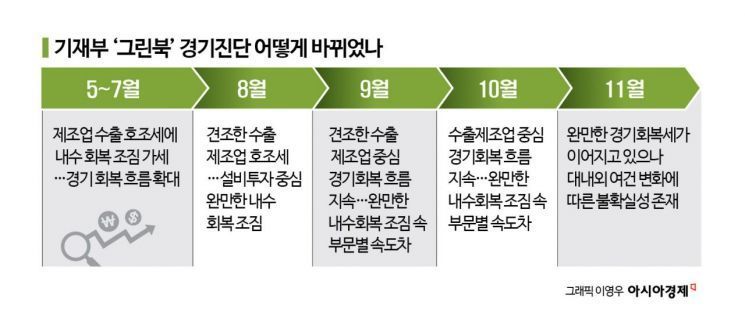
On the 15th, the Ministry of Economy and Finance stated this in the November issue of the ‘Recent Economic Trends (Green Book).’ In its economic assessment, the ministry had repeatedly used the phrase ‘signs of domestic demand recovery’ for six months from May to October. Regarding last month’s economy, the ministry described it as “a continued recovery trend centered on exports and manufacturing, with signs of a gradual domestic demand recovery mainly in facility investment and the service sector, though there are differences in the pace among sectors.” While major institutions, including the Korea Development Institute (KDI), a government-funded research institute, have pointed out the prolonged sluggishness of domestic demand, it appears that the government has withdrawn its rosy outlook on the domestic demand sector.
Kim Gwi-beom, head of economic analysis at the Ministry of Economy and Finance, explained, “Basically, the judgment on domestic demand is not significantly different from last month’s. However, the change in expression reflects the impact of increased economic uncertainty overall due to changes in domestic and external conditions, and this includes the diagnosis of domestic demand.”
While the ministry maintained its assessment that economic recovery is continuing following last month, it made changes to the detailed expressions. It added the term ‘gradual’ and included mention of the existence of ‘uncertainty’ due to changes in domestic and external conditions. Regarding the global economy, it explained, “Although an overall recovery trend is observed, geopolitical risks in the Middle East remain, and uncertainties have increased due to possible changes in the trade environment.” This reflects consideration of changes in conditions such as the possibility of tariff increases following Trump’s election.
Kim said, “We are revising our economic assessment by reflecting the third-quarter gross domestic product (GDP) announced on the 24th of last month. Although there was a rebound, it was not stronger than expected, and we added the content that there is uncertainty due to changes in the trade environment.” The Bank of Korea announced that the real GDP growth rate for the third quarter (compared to the previous quarter, preliminary figure) was 0.1%. He added, “It is currently impossible to accurately estimate the likelihood of realization of global tariff policy changes,” and “We believe the range of impact on the domestic economy will be broad under the current circumstances.”
According to the Green Book, construction, a major indicator comprising domestic demand, continued its sluggish trend. In September, construction output (constant prices) decreased by 0.1% compared to the previous month. Although civil engineering works increased by 9.9%, building construction performance fell by 3.7%, resulting in a 12.1% decrease compared to the same month last year. However, facility investment in September increased by 8.4% compared to the previous month. Machinery increased sharply by 17%, while transportation equipment decreased by 15.1%.
Retail sales also showed a sluggish performance. In September, retail sales decreased by 0.4% compared to the previous month. In particular, the growth rate of domestic credit card approvals in October increased by only 1.2% compared to the same period last year. This is a decline from the growth rates of 4.6% in September and 4.4% in August. The increase in the number of Chinese tourists supporting domestic demand has also slowed. The number of Chinese tourists increased by 789,000 in August, but only by 539,000 in September and 544,000 in October.
On the 12th, KDI also lowered its forecast for Korea’s economic growth rate this year to 2.2%, down 0.3 percentage points from the forecast three months ago (2.5%), citing the slower-than-expected domestic demand recovery as a reason for the downward revision. It diagnosed that private consumption, centered on goods consumption, still shows a low growth rate, and construction investment continues to experience accumulated sluggishness.
© The Asia Business Daily(www.asiae.co.kr). All rights reserved.

















