[MuskeuXTeureompeu]① Efficiency Comes First... Let's Just Eliminate It for Now
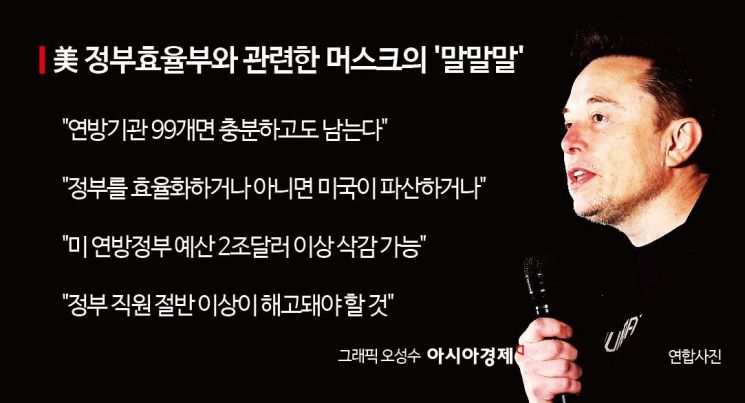
"Are 428 federal agencies really necessary? Many agencies are unheard of, and many have overlapping areas. 99 agencies would be sufficient."
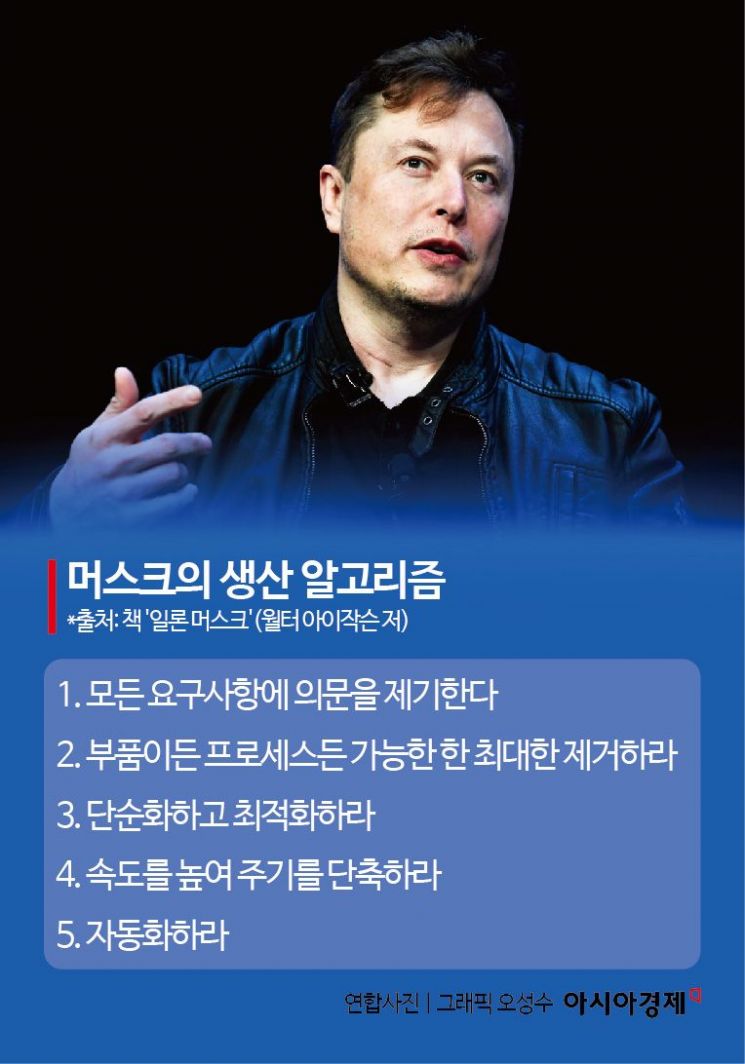
Elon Musk, CEO of Tesla, criticized the bureaucracy of the U.S. federal government, reflecting his core values that prioritize productivity and efficiency above all else. As the head of the 'Department of Government Efficiency (DOGE)' appointed by the second Trump administration, Musk is a representative figure who advocates for maximizing productivity. Whenever he attends meetings at companies he leads, such as Tesla and SpaceX, he demands what is called a 'production algorithm.'
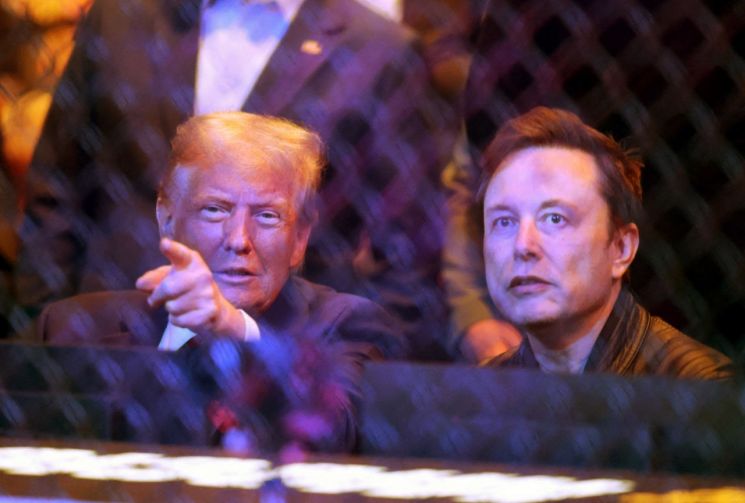 President-elect of the United States Donald Trump (left in the photo) and Elon Musk, CEO of Tesla, nominated as the head of the Government Efficiency Department for the second administration Photo by Reuters and Yonhap News
The first clause of the production algorithm also focuses on boosting productivity. Unnecessary production steps are boldly eliminated, and mass layoffs are not hesitated. For the sake of efficiency, even illegal actions are not shunned. Walter Isaacson, who wrote Musk's biography last September, introduced that "Musk CEO never accepts requirements from departments like legal or safety authorities."
"Who made this rule?" No hesitation even with illegality
The reason Trump appointed Musk as the head of the Department of Government Efficiency is that Musk's image as a businessman perfectly matched Trump's style. Musk is an entrepreneur running multiple companies such as Tesla, SpaceX, X (formerly Twitter), Neuralink, and The Boring Company. He eliminates all unnecessary processes and prioritizes productivity even if safety issues arise. His biography introduces anecdotes showing how he pursues efficiency in running his companies.
In 2018, while touring the Tesla assembly line in Fremont, California, he witnessed production lines frequently stopping due to safety sensors activating. On the spot, he ordered the removal of all sensors that were not essential, threatening, "Anyone who installs unimportant sensors will be recommended to resign." As a result, production line stoppages were greatly reduced, but the chief quality control officer resigned, and the industrial accident rate was 30% higher than other companies in the industry. His method is to check who made even minor processes if deemed unnecessary, ask why they are needed, and then remove them without hesitation.
This approach has continued from the early days of his business to the present. In the early 2000s, Musk sought the reason for the excessively high cost of rocket engine production at SpaceX and was told it was because they had to comply with hundreds of specifications and requirements from the military and NASA. Musk asked who made those requirements, and the employees' answers of 'the military' or 'legal authorities' did not convince him. He always questioned requirements, minimized costs and processes, and ordered to go beyond established rules. He was even willing to face lawsuits.
He applied these principles not only to production processes but also to organizational management. When acquiring the social networking service X in October 2022, Musk's first action was to prepare for layoffs. Within two months, he laid off employees three times, reducing the workforce from 7,500 to about 2,000. Employees were blocked from accessing the internal network and received layoff notices via email in a single day. A close aide who compiled the layoff list explained to Isaacson that "Musk truly believes that a small group of outstanding all-around engineers can produce 100 times the results of a general group."
Which federal agency will be the first on the operating table?
The New York Times (NYT) recently described Musk CEO's efficiency maximization movement as a 'Slash First, Fix Later' approach. Instead of partially reducing costs, it drastically cuts more than necessary and then solves the problems that arise. Accordingly, Musk's decision to downsize the federal government, which is evaluated as a 'mass of inefficiency,' is expected to be relentless. The federal government spent $6.75 trillion (about 9,500 trillion KRW) in the 2024 fiscal year and ran a deficit. He believes that the more than 400 federal agencies can be reduced to about 99, and more than half of federal employees can be laid off.
Last month, when Howard Lutnick, co-chair of Trump's transition team, asked, "How much of the $6 trillion national budget can be cut?" Musk replied, "At least $2 trillion," indicating that his pursuit of extreme efficiency will be sharp and fierce.
The Department of Education is likely to be Musk's first target. Trump advocated for the abolition of the federal Department of Education throughout his presidential campaign, and Musk also showed agreement. Along with Vivek Ramaswamy, co-head of the Department of Government Efficiency, they proposed abolishing the Department of Education in the federal government reform plan and transferring workforce training programs to the Department of Labor. As of March this year, about 70% of general federal employees work in the military or security-related agencies, and the Department of Education (4,425 employees) has the fewest general employees but the highest median salary at $118,410 among departments.
There is also a possibility of abolishing the Federal Bureau of Investigation (FBI) and transferring its 15,000 special agents to other agencies, or transferring the Internal Revenue Service (IRS) and the Nuclear Regulatory Commission to other departments.
Trump hopes that the Department of Government Efficiency will dismantle the existing federal bureaucracy, reduce excessive regulations and wasteful spending, and pave the way for restructuring federal agencies. During Trump's first administration, his son-in-law Jared Kushner ran the U.S. Innovation Office to bring private sector know-how into the government. Several IT company CEOs also participated in the White House advisory committee to provide advice at that time.
The key is how much real authority Musk will be given
Considering Musk's past actions as a businessman, there is speculation that he may attempt aggressive changes that are somewhat rougher and tougher than the first administration. Especially, Trump issued the executive order 'Schedule F' at the end of 2020, the late first administration, which granted flexibility in hiring and firing federal employees. This order disappeared under the Biden administration. Among federal employees, voices say it is only a matter of time before this system is restored.
Federal employees who know Musk's style are reportedly suffering from anxiety and fear. However, at this point, what needs to be observed regarding the operation of the Department of Government Efficiency is whether Musk has real authority and how much. Although the department was named as a department rather than a committee as originally planned, it cannot become an official federal department unless a law establishing the new department is passed, and it may only serve as an advisory body. Also, since both Musk and Ramaswamy have not been hired as federal employees, there are ongoing questions about whether it is appropriate for them to have authority, considering conflicts of interest and requirements such as asset disclosure and disposal of some corporate shares.
The U.S. political media Politico recently evaluated that Musk's federal bureaucracy experiment faces two unknowns: which parts of the government will be targeted and how seriously the U.S. political world will take it. Another political media Axios predicted, "If the efficiency led by Musk interferes with essential government services, he could lose popularity."
© The Asia Business Daily(www.asiae.co.kr). All rights reserved.



















