Survival Strategies to Add Freshness to Aging Brands
Shortened Trend Cycles, Ways to Save on Research and Marketing Costs
BR Korea's Deficit Last Year... A New Turning Point Needed
This year, SPC Dunkin, which turned thirty, is strengthening collaborations with food companies. By carrying out collaborations that break boundaries from Spam to Babamba, the strategy is to survive in the increasingly fierce dessert market. BR Korea, which operates Dunkin and Baskin Robbins, recorded a loss for the first time last year. Although it once dominated an era, it is now time for a new turning point for the aging Dunkin.
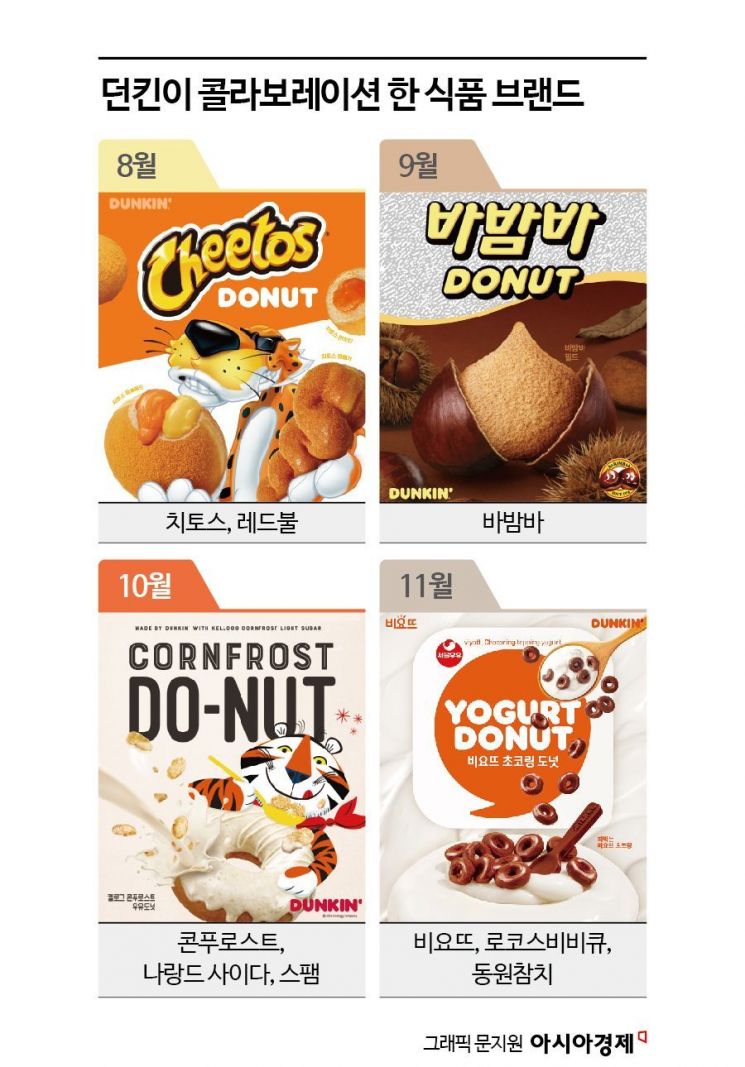
According to the food industry on the 16th, Dunkin has continued collaborations with nine food companies this second half of the year, including Lotte Wellfood, Seoul Milk, Dongwon F&B, Kellogg's, and Haitai Ice Cream. This is a significant increase compared to four companies in the first half. First, in August, Dunkin partnered with Lotte Wellfood to launch three products: 'Cheetos Twisted Doughnut,' 'Cheetos Dual Field,' and 'Cheetos Munchkin,' and introduced the 'Red Bull Zero Coolata' in collaboration with energy drink Red Bull. This beverage is made by blending Red Bull Sugar-Free with ice.
In September, Dunkin released one 'Babamba Field' doughnut using Haitai Ice Cream's steady seller Babamba, along with three beverages: 'Babamba Coolata,' 'Babamba Latte,' and 'Babamba Iced Latte.'
In October, Dunkin collaborated with Kellogg's to launch the 'Corn Frost Milk Doughnut.' This product is finished with a white coating made by grinding 'Corn Frost Light Sugar,' which has reduced sugar content, over a mild milk doughnut. Dunkin also introduced the 'Narangde Pine Sparkling Coolata' in partnership with Dong-A Otsuka. Additionally, they launched the 'Spam English Muffin' together with the canned ham brand Spam. This was a new menu item adding Spam to the Dunkin steady seller 'English Muffin.'
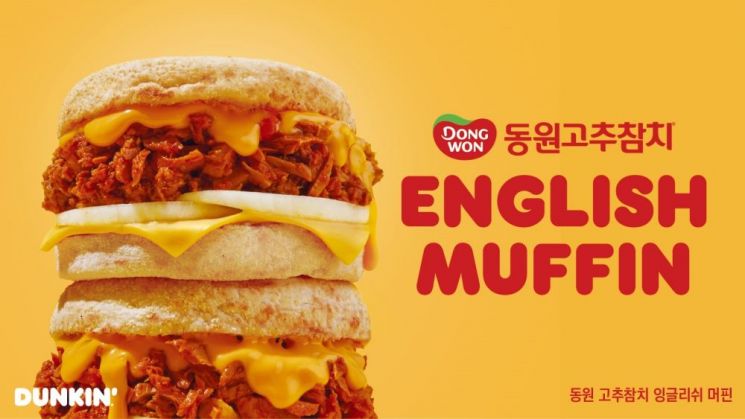
This month, Dunkin is selling the doughnut 'Spoonable Biyotte Choco Ring' and the beverage 'Biyotte Choco Ring Coolata,' using Seoul Milk's topping yogurt Biyotte. They also introduced the 'Locos BBQ Pulled Pork Burger' in collaboration with the popular restaurant Locos BBQ in Gyeongridan-gil, and launched two sandwiches using Dongwon F&B's representative product 'Dongwon Tuna.'
Dunkin's collaborations are not a recent phenomenon. In the past, they also collaborated with various brands from other industries to release goods such as umbrellas and bowls. However, recently, they have been increasing collaborations within the same industry. Dunkin's collaborations align with consumer trends seeking new flavors within familiarity. A Dunkin representative explained, "The modish consumer trend, where people recreate products in their own way and consume them, is spreading," adding, "We continue various collaborations to target the tastes of this younger generation." They further stated, "We plan to continue various attempts to provide customers with fresh enjoyment."
The alliances with food companies are also attempts to add freshness to an aging brand over a long period. Dunkin celebrated its 30th anniversary in Korea this year. BR Korea, an SPC affiliate, opened the first Dunkin store in Itaewon in 1994, marking thirty years. Currently, Dunkin has about 660 franchise stores, still the largest in the doughnut industry, but store openings have stagnated, and competition with new brands is intensifying. Accordingly, Dunkin introduced the premium store Dunkin Wonders this year, selling handmade doughnuts, and adopted a food company collaboration strategy that saves research and marketing costs.
In fact, this strategy is also leading to increased sales. A Dunkin representative said, "Collaborations with other food brands provide familiar yet novel experiences, positively influencing customer brand recall," and added, "We are seeing increased sales and natural viral effects on social media with new and interesting products."
This year is important for Dunkin not only because of the 30th anniversary but also because BR Korea, which operates Dunkin and Baskin Robbins, recorded an operating loss of 29 billion KRW last year, marking its first deficit. An industry insider said, "As the domestic market stagnates, the dessert market is seeing fiercer competition between existing and new brands," adding, "In a trend where fashion cycles are getting shorter, it appears Dunkin is making various attempts to establish new growth engines for its aging brand."
© The Asia Business Daily(www.asiae.co.kr). All rights reserved.
![User Who Sold Erroneously Deposited Bitcoins to Repay Debt and Fund Entertainment... What Did the Supreme Court Decide in 2021? [Legal Issue Check]](https://cwcontent.asiae.co.kr/asiaresize/183/2026020910431234020_1770601391.png)

















