Criticism from Hankyung Association, KCCI, KITA, and KEF
"Concerns over Overseas Speculative Capital Encouragement Law Acting as a Getaway Scheme"
On the 14th, the business community expressed serious concerns over the Democratic Party of Korea adopting a bill to strengthen corporate governance regulations in the Commercial Act as a party policy. They warned that the amended law could turn into a 'Muktwi-Jojang Law'?a tool that allows foreign speculative capital to aggressively seize management rights of domestic companies.
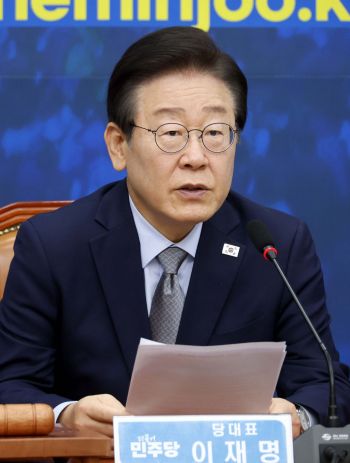 Lee Jae-myung, leader of the Democratic Party of Korea, is speaking at the Supreme Council meeting held at the National Assembly on the 13th. Photo by Kim Hyun-min
Eight economic organizations, including the Korea Economic Association, issued a statement criticizing the premature amendment of the Commercial Act, saying it could increase management risks for domestic companies.
The statement was jointly authored by eight organizations: the Korea Economic Association, the Korea Chamber of Commerce and Industry, the Korea International Trade Association, the Korea Federation of Small and Medium Business, the Korea Employers Federation, the Federation of Korean Mid-sized Enterprises, the Korea Listed Companies Association, and the KOSDAQ Association.
These organizations expressed concern that "a premature amendment of the Commercial Act will lead to a proliferation of lawsuits against directors and be exploited as a tool for foreign speculative capital to attack management rights, severely damaging the competitiveness of domestic companies as a 'foreign speculative capital Muktwi-Jojang Law.'"
They pointed out that increased litigation risks could delay directors' decision-making, potentially blocking companies from entering new industries. They warned that as speculative capital expands its attacks on management rights, it could hinder corporate growth.
They argued that reduced corporate competitiveness would deepen the Korea discount (undervaluation of the Korean stock market), harm honest investors, cause national wealth to flow out, and ultimately become a burden on the people and the Korean economy.
These organizations diagnosed that "our economy is facing a serious crisis due to increased uncertainties such as the spread of protectionism abroad and intensified US-China conflicts, as well as domestic issues like the absence of new growth engines, weakening competitiveness of key manufacturing industries, and prolonged sluggish domestic demand."
They raised their voices, saying, "Now is the time to create a business environment where companies can freely invest by exercising entrepreneurial spirit, not a time to discuss strengthening governance regulations that dampen corporate growth will."
They urged, "We hope the National Assembly will focus on overcoming the difficult economic environment rather than discussing amendments to the Commercial Act."
© The Asia Business Daily(www.asiae.co.kr). All rights reserved.

















