Hanwha Asset Management Hosts JP Morgan Invitational Seminar
JP Morgan Asset Management: "Expecting 6.4% Annual Return with 60% Stocks, 40% Bonds Portfolio"
Hanwha Asset Management: "Considering Entry into Robo-Advisor Discretionary Service Market"
"Although the valuation burden of the U.S. stock market has increased, the reason for the positive outlook is that earnings are coming out steadily. From that perspective, the U.S. stock market is more attractive compared to other markets."
Jordan Stewart, Portfolio Manager at JP Morgan Asset Management, responded to concerns about the valuation burden of the U.S. stock market by saying, "If earnings growth is maintained, valuations can be supported."
Hanwha Asset Management held a seminar with JP Morgan Asset Management on the 14th in Yeouido, Seoul. Hanwha Asset Management established a relationship in 2017 by acquiring regional funds managed by JP Morgan Asset Management Korea. They have maintained a strategic partnership to this day.
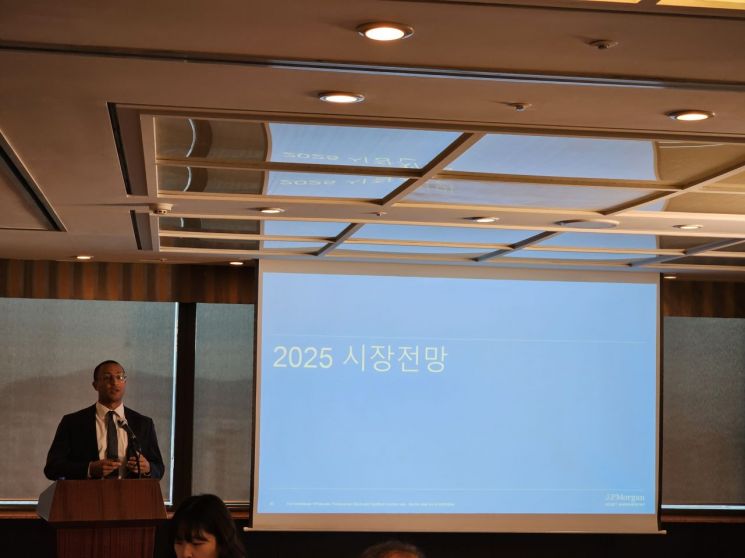 Jordan Stewart, JP Morgan Asset Management Portfolio Manager, is explaining the asset market for next year. Photo by Hyunseok Yoo
JP Morgan Asset Management: Despite High Valuation Burden in U.S. Stock Market, Still Attractive... Investment Opportunities Expanding Beyond M7
JP Morgan Asset Management forecasted that while the stock market can sustain performance in the mid-term, there may be short-term valuation pressures. However, given the improving environment surrounding the market, it is necessary to pay attention to individual stocks and other areas.
He explained, "The Federal Reserve (Fed), European Central Bank (ECB), Bank of Korea, and other global central banks have started cutting benchmark interest rates, and this easing trend is expected to continue next year. As monetary policy loosens, capital raising costs decrease, which can further activate economic activities, serving as a supporting factor for the stock market."
He added, "Going forward, more cautious and detailed decisions on individual stocks and asset allocation are required. Investment opportunities will expand beyond the Magnificent 7 (M7) to other large-cap stocks in the S&P."
2025 LTCMA: Expecting an Average Annual Return of 6.4% with a 60/40 Portfolio... "7.0% with Alternative Assets Added"
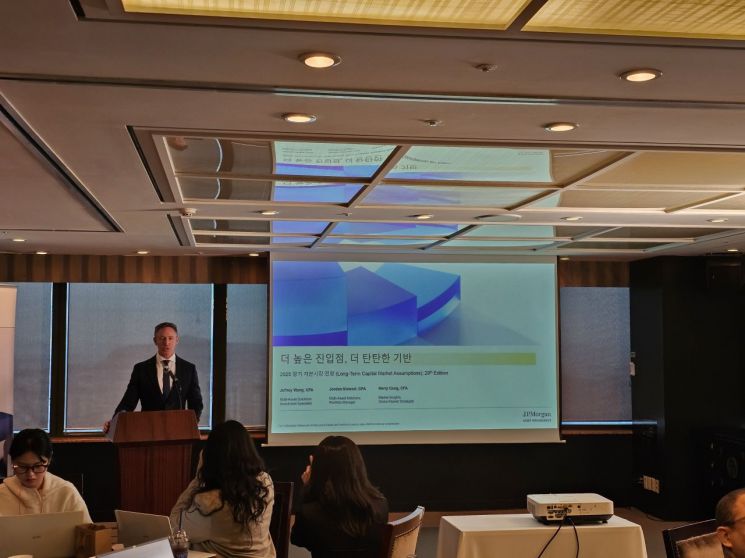 Carrie Craig, Global Market Strategist at JP Morgan Asset Management, is explaining the '2025 Long-Term Capital Market Assumptions (2025 LTCMA).' Photo by Hyunseok Yoo
JP Morgan Asset Management also projected that a '60/40 portfolio,' investing 60% in stocks and 40% in bonds, will yield an average annual return of about 6.4% over 10 to 15 years. JP Morgan Asset Management releases the 'Long-Term Capital Market Assumptions (LTCMA)' annually. LTCMA is a research product combining quantitative and qualitative information from over 100 top portfolio managers, research analysts, and strategists worldwide. This outlook provides risk and return forecasts for over 200 asset classes in 19 base currencies.
According to the '2025 LTCMA,' a 60/40 portfolio is expected to achieve an average annual return of 6.4%, which could rise to 7% when alternative assets are added. Carrie Craig, Global Market Strategist at JP Morgan Asset Management, said, "The expected annual return is 6.4%, slightly lower than last year but still above the long-term average. Although it may sound a bit low, it is similar to the average portfolio return over the past 20 years." She added, "Combining active management and alternative assets can further enhance returns."
For stocks, considering current high valuations, returns are expected to be between 6.7% and 8.1%, while bonds are projected to yield an average annual return of 3.9% based on the 10-year U.S. Treasury yield. With interest rate declines and improved liquidity conditions, private equity investments have become more attractive. Among real assets, non-core real estate in emerging U.S. regions is expected to deliver high returns.
Additionally, the risk of a recession next year is expected to remain low, allowing the global economy to continue growing. Special attention is given to credit bonds, where a lower likelihood of corporate bond defaults will lead to a narrowing spread (the interest rate gap between risky and risk-free bonds), making interest income attractive.
Hanwha Asset Management: Successful Entry into the Retirement Pension Market through Collaboration with JP Morgan Asset Management... Considering Expansion into Robo-Advisors
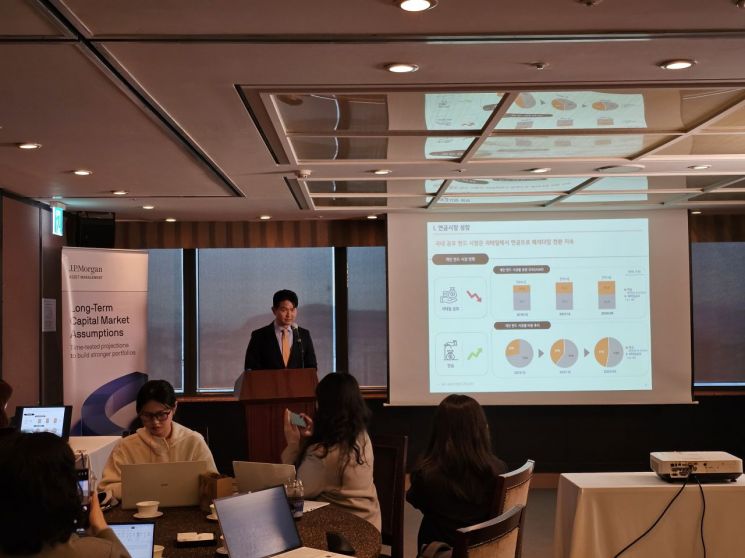 Cha Deok-young, Head of the Pension Solutions Division at Hanwha Asset Management, is discussing the company's achievements and future plans. Photo by Yoo Hyun-seok
Hanwha Asset Management analyzed that the domestic public fund market is undergoing a paradigm shift from general retail to pension-centered. They plan to focus on the defined benefit (DB) retirement pension market and default option target-date funds (TDFs). For large corporations with a certain scale of DB retirement pensions, demand for performance-linked products that can complement principal-guaranteed returns is expected to increase when interest rates begin to decline. Hanwha Asset Management also self-assessed that it has successfully entered the DB retirement pension market through collaboration with JP Morgan Asset Management.
Cha Deok-young, Head of Pension Solutions Business at Hanwha Asset Management, said, "The fund assets in DB retirement pension accounts have grown significantly this year. We plan to continuously attract related funds, focusing on major corporations with established networks."
Hanwha Asset Management's default option TDF assets increased by 238%, from 45.2 billion KRW at the end of last year to 152.7 billion KRW as of the end of October. They plan to continuously expand the scale of pension products within the default option through additional lineups of TDFs and balanced funds (BFs).
Furthermore, Hanwha Asset Management expects the market to grow when discretionary robo-advisor (RA) services are implemented in individual retirement pension (IRP) accounts. They hinted at the possibility of entering the market as a discretionary manager. Their strategy is to provide RA algorithms and discretionary systems to retirement pension providers such as banks and securities firms holding IRP accounts, competing in the market with securities firms and fintech companies capable of discretionary management.
Hanwha Asset Management owns the direct sales platform PINE, which has been verified for customer management, security, and system stability through operations over the past 2-3 years. Along with expanding the PINE platform, they are expected to continue differentiated efforts by developing systems for discretionary services in-house.
Cha said, "We will strengthen our management competitiveness in preparation for improvements and re-selection processes of the default option system. To overcome the limitations of channel promotions, we are continuously exploring direct sales strategies to customers through online marketing."
© The Asia Business Daily(www.asiae.co.kr). All rights reserved.
![A Woman Who Jumps Holding a Stolen Dior Bag... The Mind-Shaking, Bizarre Con of a "Human Knockoff" [Slate]](https://cwcontent.asiae.co.kr/asiaresize/183/2026021902243444107_1771435474.jpg)


















