Support from fostering new service industries to exports
Introduction of MyData across all sectors including medical and telecommunications
2.5 trillion KRW support to foster major brand hotels
Strengthening the development of specialized workforce in the service sector
The government has decided to foster technology-based new industries to enhance the competitiveness of the service sector while also developing linked service industries in the manufacturing sector. It plans to support export financing worth 66 trillion won over the next five years to promote the overseas expansion of domestic service industries. Through this, the government aims to raise the value-added ratio of the service sector to 70% of the entire industry by 2035.
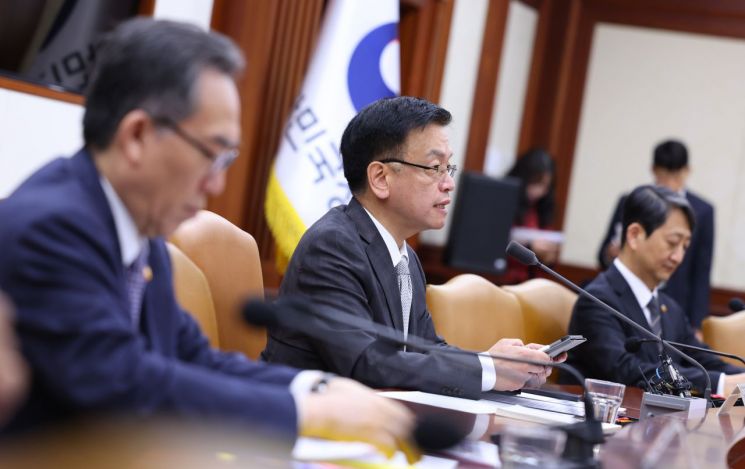 Choi Sang-mok, Deputy Prime Minister for Economy and Minister of Strategy and Finance, is presiding over the Economic Ministers' Meeting and the Foreign Economic Ministers' Meeting held at the Government Seoul Office on the morning of the 7th. Photo by Yonhap News
On the 14th, the government announced the "Service Industry Productivity Innovation Support Plan" at the Economic Ministers' Meeting held at the Government Seoul Office, chaired by Choi Sang-mok, Deputy Prime Minister and Minister of Economy and Finance. This plan was prepared to boost the productivity of the domestic service industry, nurture it as a new growth engine for the Korean economy, and promote the transition to a service economy.
The government will pursue four major tasks: fostering new service businesses, developing manufacturing-linked service industries, supporting the scaling and standardization of service industries, and promoting service exports. Additionally, to upgrade and enhance the service industry infrastructure, the government will cultivate specialized service personnel and advance research and development (R&D). Through these efforts, it plans to increase the value-added ratio of the service sector from 63.0% last year to about 70% by 2035.
An official from the Ministry of Economy and Finance said, "Since the global trend is that new services emerge by combining service sectors with digital technology, we aim to foster related new industries." He added, "The support plan also includes growing the service sector by leveraging our strengths in manufacturing." He explained, "In consumer service areas, economies of scale will be achieved, such as providing financial support and regulatory improvements for large hotel brands. The core idea is to support the domestic service industry to become competitive and expand overseas through such assistance."
To foster promising new service industries, the government will support the participation of high-growth-potential service companies in the "Promising SME Jump-up Program." This program includes directing, vouchers, and financial support such as special guarantees up to 20 billion won. Next year, the government plans to select 100 small and medium-sized enterprises (SMEs) with strong scale-up intentions, growth potential, and technological capabilities to participate in the program.
To expand policy financial support (preferential interest rates, limits, and guarantees) for technology-based innovative services, the government is also considering incorporating the tech service sector into the "Innovation Growth Joint Criteria." These criteria were established to supply policy finance to innovative industries, and tech services refer to models that combine technology with specific industries to improve productivity and efficiency, including food-tech and travel-tech.
To foster the data industry, the government will introduce MyData across all sectors starting with healthcare and telecommunications next year, build national data infrastructure, and support the activation of data trading and distribution. For mobility industry innovation, autonomous driving services will diversify from short-distance and passenger-focused to long-distance and freight services. The government will also promote urban air mobility (UAM) demonstrations in the Seoul metropolitan area.
The government will also support the development of linked service industries leveraging manufacturing strengths. It will actively nurture the maintenance, repair, and overhaul (MRO) market in key manufacturing sectors such as defense, shipbuilding, nuclear power, and aviation. Responding to the trend of increasing value-added creation in manufacturing-related services throughout the manufacturing value chain, the government will expand service inputs such as R&D and design across the entire manufacturing process. It will also support the development of business models that provide products and technologies in the form of digital services.
In sectors where demand is increasing but consumer search costs are excessive, the government will support scaling and standardization. For the lodging industry, regulations will be rationalized to facilitate the construction of tourist hotels with low harmful effects near universities. To expand the supply of large brand hotels, preferential financing worth 2.5 trillion won will be provided over five years starting next year. To systematically manage the lodging industry, which is governed by multiple ministries and laws such as the Tourism Promotion Act (Ministry of Culture, Sports and Tourism) and the Public Health Management Act (Ministry of Health and Welfare), the government plans to establish a "Lodging Industry Management System Improvement Plan."
Scaling and standardization in elderly welfare services will also be supported. The government will encourage the expansion of elderly care facilities near urban areas by utilizing closed school sites and national/public idle lands. In regions where supply is insufficient compared to demand, the government will review the installation standards for elderly care facilities and consider establishing non-reimbursable service standards and items related to new elderly care services.
To promote service exports, the government will provide export financing worth 66 trillion won from next year through 2029. It will actively support service companies' entry into the multilateral development bank (MDB) procurement market through disclosure of trust fund project information. Additionally, a dedicated export voucher track for tech service companies will be established to provide differentiated services such as software localization and user experience (UX) design improvements tailored to the needs of tech service companies.
To upgrade and enhance the service industry infrastructure, the government will also focus on cultivating specialized personnel. It will expand vocational training courses for high value-added service sectors based on technology such as software. To expand government support for service R&D in high-potential fields like artificial intelligence (AI) and cloud computing, the government will conduct demand surveys and promote private sector service R&D investment.
© The Asia Business Daily(www.asiae.co.kr). All rights reserved.

















