Nearby Large Gatherings Scheduled... Securing Safe Routes
Partial Entry and Exit Closures, Enhanced Security Screening
Protection for Presiding Judges Under Review
On the 15th, when the first trial sentencing hearing for Lee Jae-myung, leader of the Democratic Party of Korea, on charges of violating the Public Official Election Act is held, the court decided to completely ban the entry of general vehicles into the Seoul Court Complex premises. Some entrances and exits will be closed, and security checks for entering the court building will be significantly strengthened.
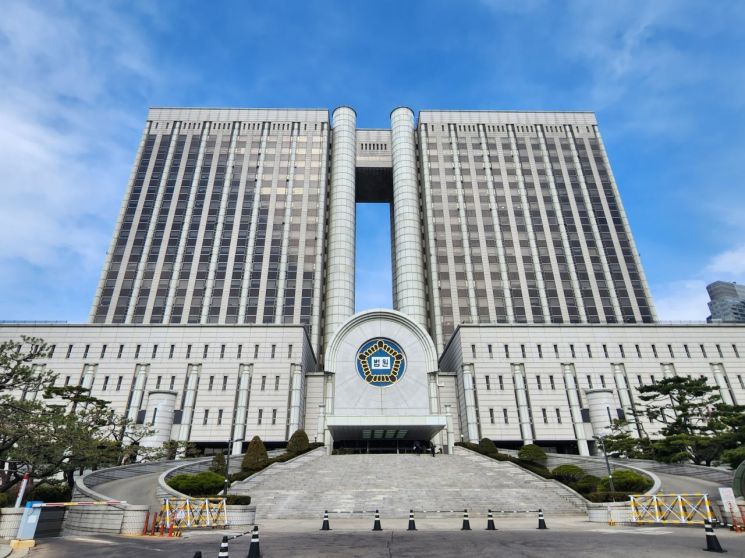
The Seoul High Court (Chief Judge Yoon Joon) announced on the 13th that, due to planned mass gatherings near the Seoul Court Complex on the 15th, it held a meeting chaired by Hong Dong-gi, Senior Presiding Judge of the Seoul High Court, attended by senior presiding judges of the Seoul Central District Court and the Bankruptcy Court, the Secretariat Director, and the Security Chief, and established the "Order Maintenance Plan for November 15" based on these matters.
First, to secure a safe route, the court will move the trial from the small courtroom where it was previously held to a medium courtroom with about 100 seats, and close some entrances. This measure is to prevent the routes of other courtroom spectators and those related to or attending Lee’s trial from overlapping.
In addition to the existing security personnel at the Court Complex, security officers from the Supreme Court will be additionally deployed. The number of security personnel inside the courtroom will also increase, and control of entrants at courtroom entrances and security checks will be strengthened.
Vehicle control will also be tightened. On the day, entry of general vehicles into the Seoul Court Complex premises will be completely prohibited, except for essential vehicles such as official vehicles. Vehicles of parties or legal representatives involved in other trials will also be restricted from entering.
The court requested that parties involved in trials or related persons arrive earlier than usual to avoid any disruption to the schedule, considering the congestion near the building and the time required for security checks on the day.
Filming inside the Seoul Court Complex building is prohibited except for journalists who have obtained prior permission. In particular, filming outside the building within the fence of the Seoul Court Complex (especially in front of the revolving door of the West Building) is also prohibited without permission from the Seoul High Court officials.
Meanwhile, regarding order maintenance inside the courtroom of the Seoul Central District Court where the sentencing will take place, the court stated that additional security personnel will be deployed, control and searches of entrants at the courtroom entrance will be strengthened, entry will be allowed only to those holding admission tickets, and emergency response measures have been prepared.
The court is also reviewing measures to strengthen personal protection for the judges of the presiding trial panel in case of emergencies on the sentencing day.
The police responsible for maintaining order outside the court are also reportedly considering deploying additional officers.
Meanwhile, the 34th Criminal Division of the Seoul Central District Court (Chief Judge Han Sung-jin), which is hearing this case, decided on the day not to conduct filming or live broadcasting of the verdict announcement, considering the related legal interests comprehensively.
Regarding filming or live broadcasting in the courtroom, Article 59 of the Court Organization Act (Prohibition of Recording, etc.) stipulates that "No one shall record, film, or broadcast live inside the courtroom without the permission of the presiding judge," allowing filming or live broadcasting only with the judge’s permission.
In addition, Article 4 (Restrictions on Filming, etc.) Paragraph 1 of the Supreme Court Rules on Courtroom Attendance and Filming, which specifies detailed provisions related to this, states that "Anyone who wishes to obtain permission from the presiding judge under Article 59 of the Court Organization Act must submit an application specifying the purpose, type, target, time, and name of the affiliated institution or individual by the day before the trial date."
Paragraph 2 of the same article states, "The presiding judge may grant permission for the application in the preceding paragraph only when the defendant (or the plaintiff or defendant appearing in court) consents. However, this does not apply if the presiding judge deems that granting permission for filming, etc., is reasonably necessary for the public interest regardless of the defendant’s (or plaintiff’s or defendant’s) consent." In principle, the presiding judge may permit filming or live broadcasting inside the courtroom only with the consent of the defendant in criminal trials or parties in civil trials, but exceptionally may grant permission without such consent for the public interest.
So far, there have been three instances of live broadcasts of lower court trials, not by the Supreme Court: the sentencing of former President Park Geun-hye’s state affairs manipulation case in April 2018, the case of Park’s receipt of National Intelligence Service special activity funds and interference in party nominations in July of the same year, and the first trial of former President Lee Myung-bak’s embezzlement and bribery case in October of the same year.
Earlier, figures from the ruling party, including People Power Party leader Han Dong-hoon, advocated for the necessity of live broadcasting Lee’s sentencing hearing. The People Power Party’s Legal Advisory Committee even submitted a petition to the Seoul Central District Court requesting live broadcast.
On the other hand, the Democratic Party and others opposed it, calling it a "public shaming" and a violation of human rights.
The trial panel currently hearing Lee’s perjury inducement charge case, scheduled for the 25th, has not yet decided whether to permit live broadcasting.
© The Asia Business Daily(www.asiae.co.kr). All rights reserved.

















