KOSPI Starts Weak Amid US Stock Market Decline
Absence of Buying Power and Momentum... Closes with Increased Losses
"Both Supply-Demand and Investor Sentiment Weak, Conservative Approach Needed"
Both the KOSPI and KOSDAQ markets plunged sharply. Samsung Electronics, the largest company by market capitalization, fell more than 4%, threatening the 50,000 KRW level.
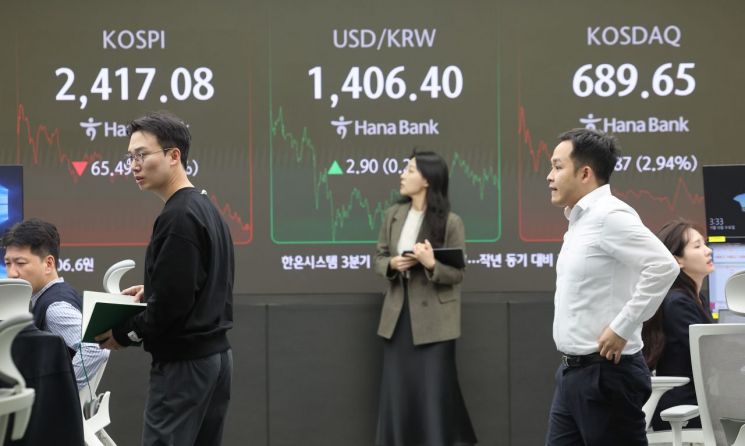
On the 13th, the KOSPI closed at 2,417.08, down 65.49 points (2.64%) from the previous trading day. The KOSPI started weak, influenced by profit-taking selling in the U.S. stock market overnight, and fell for the fourth consecutive day due to foreign selling centered on the electrical and electronics sector. While the U.S. stock market had been rising for several days, the KOSPI did not join the upward trend but followed the downward momentum.
By investor type, individuals and institutions were net buyers of 649.3 billion KRW and 18.9 billion KRW, respectively. In contrast, foreigners were net sellers of 713.4 billion KRW.
By sector, the electric and gas industry rose 2.35%, and transportation and warehousing increased 1.87%, but most other sectors closed lower, with steel and metals plunging 8.05%. Additionally, electrical and electronics and manufacturing sectors fell more than 3%.
Among the top market capitalization stocks, Samsung Electronics closed at 50,600 KRW, down 2,400 KRW (4.53%) from the previous trading day. During the session, it dropped to 50,500 KRW, hitting a 52-week low. Uncertainty over domestic semiconductor stocks increased due to the second term of the Trump administration, resulting in declines on six of the last seven trading days. SK Hynix also fell 1.56%. Other stocks such as LG Energy Solution, Samsung Biologics, and Hyundai Motor dropped more than 3%.
On the day, 107 stocks rose on the KOSPI, including Korea Parallel and Daewon Chemical, which hit the upper price limit, while 803 stocks fell without any hitting the lower limit. Twenty-nine stocks remained unchanged.
The KOSDAQ closed at 689.65, down 20.87 points (2.94%) from the previous trading day. The market closed lower amid broad weakness among top market capitalization stocks and increased foreign selling pressure.
By investor type, institutions were net buyers of 38.2 billion KRW. Meanwhile, individuals and foreigners were net sellers of 24.3 billion KRW and 9.1 billion KRW, respectively.
By sector, except for the entertainment and culture sector which recorded slight gains, most sectors were weak. Transportation equipment and parts fell 4.36%, while general electrical and electronics, chemicals, and manufacturing declined more than 3%.
Among the top market capitalization stocks, Alteogen closed at 421,500 KRW, down 18,000 KRW (4.10%) from the previous trading day. Enchem plunged 9.39%, and Rigachem Bio fell 8.97%. Other stocks such as EcoPro BM and Lino Industrial also closed down more than 5%.
On the KOSDAQ, five stocks including Hurim Robot and PNTMS hit the upper price limit, with 224 stocks rising. Meanwhile, 1,411 stocks fell without any hitting the lower limit, and 53 stocks closed unchanged.
Regarding the continuous sharp decline in the stock market, Ji-won Kim, a researcher at KB Securities, said, "As the Trump trade in the U.S. stock market took a breather, it was expected that the domestic market's decline would ease, but due to the absence of buying entities and momentum, the decline deepened toward the end of the session." He added, "The KOSPI market capitalization fell below 2,000 trillion KRW, and both the price-earnings ratio (PER) and price-to-book ratio (PBR) are at their lowest levels since the beginning of the year. Since both supply-demand and investor sentiment are weak, a conservative approach is necessary for the time being."
Some analysts suggest that the market is approaching a short-term bottom. Su-yeon Kim, a researcher at Hanwha Investment & Securities, noted, "The KOSPI fell below the 2,500 level for the first time since August 5," adding, "The 20-day deviation is 96.3%, and usually when the 20-day deviation is 95%, the KOSPI rebounds from a short-term bottom." She further stated, "Besides the deviation, several clues such as the widened correlation coefficient between developed and emerging markets indicate that the market is technically oversold."
© The Asia Business Daily(www.asiae.co.kr). All rights reserved.

















